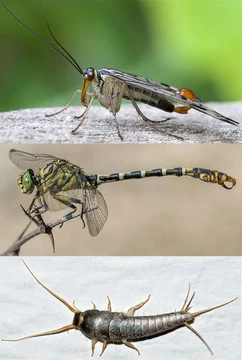
Silverfish
Nocturnal, wingless insect known for silvery scales and fish-like movement.

The silverfish (Lepisma saccharinum) is a small, primitive, wingless insect in the order Zygentoma. Its common name derives from its silvery light grey colour and fish-like movements, while its scientific name indicates a diet of carbohydrates such as sugar or starches. The Entomological Society of America restricts the term 'silverfish' solely to this species, though the name is used globally for various Zygentoma.
Quick Facts
- Taxon
- Lepisma saccharinum
Facts from the source article.
Lore & Background
The silverfish is a nocturnal insect typically 7–10 mm long, with a tapered abdomen, two long cerci, and a terminal filament. It has two small compound eyes, long antennae, and moves in a wiggling motion resembling a fish. Newly hatched nymphs are whitish, developing a greyish hue and metallic sheen as they age. Silverfish can regenerate lost terminal filaments and antennae within four weeks and live up to three years, though some estimates extend to eight years.
Before reproduction, silverfish perform a three-phase ritual lasting over half an hour: face-to-face antenna touching, a chase, and side-by-side tail vibration. The male deposits a spermatophore, which the female takes into her ovipositor. Females lay fewer than 60 eggs at a time in crevices, with fewer than 100 eggs in a lifetime. Nymphs hatch after two weeks to two months and undergo 17 to 66 moults, sometimes 30 in a year, continuing to moult after adulthood.
Silverfish digest cellulose using cellulase from their midgut and consume book bindings, carpet, clothing, coffee, dandruff, glue, hair, paint, paper, photos, plaster, sugar, and wallpaper paste. They are considered household pests but do not transmit disease. Predators include house centipedes and the spitting spider Scytodes thoracica. Japanese cedar essential oil has shown repellent and insecticidal effects against silverfish.
Reader's Guide
The silverfish is significant as a cosmopolitan household pest that damages property by consuming polysaccharide-rich materials such as paper, glue, and textiles. Its ability to digest cellulose independently makes it a persistent threat to libraries, archives, and homes. Despite its destructive habits, it does not transmit disease, distinguishing it from many other pests. The species is also notable for its primitive wingless state and its unusual reproductive ritual, which involves a spermatophore and a three-phase courtship. Silverfish are among the few insects that continue to moult after reaching adulthood, undergoing up to 66 moults in a lifetime. Their resilience is further demonstrated by their ability to survive over a year without food if water is available. The scientific name has been subject to nomenclatural debate: originally treated as feminine, the International Commission on Zoological Nomenclature ruled in 2018 that the genus Lepisma is neuter, changing the species spelling to saccharinum. The silverfish's common name has been in use since at least 1855, reflecting its long-recognized metallic appearance and fish-like motion.
Did You Know?
- They can live for a year or more without eating if water is available.
- The essential oil of Japanese cedar (Cryptomeria japonica) repelled 80% of silverfish at a gas concentration of 0.01 mg/cm³.
Silvery Form and Fish-Like Grace
The silverfish is a small, wingless insect measuring roughly seven to ten millimetres in length, belonging to the order Zygentoma. Its most striking feature is the tapering of its abdomen, which, combined with the silvery scales covering its body, gives it a distinctly fish-like silhouette. Newly hatched individuals appear whitish, but as they mature they acquire a greyish tone and a subtle metallic sheen that catches the light. At the tip of the abdomen sit two long cerci flanking a single terminal filament, while a pair of small compound eyes sits near the front—unusual among Zygentoma, since families such as Nicoletiidae are entirely eyeless. The insect moves in a rapid, wiggling undulation that closely mimics the swimming motion of a small fish, and it is an agile runner that actively avoids light. Perhaps most remarkably, a silverfish can regenerate a lost terminal filament or antenna within roughly four weeks, a regenerative capacity that sets it apart from many of its insect relatives.
A Three-Act Mating Dance and a Long Moulting Life
Before any eggs are laid, a silverfish pair performs an elaborate courtship ritual that can stretch beyond thirty minutes. In the first act, the male and female face each other, their long antennae vibrating as they touch, then they step back and advance again in a repeated rhythm. The second act sees the male dart away while the female pursues him. In the third, they align side by side, head to tail, and the male vibrates his tail against her body. At the ritual's close, the male deposits a spermatophore—a sperm capsule wrapped in gossamer—which the female draws into herself through her ovipositor. She then lays clusters of fewer than sixty oval, whitish eggs, each about 0.8 millimetres long, tucked into small crevices. Hatching takes anywhere from two weeks to two months. The young emerge whitish and miniature versions of adults, then undergo between seventeen and sixty-six moults over their lives—sometimes thirty in a single year—and unlike most insects, they continue moulting even after reaching adulthood. Total lifespan spans roughly two to eight years.
A Cosmopolitan Cellulose Eater in Human Spaces
Found across Africa, the Americas, Australia, Eurasia, and parts of the Pacific, the silverfish thrives wherever relative humidity sits between seventy-five and ninety-five percent. In cities it colonises attics, basements, bathtubs, kitchens, libraries, classrooms, and the pages of old books. Its diet is remarkably broad: it produces its own cellulase in the midgut, allowing it to break down cellulose in paper, book bindings, wallpaper paste, and plaster. It also feeds on starches, dextrin in adhesives, glue, hair, dandruff, cotton, linen, silk, coffee, photos, some paints, dead insects, leftover crumbs, and even its own shed exoskeletons. In times of scarcity it will turn to leather and synthetic fabrics, and it can survive a year or more without food provided water is available. Though it is a well-known household pest that damages tapestries and paper goods, it does not transmit disease. Its natural enemies include house centipedes and the spitting spider Scytodes thoracica. Research has also shown that essential oil of the Japanese cedar can repel or kill silverfish at very low concentrations.
A Name in Flux: Nomenclature and Taxonomic Neighbours
Carl Linnaeus first described this species in the 1758 tenth edition of Systema Naturae, originally spelling the specific epithet as saccharina, a nod to its fondness for starchy, carbohydrate-rich foods such as dextrin. The common name silverfish has been in use since at least 1855, drawn from the insect's metallic sheen and its undulating, fish-like gait. For decades, most entomologists treated the genus name Lepisma as feminine, a convention codified in ICZN Direction 71 of 1957. That changed in 2018 when the International Commission on Zoological Nomenclature issued Opinion 2427, ruling that Lepisma and all genera sharing that ending are grammatically neuter under ICZN Article 30, which corrected the specific epithet to saccharinum. The Entomological Society of America further restricts the common name silverfish to this single species, even though the term is used loosely worldwide. Close relatives include Ctenolepisma longicaudatum, C. quadriseriatum, and C. urbanum in North America, Acrotelsella devriesiana in Australia, and the mottled firebrat Thermobia domestica.
More in Insects And Their Relatives 1-21
Spotted an error? Know more?
Reader corrections go straight into our review queue. Suggest an edit · How this site is sourced