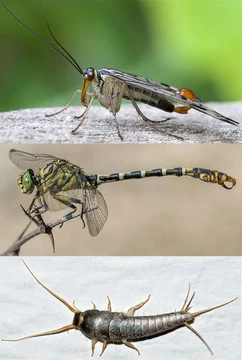
Snakefly
Predatory insects with elongated thorax, resembling a snake.

Snakeflies are a group of predatory insects comprising the order Raphidioptera, from Ancient Greek ῥαφίς (rhaphís), meaning 'needle', and πτερόν (pterón), meaning 'wing'. They are a relict group, having reached their apex of diversity during the Cretaceous before undergoing substantial decline. Recognizable representatives first appeared during the Early Jurassic, and modern species closely resemble those from that period, leading them to be considered living fossils.
Quick Facts
- Taxon
- Raphidioptera
Facts from the source article.
Lore & Background
Adult snakeflies are easily distinguished from similar insects by having an elongated prothorax but not the modified forelegs of mantis-flies. Most species are between 15 and 30 mm in length. The head is long and flattened, heavily sclerotised, and very mobile. Members of the family Inocelliidae have no ocelli, while members of Raphidiidae have three distinct ocelli. The two pairs of dragonfly-like wings are similar in size, with a primitive venation pattern and a coloured pterostigma. Females have a large and sturdy ovipositor used to deposit eggs in concealed locations.
Snakeflies are holometabolous insects with a four-stage life cycle: eggs, larvae, pupae, and adults. Larvae develop under bark, in leaf litter, or in detritus, and may take several years before metamorphosis, requiring a period of chilling before pupation. Both adults and larvae are predators of soft-bodied arthropods such as aphids and mites. Adult snakeflies are diurnal and territorial, and pollen has been found in their guts, though its role is unclear.
Reader's Guide
Snakeflies are significant as a relict group that once had a much wider distribution and greater diversity, especially during the Cretaceous. The Cretaceous–Paleogene extinction event likely extinguished all but the most cold-tolerant species, leaving only two extant families: Raphidiidae and Inocelliidae. Today they are found in temperate coniferous forests across Europe, Asia, parts of Africa north of the Sahara, western North America, and Central America, but are absent from the tropics and Southern Hemisphere. Their modern distribution is fragmented, with many species confined to single mountain ranges. As living fossils, they provide insight into insect evolution during the Mesozoic. They are important predators in their ecosystems, controlling populations of aphids and mites, and are themselves preyed upon by birds and parasitized by wasps.
Did You Know?
- Snakeflies are considered living fossils because modern species closely resemble species from the early Jurassic period.
- Larvae typically take 2–3 years to develop, occasionally up to 4–5 years, and require a period of cool temperatures around 0 °C to induce pupation.
Taxonomy & Evolutionary History
Snakeflies belong to the insect order Raphidioptera, a name derived from two Ancient Greek words: rhaphís, meaning needle, and pterón, meaning wing. Today, this order is represented by just two living families—Raphidiidae and Inocelliidae—encompassing roughly 260 described species. However, the group's evolutionary story tells a far grander tale. Fossil evidence shows that recognizable snakefly representatives first appeared during the Early Jurassic, and the order reached its peak of diversity and geographic spread during the Cretaceous period. Since then, snakeflies have undergone a substantial decline, leaving them as a relict group whose modern distribution is a shadow of what it once was. While they now inhabit temperate regions across the globe, they are entirely absent from tropical zones and the Southern Hemisphere. Central Asia harbors the greatest concentration of species today, hinting at the region's importance in the group's ancient history. The limited number of extant species, combined with their restricted habitats, underscores how much of this order's former richness has been lost to geological time and environmental change.
Physical Description & Morphology
Adult snakeflies are long, slender insects typically measuring between 15 and 30 millimeters in length. Their most striking feature is the notably elongated prothorax, which, combined with a highly mobile head, gives the group its common name. The head itself is long, flattened, and heavily sclerotised, bearing large compound eyes positioned on its sides. Members of the family Raphidiidae possess three distinct ocelli, whereas Inocelliidae lack them entirely. The mouthparts are strong and adapted for biting, while the three pairs of legs remain similar in size and appearance. Two pairs of long, membranous, dragonfly-like wings extend from the thorax, featuring a primitive venation pattern, a thickened leading edge, and a colored wingspot called the pterostigma. A subtle but important distinction exists between the families: raphidiids have a cross vein within the pterostigma that inocelliids do not. Females in both families carry a large, sturdy ovipositor, which they use to deposit eggs into crevices or beneath tree bark. Unlike mantis-flies, snakeflies do not possess modified forelegs, making the elongated neck their primary distinguishing trait among similar insects.
Life Cycle & Development
Snakeflies undergo complete metamorphosis, progressing through four distinct stages: egg, larva, pupa, and adult. Before reproduction, adults perform an elaborate courtship ritual that includes grooming behaviors involving the legs and antennae. Mating positions differ between families: raphidiids adopt a dragging position, while inocelliid males position themselves in tandem beneath the female, with copulation lasting up to three hours in some species. Eggs are laid in concealed locations and hatch within days to about three weeks. The resulting larvae possess large heads with projecting mandibles, a sclerotised head and first thoracic segment, and a soft, fleshy remainder of the body. They have three pairs of true legs but no prolegs, instead using an adhesive abdominal organ to cling to vertical surfaces. Larval development is remarkably prolonged, typically lasting two to three years but sometimes extending to six, with some species passing through as many as ten or eleven instars. A critical requirement for pupation is a period of chilling, probably near zero degrees Celsius. The prepupal larva constructs a cell for pupation, and the pupa itself can bite when disturbed. In some cases, if larvae begin pupating in late summer, adults may not emerge for up to ten months.
Distribution, Habitat & Ecology
Snakeflies are predominantly associated with temperate coniferous forests, and their global distribution reflects their relict status. The majority of species occur in Europe and Asia, with the range extending from Spain to Japan in the eastern hemisphere. In Africa, they are restricted to mountainous regions north of the Sahara, while in North America they are found west of the Rocky Mountains, stretching from southwest Canada down to the Mexican-Guatemalan border. In the southern portions of their range, snakeflies are largely confined to higher altitudes, reaching up to approximately 3,000 meters. Despite the order's broad geographic presence, individual species often have very limited ranges, with some confined to a single mountain range. Ecologically, adult snakeflies are diurnal, territorial, and carnivorous, serving as important predators of aphids and mites. Pollen has also been found in their guts, though its role remains unclear. Larvae of many raphidiid species live just beneath tree bark, while others inhabit tree boles, rock crevices, leaf litter, and detritus, where they prey on the eggs and larvae of mites, springtails, spiders, and various other soft-bodied arthropods. Birds are known predators of snakeflies.
More in Insects And Their Relatives 1-21
Spotted an error? Know more?
Reader corrections go straight into our review queue. Suggest an edit · How this site is sourced