Villa Boscoreale
Roman rustic villas buried by Vesuvius, rich in frescoes and artifacts.
Last updated

via Wikipedia: Villa Boscoreale · see source
Where it is
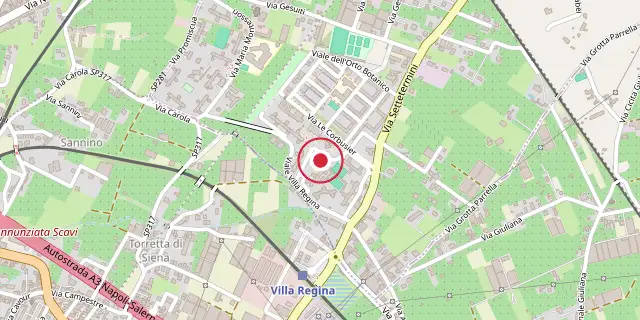
Coordinates: 40°45′40″N 14°28′16″E (40.7610, 14.4710) · Open in OpenStreetMap
Coordinates and connected clubs: the infobox of Wikipedia: Villa Boscoreale (CC BY-SA 4.0). Map: drawn by Codexery from OpenStreetMap tiles.
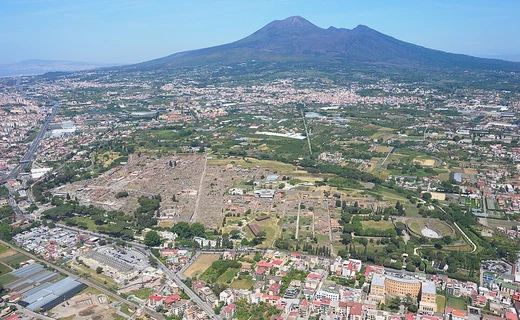
Villa Boscoreale is a name given to any of several Roman villas discovered in the district of Boscoreale, Italy. They were all buried and preserved by the eruption of Mount Vesuvius in 79 AD, along with Pompeii and Herculaneum.
The only one visible in situ today is the Villa Regina, the others being reburied soon after their discovery. Although these villas can be classified as "rustic" (villae rusticae) rather than of otium due to their agricultural sections and sometimes lack of the most luxurious amenities, they were often embellished with extremely luxurious decorations such as frescoes, testifying to the wealth of the owners. Among the most important finds are the exquisite frescoes from the Villa of Publius Fannius Synistor and the sumptuous Boscoreale Treasure of the Villa della Pisanella, which is now displayed in several major museums.
Villa Regina
Discovered in 1977, Villa Regina lay under about 26 feet of compressed volcanic ash and pyroclastic material, later topped by centuries of everyday deposits. Unlike villas plundered and reburied by treasure hunters, it was treated as an archaeological discovery and preserved complete. The villa functioned as a comfortable working farm rather than a luxurious estate, though its central courtyard is colonnaded on three sides with red and white stucco columns.
Excavators found large quantities of pottery and farm implements, and made plaster casts of the original entrance doors from hollow spaces left. A plaster cast of a pig killed in the catastrophe was also made. Preserved parts of a wine press remain, and near the center is a wine cellar with 18 buried dolia capable of storing 10,000 liters of must. An oil lamp from the 3rd–5th century AD indicates later Roman-era tunneling.
Pollen analysis identified cultivated trees including Birch, Hazelnut, Cypress, Ash, Walnut, Pine and Olive, as well as flowers such as Anemone, Borage, Dianthus, Amaranth, Aster, Sedge, Geranium, Buttercup, and Mallow. Grape cultivation was confirmed, and holes from Roman vine roots were replanted with vines.
Villa of P. Fannius Synistor
This villa was of relatively modest size compared to others in the area, lacking an atrium, pool, or sculpture collection, yet its frescoes were exceptional in beauty and quality. Evidence from tablets and graffiti suggests the house was built around 40–30 BC. Privately discovered, excavated, partially dismantled, and reburied in 1900, the villa had three stories, a bath suite, and an underground passage to a stable and agricultural buildings that were not excavated.
The central ground floor of the living quarters comprised over thirty rooms or enclosures around a peristyle. The main entrance was approached by five broad steps leading to a colonnaded forecourt rather than a typical atrium. Ownership is contested: while Publius Fannius Synistor certainly resided there, excavated bronze tablets bear the name Lucius Herennius Florus. Since the tablet with the letters L. HER.
FLO was found inside the villa, it is believed to mark ownership. These two are the only confirmed owners in the early 1st century BC and 1st century AD, though earlier owners may have existed. The villa is most notable for its buon fresco paintings, considered the highest quality Roman frescoes ever found, now scattered worldwide after auction. Most figures in the frescoes show characteristics of Greek Hellenism or Classicism; those in the living room may depict philosophers such as Epicurus, Zeno, or Menedemus, or old kings like King Kinyras of Cyprus.
Bedrooms in the Second Style also evoke Hellenistic qualities. The images survived the Vesuvian cataclysms due to the skill of the fresco work and the absence of organic pigments such as indigo, murex purple, and red madder. Reddening of some yellow ochre indicates temperatures exceeded 300°C.
Villa della Pisanella
First unearthed by landowners over several seasons from 1876, the villa was excavated in 1894, revealing a villa rustica covering 1000 m² with a clearly defined residential sector including baths, and a pars rustica with farm buildings and warehouses. Farmyard animals were bred, and most ground-floor rooms processed and stored oil, wine, and cereals. Most portable belongings remained in place, though some objects were not in their intended locations; for example, two bronze bathtubs with lion head handles had no obvious destination in the bathing complex, one too large to fit through the last door.
A large chest held forty keys and silver tableware; in the kitchen lay the skeleton of a chained dog; in the stable, bones of several tethered horses, one of which had escaped. In the olive pressing-room (torcularium), the first three human skeletons were found, including a woman wearing gold earrings with topaz jewels, possibly the mistress of the house, called Maxima (a name on many silver vessels). Some speculate the previous owner was L. Caecilius Lucundus, a Pompeian banker.
In 1895, the Boscoreale Treasure was discovered in a chest in the torcularium, consisting of 102 items: silver tableware, bracelets, earrings, rings, a double gold chain, and a thousand gold coins in a leather bag. At the eruption, it was likely one of the safest rooms, where the owner ordered a trusted man to hide it. All treasures were smuggled to France via the Rothschild Family and sold. Excavations resumed in 1896 by Angiolo Pasqui.
Did You Know?
- The Villa Regina was discovered in 1977 under about 26 feet (8 meters) of compressed volcanic ash and pyroclastic flow material.
- A plaster cast of a pig killed in the 79 AD eruption was made from hollow spaces left in the ash at Villa Regina.
- Frescoes from the Villa of P. Fannius Synistor survived temperatures exceeding 300 °C, as shown by reddening of yellow ochre.
More in Houses of Pompeii
Sources
Compiled from Wikipedia and the sources listed below. Text from Wikipedia is available under CC BY-SA 4.0; this entry is adapted from it.
- Wikipedia: Villa Boscoreale (CC BY-SA 4.0).
Spotted an error? Know more?
Reader corrections go straight into our review queue. Suggest an edit · How this site is sourced