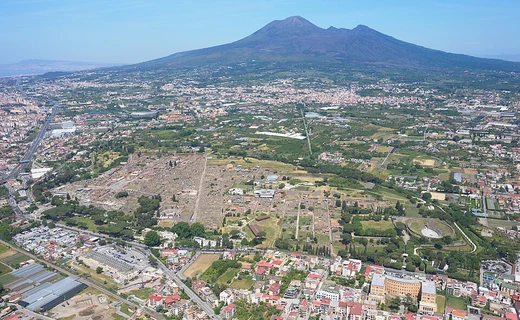
Eruption of Mount Vesuvius in 79 AD
Deadly 79 AD eruption buried Pompeii and Herculaneum under ash and pyroclastic flows.
In 79 AD, Mount Vesuvius, a stratovolcano in what is now Campania, Italy, erupted catastrophically, destroying several Roman towns including Pompeii and Herculaneum. The eruption ejected a column of super-heated tephra and gases 33 km high, releasing immense thermal energy and giving its name to the Vesuvian eruption type. The buried cities were later excavated, revealing extraordinary details of Roman life and becoming a UNESCO World Heritage Site.
Quick Facts
- Date
- 79 AD
- Volcano
- Mount Vesuvius
- Location
- Campania, Italy
- Impact
- Buried the Roman settlements of Pompeii
- Herculaneum
- Oplontis
- and Stabiae
- Deaths
- 1,500–3,500, possibly up to 16,000
Facts from the source article.
Did You Know?
- A major earthquake on February 5, 62 AD caused widespread destruction around the Bay of Naples, particularly to Pompeii, and some damage had still not been repaired when the volcano erupted.
- Minor earthquakes were reported in the four days before the 79 AD eruption, but the warnings were not recognized.
Nature of the eruption
The eruption of Mount Vesuvius in 79 AD lasted for two days. On the first day, during the early afternoon, the volcano erupted violently, launching a tall column of ash and pumice into the sky. This material fell back to earth, covering the area and causing roofs to cave in. Over the next few hours, people attempted rescues and escapes. At the same time, one or more large earthquakes struck, bringing down walls and killing some of those fleeing. A mild tsunami also occurred in the Bay of Naples. Sometime during the night or early the next morning, pyroclastic flows began near the volcano. The first of these left only a few centimeters of ash on top of the grey pumice and caused little damage. A second, short phase left a thin layer made mostly of lava and pumice. In the early morning, another pyroclastic flow moved rapidly, was dense and extremely hot, knocked down many walls, and either incinerated or suffocated the remaining people. This thick ash layer sealed bodies in cavities, preserving their shapes for later plaster casts. By the evening of the second day, the eruption no longer affected the town of Misenum, leaving only a hazy atmosphere that dimmed the sunlight. A 1982 study of ash layers concluded that the eruption had two main phases, Vesuvian and Pelean, which alternated six times. The first phase, a Plinian eruption, shot a column of volcanic debris and hot gases between 15 and 30 kilometers into the stratosphere. This phase lasted 18 to 20 hours and spread pumice and ash, creating a 2.8-meter-thick layer to the south, toward Pompeii. An earthquake at this time caused buildings in Pompeii to collapse.
The two Plinys
The only surviving eyewitness account of the eruption consists of two letters by Pliny the Younger, who was 17 at the time, written to the historian Tacitus some 25 years later. Observing the first volcanic activity from Misenum, across the Bay of Naples about 29 km from the volcano, Pliny the Elder, his uncle, launched a rescue fleet and went to rescue a personal friend. His nephew declined to join. One of the younger Pliny's letters relates what he could discover from witnesses of his uncle's experiences; a second letter details his own observations after his uncle's departure. Pliny the Younger saw an extraordinarily dense cloud rising rapidly above the mountain. A request by messenger for an evacuation by sea prompted the elder Pliny to order rescue operations and sail away. His nephew attempted to resume normal life, studying and bathing, but that night a tremor woke him and his mother, prompting them to abandon the house for the courtyard. At another tremor at dawn, the population abandoned the village. After a third tremor, the sea seemed to roll back upon itself, evidence of a tsunami, though no extensive damage from wave action is evident. A black cloud obscured the early light, through which shone flashes like sheet lightning. The cloud obscured Point Misenum and the island of Capri. Fearing for their lives, the population moved back from the coast along the road. Pliny's mother asked him to abandon her, but he led her away. A rain of ash fell, and Pliny needed to shake it off periodically to avoid being buried. Later that day, the ash stopped, and the sun shone weakly, encouraging them to return home and wait for news of Pliny the Elder. The earthquake and tsunami damage at Misenum were not severe enough to prevent continued use of the home.
Casualties from the eruption
We know the names of only a handful of people who died in the 79 AD eruption of Mount Vesuvius, aside from Pliny the Elder: the Herodian princess Drusilla and her son Agrippa, the merchant Aulus Umbricius Scaurus, the businessman Alleius Nigidius Maius, and the poet Caesius Bassus. By 2003, around 1,044 plaster casts had been made from body-shaped voids in the ash around Pompeii, along with the scattered bones of another 100 people. At Herculaneum, the remains of about 332 bodies have been uncovered, including 300 in arched vaults found in 1980. The overall death toll is still unknown. Of the 1,044 casts, 38% came from ash fall deposits, mostly inside buildings, where victims may have been sheltering. The other 62% were found in pyroclastic surge deposits. Later research showed that the fourth pyroclastic surge, the first to hit Pompeii, reached 300 degrees Celsius, killing people instantly. The twisted poses of the bodies are not from prolonged suffering but from cadaveric spasm caused by heat shock. The heat was so extreme that it vaporized organs and blood, and one victim’s brain may have been turned to glass by the temperature, though this claim is debated.
Date of the eruption
Ancient Roman writers mentioned Vesuvius’s catastrophic eruption, but none gave its exact date. The first-century historian Josephus noted it happened during the reign of Titus Caesar. Suetonius, writing in the second century, recorded that Titus’s rule saw dreadful disasters, including the eruption. Cassius Dio, over a century later, described a great fire that suddenly flared up at the very end of summer. For over five hundred years, until around 2018, most accounts stated the eruption began on August 24, 79 AD. That date came from a 1508 printed edition of a letter by Pliny the Younger, who witnessed the event and wrote to Tacitus about twenty-five years later. Because the letter was hand-copied for more than fourteen centuries before being printed, the original date may have been corrupted. Manuscript experts think Pliny’s original date could have been August 24, October 30, November 1, or November 23, due to Roman dating conventions. Most surviving medieval copies point to August 24, which scholars and popular books long accepted. A 2022 analysis of historical translations argued that only August 24 is supported by Pliny’s evidence. However, since at least the late 1700s, a minority of archaeologists and scientists have proposed an autumn eruption, perhaps in October or November. In 1797, Carlo Rosini reported that excavations at Pompeii and Herculaneum revealed remains of autumn fruits and braziers, not summer items.
More in Pompeii
Spotted an error? Know more?
Reader corrections go straight into our review queue. Suggest an edit · How this site is sourced