Spanish Mustang
Last updated
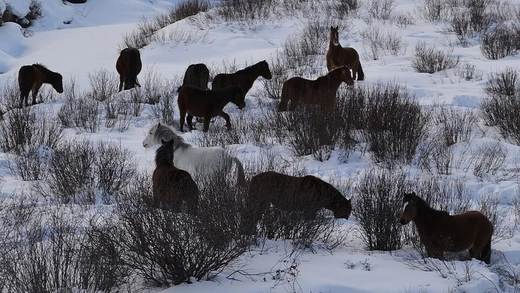
The Spanish Mustang is a modern American breed, not a feral horse, descended from Spanish horses brought to the Americas during early conquests. It belongs to the Colonial Spanish horse group, a type now scarce in Spain. By the 1900s, wild herds had dwindled, prompting preservation efforts using feral, Native American, and ranch stock. A registry was established in 1957.
History
The Spanish Mustang traces its roots to horses brought from the Iberian Peninsula to Mexico during the Spanish conquest and colonization of New Spain. As the 16th-century conquest advanced, these horses spread northward, crossing the Rio Grande. Over the following hundred years, Apache, Comanche, Ute, and Shoshone peoples stole and traded them to various tribes across the Great Plains and Rocky Mountains. By the early 20th century, the breed was nearly extinct.
It became one of the first breeds created through a deliberate conservation effort to preserve the descendants of these Spanish horses. Robert E. Brislawn of Oshoto, Wyoming, and his brother Ferdinand L. Brislawn of Gusher, Utah, led this work, with additional credit to Gilbert Jones and Ilo Belsky. They collected horses from feral mustang herds, Native American herds, and ranch stock across the West, selecting those with a physical appearance suggesting Spanish ancestry.
Two full brothers, Buckshot and Ute, were among the first foundation stallions. Their sire was a buckskin stallion named Monty, and their dam came from Ute Reservation bloodlines. Monty was captured in Utah in 1927 but escaped back to the wild in 1944, taking his mares with him, and was never recaptured. The Brislawns, along with Lawrence P. Richards, established the Spanish Mustang Registry, which was incorporated in 1957.
Disagreements over which horses to accept led Jones to form the Southwest Spanish Mustang Association in 1977, with other registries appearing later. A 2006 DNA study found that the Spanish Mustang, along with horses from the Sulphur Springs and Kiger Herd Management Areas, carries haplotypes tracing back to horses from the Iberian Peninsula.
Characteristics
The Spanish Mustang is a compact, sturdy breed, typically standing under 15 hands tall, with horses exceeding that height generally not preferred. Their weight ranges from 650 to 1,100 pounds. These horses have smooth, well-defined muscles, short backs, rounded rumps, and low-set tails. They are built with a strong coupling and an uphill balance, featuring a deep girth, well-laid-back shoulders, and fairly prominent withers.
The facial profile is straight or slightly concave, with a broad forehead. Mares and geldings have fairly crested necks, while mature stallions develop a heavy crest. The chest is moderately narrow but clearly defined. Chestnuts are small or entirely absent, especially on the hind legs, and ergots are also small or missing.
Their feet are round and hard, and the legs should be correctly conformed, though the hind legs may be set slightly under the body. Cannons are short, and the bone is rounded. Some individuals are gaited, and a variety of footfalls are acceptable. Paddling or winging out is not considered a fault unless it causes interference or stems from a lack of straightness in the leg.
The breed comes in many colors, including common shades like bay, chestnut, black, and gray, as well as less frequent patterns such as Appaloosa and paint, plus solid colors like grulla, buckskin, palomino, cremello, isabella, roan, and perlino. Spanish Mustangs are prized for their stamina, hardiness, and long-distance ability, making them suitable for endurance riding and various English and Western riding events.
More in Horse Breeds Originating in the United States
Sources
Compiled from Wikipedia and the sources listed below. Text from Wikipedia is available under CC BY-SA 4.0; this entry is adapted from it.
- Wikipedia: Spanish Mustang (CC BY-SA 4.0).
Spotted an error? Know more?
Reader corrections go straight into our review queue. Suggest an edit · How this site is sourced