Mountain Pleasure Horse
Last updated

via Wikipedia: Mountain Pleasure Horse · see source
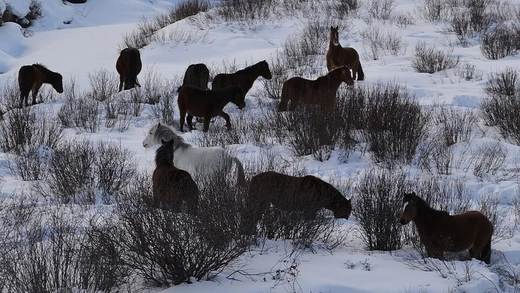
The Mountain Pleasure Horse is a gaited breed developed in the Appalachian Mountains of Eastern Kentucky. It reflects the primitive Appalachian gaited horse type, and genetic testing shows it shares ancestry with the American Saddlebred, the Tennessee Walking Horse, and the Rocky Mountain Horse.
Some bloodlines are traceable for over 180 years. The Mountain Pleasure Horse Association was formed in 1989, the first mountain horse breed association to require blood-typing for foundation stock and all subsequent registrations for absolute parentage identification. In recent years, DNA testing has replaced blood-typing.
History
Mountain Pleasure Horses descend from smooth-gaited horses brought by the first settlers. Small, hardy Hobbies and gaited ponies from the British Isles were used to develop the American Narragansett Pacer, bred in New England Colonies during the 17th century. The Narragansett was a fast pacing horse for racing and performed a smooth ambling gait, sometimes called a 'single-footed trot,' making it a favorite for travel between sparsely settled colonies, especially in rugged terrain.
The purebred strain was lost to crossbreeding by the early 1800s, but small populations thrived in the Appalachian regions, treasured for their smooth gaits, hardiness, and sweet dispositions. The last-known Narragansett mare died in 1880. In Eastern Kentucky, these descendants were simply called 'saddle horses' or 'mountain horses,' expected to work fields or carry a rider as needed. Families bred mares to the best stallion within the same branch, often referred to by family names like 'Coffey’s Major,' 'Cable’s Rex,' 'Little’s Silver,' and 'Jasper Jones Bucky.'
From the early 1900s to the 1940s, Tennessee Walking Horse breeders made regular trips into eastern Kentucky to find well-gaited mares for their foundation stallions. Palomino horses were also highly sought after, with several sold to a horse broker who purchased horses for Roy Rogers. Geneticist Ernest 'Gus' Cothran, while at the University of Kentucky, developed a chart showing breed progression through blood-typing, and blood markers have shown the Mountain Pleasure Horse related to the Rocky Mountain Horse, American Saddlebred, and Tennessee Walking Horse. Modern genetic testing confirms those findings.
Characteristics
Mountain Pleasure Horses are medium-sized, standing on average (height not specified in source). Desired characteristics include balanced proportions for soundness and longevity, a laid-back shoulder ideally at a 45-degree angle for a reaching stride, and strong, correctly angled hind legs for impulsion and navigating rugged or steep terrain. An arched neck, attractive head, and kind eye are preferred.
The breed is intended to be a gentle family horse with a calm temperament, sensibility, and intelligence. Their intermediate speed gait is an evenly spaced, four-beat lateral gait with moderate forward speed and extension without exaggerated knee and hock action. The racking gait is very smooth, the product of generations of careful breeding, and foals are known to demonstrate this innate ability within hours of birth.
Mountain Pleasure Horse Association
In 1989 a group of Kentucky breeders formed the Mountain Pleasure Horse Association. On Saturday 'Certification Days,' people brought their old-time mountain horses before a panel of examiners. Foundation stock was selected, known pedigrees were recorded, and blood was drawn and sent to the University of Kentucky to begin proof of parentage for all registered horses. The MPHA stallion registry books were closed in 1991 with 100 registered stallions.
The mare registry books were closed the following year with 400 mares on the books. On September 29, 1994, Kentucky Governor Brereton C. Jones issued a proclamation recognizing the Mountain Pleasure Horse, acknowledging that breeders in Eastern Kentucky had developed a unique breed known for its gentle disposition, smooth gait, work ethic, and sure-footedness, bred for 160 traceable years, and that University of Kentucky research found them to be the parent stock of all other American gaited horse breeds. A photocopy of this document is on the MPHA website.
Genetic Significance
Due to the genetic importance and small numbers, Equus Survival Trust has placed the Mountain Pleasure Horse on their watch list with status listed as 'critical.' From 1994 to 2009, the MPHA books remained closed to outside horses. In March 2009, the board opened the books to allow appendix horses and 'outstanding mountain stallions' to be registered under certain circumstances, to increase breeding numbers. In 2014, the board determined the appendix program had brought negative consequences and separated the registry into two divisions: Purebreds and Appendix.
Appendix horses and their progeny continue in the Appendix registry, while only horses descended from original foundation stock are in the Purebred section. This separation allowed MPHA to again qualify for Kentucky Horse Breeders Incentive Fund (KBIF) funding, with an Award Distribution Plan for 2015–2017 enabling nominated purebred Mountain Pleasure Horses to earn points in eligible ACTHA or MPHA competitive trail riding or obstacle challenge classes in Kentucky and the United States.
More in Horse Breeds Originating in the United States
Sources
Compiled from Wikipedia and the sources listed below. Text from Wikipedia is available under CC BY-SA 4.0; this entry is adapted from it.
- Wikipedia: Mountain Pleasure Horse (CC BY-SA 4.0).
Spotted an error? Know more?
Reader corrections go straight into our review queue. Suggest an edit · How this site is sourced