Morgan horse
Last updated
The Morgan horse is one of the earliest horse breeds developed in the United States, tracing back to the foundation sire Figure, later named Justin Morgan after his best-known owner. Morgans served many roles in 19th-century American history, including as coach horses, for harness racing, and as cavalry horses during the American Civil War on both sides. The breed has influenced other major American breeds such as the American Quarter Horse, Tennessee Walking Horse, and Standardbred, and is the state animal of Vermont and the state horse of Massachusetts.
Breed characteristics
The Morgan horse breed has a single standard that applies to all individuals, no matter their bloodline or discipline. These horses are compact and refined, with strong legs and an expressive head that is straight or slightly convex in profile, a broad forehead, and large, prominent eyes. They have well-defined withers, laid-back shoulders, and an upright, well-arched neck. The back is short, the hindquarters are heavily muscled, and the croup is long and muscular.
The tail is set high and carried gracefully and straight. Morgans are known as easy keepers, and their height range includes some individuals above and below the standard. Their gaits, especially the trot, are animated, elastic, square, and collected, with balanced front and rear legs. A small number of Morgans are gaited and can perform intermediate speeds like the rack, fox trot, or pace.
According to the United States Equestrian Federation, the breed is noted for stamina, vigor, personality, eagerness, and a strong natural way of moving. Morgans are reputed to be intelligent, courageous, and good-tempered. Common coat colors are bay, black, and chestnut, with less common ones including gray, roan, dun, silver dapple, and cream dilutions like palomino, buckskin, cremello, and perlino. Three pinto patterns are recognized: sabino, frame overo, and splashed white; the tobiano pattern has not been seen.
One genetic disease, Type 1 polysaccharide storage myopathy, has been identified in the breed. This autosomal dominant muscle condition is caused by a missense mutation in the GYS1 gene. Its prevalence in Morgans is quite low; one study found less than one percent of randomly tested Morgans carried the allele.
Breed history
All Morgans trace back to a single foundation sire, a stallion named Figure, born in West Springfield, Massachusetts in 1789. In 1792, he was given to a man named Justin Morgan as a debt payment, and the horse later came to be identified by that owner's name. He was known for his prepotency, passing on his distinctive looks, conformation, temperament, and athleticism. His exact pedigree is unknown, though extensive efforts have been made to discover his parentage; one historian noted that writings on the possibility of his sire being a Thoroughbred named Beautiful Bay would fill 41 detective novels and a membership application for the Liars' Club.
In 1821, Figure was kicked by another horse and later died of his injuries, and was buried in Tunbridge, Vermont. Although Figure was used extensively as a breeding stallion, records exist for only six of his sons, three of whom became notable as foundation bloodstock: Woodbury, a chestnut; Bulrush, a dark bay known for endurance and speed in harness; and Sherman, another chestnut, who sired and grandsired Black Hawk and Ethan Allen. Black Hawk, born in 1833, became a foundation stallion for the Standardbred, American Saddlebred, and Tennessee Walking Horse breeds, and was known for his unbeaten harness racing record.
Ethan Allen, sired by Black Hawk in 1849, was another important sire known for speed in trotting races. In the 19th century, Morgans were used extensively for harness racing, pulling coaches, as stock horses, for general riding, and light driving work. Miners in the California Gold Rush used the breed, as did the Army during and after the American Civil War.
Uses
The Morgan breed is known for its versatility and is used for a number of English and Western events, including dressage, show jumping, Western pleasure, cutting, and endurance riding. They are also used as stock horses, for pleasure riding, and for driving, and are frequently seen in driving competitions such as combined driving and carriage driving.
Morgans were the first American breed to compete in the World Pairs Driving competition, representing the US. They serve as mounts for 4-H and Pony Club participants and in therapeutic riding programs. There are Morgan-only shows held throughout the US, and the first annual Grand National and World Championship Morgan Horse Show was held in 1973 in Detroit, Michigan, moving to Oklahoma City, Oklahoma in 1975, where over 1,000 horses compete each year.
In literature and film
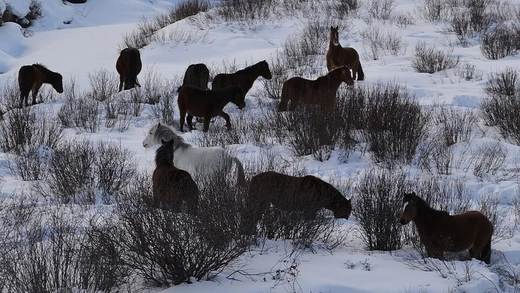
The children's book Justin Morgan Had a Horse by Marguerite Henry, published in 1945, was a fictional account of Figure and Justin Morgan and was a Newbery Honor Book in 1946. A movie based on the book was made by Walt Disney Studios in 1972. Both the book and the movie have been criticized for historical inaccuracies and for creating or perpetuating myths; one equine historian stated they should be looked upon as entertainment vehicles. Ellen Feld, a children's author, is known for her Morgan Horse series; Blackjack: Dreaming of a Morgan Horse won a Children's Choice Award in 2005, following the 2004 award for its sequel Frosty: The Adventures of a Morgan Horse. A Morgan horse is the subject of the poem The Runaway by Robert Frost, in which the speaker observes a little Morgan colt left out in a mountain pasture during winter.
More in Horse Breeds Originating in the United States
Sources
Compiled from Wikipedia and the sources listed below. Text from Wikipedia is available under CC BY-SA 4.0; this entry is adapted from it.
- Wikipedia: Morgan horse (CC BY-SA 4.0).
Spotted an error? Know more?
Reader corrections go straight into our review queue. Suggest an edit · How this site is sourced