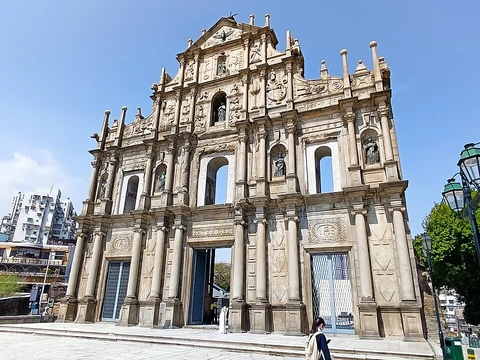
Ruins of Saint Paul's
Remnants of a 17th-century Jesuit church in Macau.
Last updated
Where it is
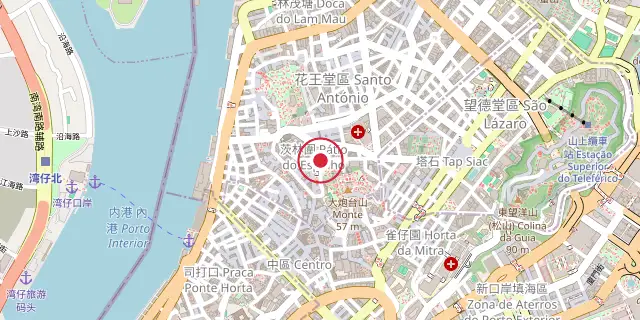
Coordinates: 22°11′53″N 113°32′28″E (22.1980, 113.5410) · Open in OpenStreetMap
Coordinates and connected clubs: the infobox of Wikipedia: Ruins of Saint Paul's (CC BY-SA 4.0). Map: drawn by Codexery from OpenStreetMap tiles.
The Ruins of Saint Paul's in Macau's Santo António district are what remains of a 17th-century Catholic complex, originally housing St. Paul's College and the Church of St. Paul, also called Mater Dei. This landmark was named a Seven Wonder of Portuguese Origin in 2010 and, since 2005, has been part of the UNESCO-listed Historic Centre of Macau.
History
Built between 1602 and 1640 by Jesuit missionaries, this church ranked among the largest Catholic places of worship in Asia during an era when Portugal and Spain shared a single monarch. A typhoon-fueled fire destroyed it on January 26, 1835. Today, only the stone frontispiece remains, perched on a small hill and reached by 68 stone steps. The Fortaleza do Monte looks down over the site, and a museum sits behind the façade.
The frontispiece is designed like an altarpiece, centered on the Assumption of Mary. Its carvings blend Asian influences, likely from Japanese Christian artisans who worked on the structure. These include an image of Mary stepping on a seven-headed hydra, labeled in Chinese characters as "Holy Mother tramples the heads of the dragon," and six stone Chinese guardian lions at the base. Those Japanese craftsmen had been converted by Jesuits and were forced out of Japan in 1587 after Toyotomi Hideyoshi outlawed Christianity.
In the museum behind the façade, visitors can see bones of persecuted Japanese Christians. Near the church lie the remains of roughly 250 Korean and Japanese individuals who were enslaved through the Portuguese slave trade.
Conservation
From 1990 to 1995, the ruins were excavated under the auspices of the Instituto Cultural de Macau, despite calls for the dangerously leaning structure to be demolished. The crypt and foundations were uncovered, revealing the architectural plan, and numerous religious artifacts were found along with relics of Chinese Christian martyrs and monastic clergy, including Father Alessandro Valignano. The Macanese government restored the ruins into a museum, and the façade is now buttressed with concrete and steel in a way that preserves its aesthetic integrity. A steel stairway that once allowed tourists to climb to the top of the façade from the rear is no longer open due to preservation concerns.
More in Historic Centre of Macau
Sources
Compiled from Wikipedia and the sources listed below. Text from Wikipedia is available under CC BY-SA 4.0; this entry is adapted from it.
- Wikipedia: Ruins of Saint Paul's (CC BY-SA 4.0).
Spotted an error? Know more?
Reader corrections go straight into our review queue. Suggest an edit · How this site is sourced