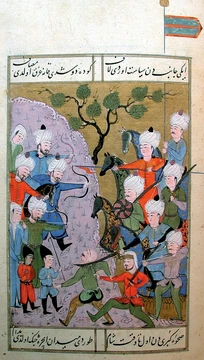
Anti-Ottoman revolts of 1565–1572
A series of revolts fueled by Ottoman decline and Holy League support.
The anti-Ottoman revolts of 1565–1572 were a series of conflicts involving Albanian, Greek, and other rebels against the Ottoman Empire. They were instigated and assisted by western powers, chiefly the Republic of Venice, and gained momentum after the Holy League's victory at the Battle of Lepanto in November 1571. However, Venice withdrew its support and signed a unilateral peace, leading to the suppression of the uprisings and subsequent massacres.
Quick Facts
- Duration
- 1565–1572
- Main regions
- Albania, Central Greece, Peloponnese
- Key battle
- Battle of Lepanto (November 1571)
- Major leaders executed
- Metropolitan bishop Germanos, several nobles
Facts from the source article.
Did You Know?
- Many Greek rowers on Turkish galleys seized them by mutiny and delivered them to the Christian allies.
- Contemporary Ottoman records preserve descriptions of the events in various codices of the era.
Background
Social tensions were heightened by the weakening of Ottoman administration, a chronic economic crisis, and arbitrary conduct by state authorities. During the 16th century, many Orthodox communities lost social and economic privileges previously recognized by Ottoman decrees. Extraordinary taxation and forced conscription for the Ottoman navy worsened conditions, while widespread destruction of churches and plundering of religious property were recorded.
Local populations hoped for military intervention by a Christian power, and news of the Holy League fleet's advance toward Greek-inhabited regions spurred appeals for assistance. The Greek diaspora in Venice, Naples, and other western European cities also sought an armed struggle. Armed preparations began among Greek communities in the Ottoman Empire. Greek representatives from the Peloponnese, such as Petros Menagias and Georgios Meizoteros, as well as Ioannis Varelis and Ioannis Akkidas, became agents for the Spanish Empire, contacting religious figures.
In Corfu, Alexios Rartouros cooperated with the Spanish and contacted nobles from Epirus. Mani, known for frequent revolts, received both Venetian and Spanish agents, which triggered Venetian concerns.
Activity in 1565 - March 1571
In Ottoman Albania, the main revolt centers were the Himara region and the Dukagjin highlands, where rebels had attempted to coordinate actions as early as a 1551 meeting at the Cape of Rodon. Large-scale rebellions erupted in Dukagjin in 1565–1566 and again in 1568 when the Ottomans tried to tax non-Muslims. By October 1570, 37 Albanian villages near Ulcinj and village elders near Shkodër requested Venetian aid, as most Ottoman forces had left to quell the Himara revolt.
Led by Bartolomeo Dukagjin and supported by Venice, Albanian rebels captured Lezhë in December 1570. A revolt also erupted in the region of Mat. Between December 1570 and March 1571, the Sultan ordered local authorities to gather janissaries and cavalry to attack Lezhë. Ottoman forces under Ahmed Pasha advanced from Skopje to Albania, then northwest toward Ulcinj, defeating a combined Venetian-Albanian force on the river Buna before reaching Ulcinj.
The city surrendered after the Ottoman fleet of Ali Muezzinzade Pasha and Pertev Pasha appeared. In southern Albania, a 1566 rebellion in Himara followed an Ottoman attempt to impose regular taxation; rebels defeated an Ottoman army of 8,000–10,000 and offered Venice support for a potential invasion. In spring 1570, the Venetian administration in Corfu sent the stratiot Meksha Gjerbësi, an Albanian speaker, to the hinterland of Vlorë to subvert villages.
Meetings between Venetian provveditore Sebastiano Venier and Himara village elders in March 1570 led to promises of revolt in exchange for artillery and provisions, with Himariots expecting wide autonomy under Venetian protection.
1571-1572
After the Christian victory at Lepanto, many Greeks went to Spain seeking support. Large-scale unrest spread: on Aegina and Lefkada, Christian inhabitants rose in revolt; on Naxos they refused to pay the jizya tax. Revolts were noted on Andros, Paros, Rodos, Kos, Karpathos, Imbros, Skiathos, Chios, Agios Efstratios, and Lesbos, as well as on the Asia Minor coast near Smyrna, Phocaea, and Cheshme. Thessaly, northern Euboea, and parts of Macedonia, including Thessaloniki and Serres, saw revolutionary activity, and unrest reached Constantinople upon news of the Ottoman defeat.
Zorzis Mormoris commanded units of Stratioti in Margariti, Santa Maura (Lefkada), and Corfu. A Venetian landing operation on Lefkada on January 31, 1572, was supported by Greek stradioti, units from the Ionian islands, the coast of Epirus, and Cretans who had fought at Lepanto. Ottoman reinforcements marched toward Lefkada and Lepanto, and on April 18, Ottoman units advanced toward the Agia Mavra and Neos Pyrgos garrisons. Greeks in Venice mobilized through the Scuola dei Greci; scholar Grigorios Malaxos suggested a revolutionary movement supported by Ecumenical Patriarch Metrophanes III.
By 1572, as Venice neared a peace treaty with the Ottomans, cooperating Greeks turned to the Kingdom of Naples. Rebels in Mani approached the Spanish, and others visited Don Juan. Metropolitan bishop Makarios Melissenos and his brother Theodore negotiated with both Spanish and Venetians. In March 1572, the metropolitan bishop of Grevena, Timotheos, proposed to Pope Pius V that an expeditionary force meet rebels in the plain of Thessaloniki and attack Constantinople.
Suppression and aftermath
Venice's withdrawal from the region doomed the rebellion, and it signed a unilateral peace with the Ottomans in 1573. Spain continued to encourage insurrections and acceded to rebel petitions, but poor organization led to suppression and execution of most leaders. Ottoman suppression was harsh in Patras, which became almost deserted; metropolitan bishop Germanos and several nobles were executed, and local nobility were mutilated. Surviving revolutionary leaders from northwestern Peloponnese relocated to Mani, where anti-Ottoman activity persisted.
In Ioannina, the Ottoman governor, under pretext of contact with Venetian and Spanish spies, proposed expelling the entire Christian community from the castle and replacing them with Muslim settlers. During the last quarter of the 16th century, Greek refugees fled to Venetian-controlled areas, especially the Ionian islands. Victims of Ottoman reprisals are estimated at c. 30,000. New uprisings occurred in 1573–1574, involving the Archbishop of Ohrid, Joakim, in preparations.
In 1577, 38 chieftains of Himara, signing as Albanian elders, appealed to Pope Gregory XIII for arms, reporting that fellow Albanians of Zhulat had recently battled the Ottomans with great losses on both sides; they promised to switch allegiance to the Roman Catholic Church and recognize Philip II of Spain as sovereign, under condition of retaining Orthodox liturgical customs.
More in Greek Rebellions Against the Ottoman Empire
Spotted an error? Know more?
Reader corrections go straight into our review queue. Suggest an edit · How this site is sourced