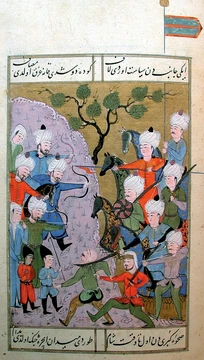
Daskalogiannis revolt
A Cretan revolt that failed due to absent Russian aid.
It began in March 1770 after Russian emissaries promised support that ultimately did not arrive. The rebellion is notable for its initial successes and subsequent brutal suppression.
Quick Facts
- Leader
- Ioannis Vlachos (Daskalogiannis)
- Start date
- 25 March 1770
- Location
- Sfakia, Crete
- Opposing force size
- 40,000 men
- End date
- 18 March 1771 (ultimatum)
- Notable figure
- Count Orlov
Facts from the source article.
Life and activity
Ioannis Vlachos was born in Anopolis village in Sfakia, Crete, in either 1722 or 1730. His father, a wealthy shipowner, sent him abroad for education, earning him the nickname Daskalogiannis, meaning 'John the Teacher.' He served as town clerk in 1750 and chairman of Sfakia in 1765, and owned four three-mast merchant ships operating from Omprosgialos and the gulf of Loutro. He knew Panagiotis Benakis at Mani, who likely introduced him to Count Orlov, sent by Catherine the Great to instigate revolt in the Peloponnese.
Leader of revolt
In early 1770, Russian emissaries contacted Daskalogiannis, promising support for a revolt in Sfakia, which he agreed to fund and organize. He prepared men, rifles, and supplies, and built defenses at strategic locations, but the Russian fleet under Count Orlov never sailed for Crete. The uprising began on 25 March 1770, with attacks on Kydonia, Apokoronas, and Agios Vasilios. Initially, rebels put Turks to flight and minted their own coins in a cave near Hora Sfakion.
However, by May the Turks assembled an army of 40,000 men at Vrysses. On the Krapi plateau, the rebels suffered a crushing defeat and fled to the high mountains. Turks destroyed villages, scattered flocks, looted the province, captured many inhabitants for slavery in Chándakas (Iraklion), and took Daskalogiannis' uncle prisoner. The promised Russian intervention failed, and the uprising did not spread to the lowlands.
On 18 March 1771, the Turks issued an ultimatum offering safe passage if rebels surrendered, accompanied by a 12-item peace document. Terms included paying back taxes, surrendering arms and leaders, ceasing contact with Christian ships, assisting in arresting Christian crews, placing Sfakia's judiciary under a Turkish-appointed justice of the peace, forbidding church repairs or new construction, and paying tithe according to the sultan's firman.
Family
Daskalogiannis was married to Sgouromallini. Their daughters Anthousa and Maria Daskalogianni fought alongside their father during the revolt. Sgouromallini and Anthousa were killed in its aftermath. Maria was enslaved and given to the Ottoman vizier, who gifted her to the teftedar of Heraklion. He married Maria without forcing her to convert to Islam, and they moved to Constantinople. After her husband's death in 1816, Maria inherited considerable money, which she donated to Greek revolutionaries after the Greek War of Independence began.
Legacy
Daskalogiannis is immortalized in folk tales and songs, most notably the epic ballad 'To tragoudi tou Daskalogianni' by Barba-Pantzelios from 1786. Tradition holds that before his last stand, he and his men danced the war dance Pentozalis. The international airport of Chania bears his name, and a memorial statue stands in his hometown Anopolis.
More in Greek Rebellions Against the Ottoman Empire
Spotted an error? Know more?
Reader corrections go straight into our review queue. Suggest an edit · How this site is sourced