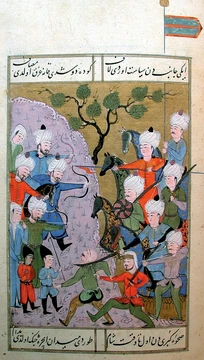
Cretan revolt (1878)
Cretan uprising ended by the Pact of Halepa in 1878.
The Cretan revolt of 1878 was an insurrection by the Cretan people against Ottoman rule on the island. It formed part of a broader movement for independence from the Ottoman Empire, which had controlled Crete since the mid-17th century. The conflict ended with the Pact of Halepa, which granted a number of concessions to the Cretan population.
Quick Facts
- Conflict
- Cretan revolt of 1878
- Location
- Ottoman Crete (now Crete, Greece)
- Result
- Ottoman victory
- Date
- January – October 1878
Facts from the source article.
Context
The Ottoman conquest of Crete began in 1645 and was completed in 1669 with the fall of Candia. The island experienced periodic insurrections during Ottoman rule. In 1821, Crete joined the Greek Revolution, but the 1830 settlement did not include Crete in the new Greek state; instead, the island came under Muhammad Ali of Egypt for about ten years, returning to the Sultan in 1840. After another revolt, relative peace lasted until 1866.
The Treaty of Paris on 30 March 1856 required the Sultan to apply the hatt-ı hümayun, guaranteeing civil and religious equality for Christians and Muslims, but Ottoman authorities in Crete resisted these reforms. Following conversions and relapses, the Empire attempted to restore liberty of conscience. The revolts of the next four decades built on the hatt-ı hümayun. The Cretan Revolt of 1866–1869 achieved some advances: on 11 November 1867, Ali proposed the Organic Law, which offered limited Cretan representation in administration, tax breaks, a bank, and equal status for Greek and Turkish.
International instability in the Balkans—revolts in Bosnia-Herzegovina in 1875 and Bulgaria in 1876, plus Serbian and Montenegrin intervention—encouraged Crete's Christian community to demand reforms. By 1875, most Christian assembly representatives were doctors and lawyers from the University of Athens. On 22 May 1876, the Cretan assembly sent complaints to the Sultan, seeking better Christian representation. On 2 August, the Porte publicly refused all complaints, including a bank, compulsory public schools, and newspaper rights.
Revolt of 1878
Despite concessions in August 1876, anger grew, and armed bands began gathering in the mountains. The Ottoman administration arrested the deputy of Chania, a prominent Christian figure, triggering the first demonstration in Crete's history outside the governor's residence. In July 1877, a 44-member committee was elected in western Crete to address the Cretan question. Three revolutionary committees formed in Vamos, Chania, and Rethymno, supplied with arms from Athens.
In August, a post-revolutionary committee was elected in Chania. Representatives of all committees met at Fres to elect a Presidium. As the conflict turned against the Ottoman Empire, Greece increased its support. On 27 December, Charilaos Trikoupis, Greece's foreign minister, announced Greek backing if a revolt occurred.
The pan-Cretan revolutionary assembly convened at Fres in January 1878. The Ottoman Empire, engaged in war with Russia, could not intervene heavily in Crete and followed British advice by sending two emissaries—Kostis Adosidis Pasha and Selim Efendi—to negotiate. Ioannis Tsouderos responded with two demands: Cretan autonomy with tribute to the Sultan, and a Christian governor elected under Great Power supervision. The emissaries requested a ten-day delay for the Sultan's reply, which expired without response.
Pact of Halepa
The Ottoman Empire, satisfied that the European Powers rejected union of Crete with Greece, agreed to concessions. In October 1878, the Pact of Halepa ended the insurrection, named after the Halepa district in Chania. It made Crete a semi-autonomous province with specific privileges, ratified by a Sultan's firman on 9 November 1878. Key measures included: a Christian general governor elected for five years (renewable); a counsellor of a different denomination beside the governor; an 80-member parliamentary assembly (49 Christians, 31 Muslims); a Cretan Gendarmerie; Greek as an official language in courts and the assembly; a general amnesty; temporary tax exemption; and permission to maintain associations, create literary circles, and publish newspapers. The Pact's constitution could not be altered by the Ottoman constitution. The first governor was Alexander Karatheodori Pasha.
More in Greek Rebellions Against the Ottoman Empire
Spotted an error? Know more?
Reader corrections go straight into our review queue. Suggest an edit · How this site is sourced