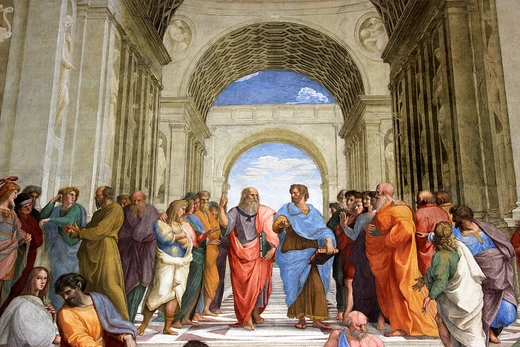
Euclidean geometry
Ancient Greek mathematician who systematized geometry in Elements.

Euclidean geometry is a system of mathematics credited to the ancient Greek mathematician Euclid, who laid it out in his work *Elements*. His method starts with a handful of basic, seemingly obvious assumptions called axioms or postulates, and from these he logically derives many further statements, or theorems. For over two thousand years, these axioms were considered so self-evident that any theorem proven from them was accepted as absolutely true, and no other kind of geometry was thought possible.
The *Elements* begins with plane geometry—the study of flat, two-dimensional shapes—which is still taught in high school as the first example of an axiomatic system and of formal mathematical proof. It then moves on to solid geometry, covering three-dimensional figures. Much of the *Elements* also presents results that today would be considered algebra and number theory, but Euclid expresses them using geometric language, such as lengths of line segments or areas of surfaces.
Euclid’s work was largely a compilation and organization of earlier geometric knowledge, but its clear logical structure was so superior that earlier texts were no longer preserved and are now mostly lost. The *Elements* consists of 13 books. Books I–IV and VI cover plane geometry, proving results like “In any triangle, two angles taken together are less than two right angles” (Book I, proposition 17) and the Pythagorean theorem (Book I, proposition 47). Books V and VII–X deal with number theory, treating numbers as geometric lengths or areas; they introduce prime numbers, rational and irrational numbers, and prove that there are infinitely many primes. Books XI–XIII concern solid geometry, including the fact that a cone’s volume is one-third that of a cylinder with the same base and height, and the construction of the five Platonic solids.
At the start of Book I, Euclid states five postulates for plane geometry, phrased as constructions: (1) draw a straight line from any point to any point; (2) extend a finite straight line continuously; (3) draw a circle with any center and radius; (4) all right angles are equal; and (5) the parallel postulate—if a line falling on two lines makes interior angles on the same side less than two right angles, those lines will eventually meet on that side.
- Field
- Mathematics (Geometry)
- Nationality
- Ancient Greek
- Known for
- Elements, Euclidean geometry, axiomatic system, parallel postulate
Lore & Background
Euclidean geometry is an axiomatic system, in which all theorems are derived from a small number of simple axioms. Near the beginning of the first book of the Elements, Euclid gives five postulates for plane geometry, including the parallel postulate. The Elements also include five 'common notions,' such as 'Things that are equal to the same thing are also equal to one another.' Modern scholars agree that Euclid's postulates do not provide the complete logical foundation that Euclid required for his presentation.
The Elements is mainly a systematization of earlier knowledge of geometry. Its improvement over earlier treatments was rapidly recognized, with the result that there was little interest in preserving the earlier ones, and they are now nearly all lost. There are 13 books in the Elements: Books I–IV and VI discuss plane geometry; Books V and VII–X deal with number theory; Books XI–XIII concern solid geometry.
Euclidean geometry is constructive. Postulates 1, 2, 3, and 5 assert the existence and uniqueness of certain geometric figures, and these assertions are of a constructive nature: we are given methods for creating them with no more than a compass and an unmarked straightedge. Euclid often used proof by contradiction.
Reader's Guide
Euclidean geometry is an example of synthetic geometry, in that it proceeds logically from axioms describing basic properties of geometric objects such as points and lines, to propositions about those objects. This is in contrast to analytic geometry, introduced almost 2,000 years later by René Descartes, which uses coordinates to express geometric properties by means of algebraic formulas. The Elements begins with plane geometry, still taught in secondary school as the first axiomatic system and the first examples of mathematical proofs. It goes on to the solid geometry of three dimensions. Much of the Elements states results of what are now called algebra and number theory, explained in geometrical language. Today, two other self-consistent non-Euclidean geometries are known, hyperbolic and elliptic geometry. An implication of Albert Einstein's theory of general relativity is that physical space itself is not Euclidean, and Euclidean space is a good approximation for it only over short distances and weak gravity. Euclid's reasoning from assumptions to conclusions remains valid independently from the physical reality.
Did You Know?
- Euclid's Elements includes the proof that there are infinitely many prime numbers.
- The parallel postulate states that if a straight line falling on two straight lines makes interior angles on the same side less than two right angles, the lines meet on that side.
- Playfair's axiom is logically equivalent to the parallel postulate: through a point not on a given line, at most one line can be drawn that never meets the given line.
- Euclid's first 28 propositions are those that can be proved without the parallel postulate.
The Axiomatic Revolution
Euclid, an ancient Greek mathematician, transformed scattered geometric knowledge into a unified logical framework through his textbook known as the Elements. Rather than simply cataloging results that had been discovered by earlier thinkers, he arranged them into a deductive chain: a small collection of intuitively appealing postulates at the base, from which an ever-growing tower of theorems could be derived, each one resting on the axioms and on propositions already established. This was the first time such propositions were organized into a system where every result is proved from axioms and previously proved theorems. The Elements was so effective as a presentation that earlier geometric treatises lost their audience, and nearly all of them have since been lost to history. Near the start of Book I, Euclid lays out five postulates governing constructions with straight lines and circles, followed by five common notions covering properties of equality. Yet modern scholars recognize that these foundations, while elegant, do not constitute the complete logical bedrock Euclid's presentation demanded; contemporary treatments rely on more extensive axiom sets to fill the gaps.
The Parallel Postulate and the Shattering of Certainty
For over two millennia, the adjective "Euclidean" went entirely unused because Euclid's axioms appeared so self-evident that theorems derived from them were regarded as absolutely true, leaving no room for alternative geometries. The one axiom that troubled even the ancients was the parallel postulate, which governs when two lines cut by a transversal will eventually meet. Euclid himself seemed to sense its qualitative difference from the other four postulates: his first twenty-eight propositions in the Elements are precisely those provable without invoking it. The ancients aspired to a system of absolutely certain propositions and believed the parallel postulate should be derivable from simpler statements. We now know no such proof can exist, because consistent geometric systems can be built in which the postulate holds and others in which it fails. Playfair's axiom offers one equivalent formulation: through a point not on a given line, at most one parallel can be drawn. Today, hyperbolic and elliptic geometries stand as self-consistent alternatives, and Einstein's general relativity reveals that physical space itself departs from Euclidean structure, with Euclidean space serving merely as a short-distance, weak-gravity approximation.
The Architecture of the Elements
The Elements spans thirteen books that move from the flat plane into three-dimensional space and into the abstract territory of number. Books I through IV and VI tackle plane geometry, establishing results such as the fact that any two angles of a triangle sum to less than two right angles (Proposition 17) and the celebrated Pythagorean theorem (Proposition 47). Books V and VII through X treat what we would now call number theory, but they do so entirely in geometric language: numbers appear as lengths of line segments or areas of surface regions, and the text introduces prime numbers, rational and irrational quantities, and proves the infinitude of primes. Books XI through XIII shift to solid geometry, where one finds the 1-to-3 volume ratio between a cone and a cylinder sharing the same base and height, along with constructions of the five Platonic solids. The plane-geometry portion of the Elements is still taught in secondary schools as the first encounter with an axiomatic system and with formal mathematical proof, making it a living thread connecting ancient Greek reasoning to modern classroom practice.
Synthetic Reasoning and the Constructive Method
Euclidean geometry belongs to the family of synthetic geometry, a mode of reasoning that begins with axioms describing the most basic properties of points, lines, and circles, and then proceeds step by step to propositions about more complex configurations. This stands in sharp contrast to analytic geometry, which René Descartes introduced nearly two thousand years later by assigning coordinates to geometric objects and translating spatial relationships into algebraic formulas. The synthetic approach is also inherently constructive: postulates one, two, three, and five do not merely assert that certain figures exist; they guarantee that those figures can actually be constructed. Although Euclid explicitly states only the existence of the objects he constructs, the logical structure of his proofs treats them as unique. This constructive, step-by-step character means that the validity of Euclidean reasoning stands independently of any physical interpretation of the axioms; the logical chain from assumption to conclusion remains sound regardless of whether the underlying space matches the physical world.
Frequently Asked Questions
Who is behind Euclidean geometry?
The ancient Greek mathematician Euclid compiled and systematized this geometric framework in his treatise *Elements*, organizing centuries of known results into a single logical structure.
How does Euclidean geometry actually work?
It begins with a small set of basic assumptions—axioms and postulates—taken as self-evident, then builds an entire edifice of theorems through step-by-step logical deduction, starting with the properties of flat, two-dimensional figures.
Why did people believe Euclidean geometry was the only possible geometry?
For more than two millennia, its starting assumptions felt so intuitively obvious that every conclusion drawn from them was treated as universally and necessarily true, leaving no room to imagine a different kind of spatial reasoning.
What is the parallel postulate and why does it matter?
It is Euclid's fifth postulate, which asserts that given a line and a point off it, exactly one line through that point will never meet the original line. It became the linchpin of the entire system because questioning it eventually unlocked entirely new geometric worlds.
How did Euclidean geometry's reign as the sole geometry come to an end?
In the 1800s, mathematicians showed that swapping out the parallel postulate still yielded a fully consistent set of rules, demonstrating that Euclid's system was one valid model of space rather than the only one.
More in Greek inventions 1-24
Spotted an error? Know more?
Reader corrections go straight into our review queue. Suggest an edit · How this site is sourced