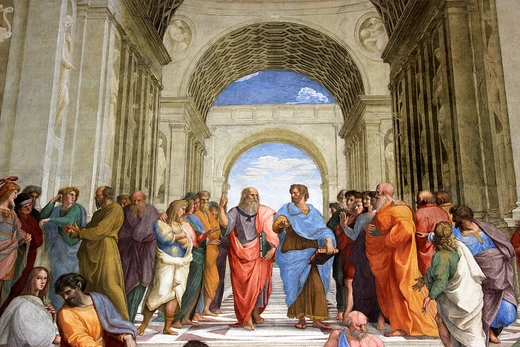
Democracy
Government where power is vested in the people.

Democracy is a system of government where the people of a state hold political power. In its simplest form, this means rulers are chosen through competitive elections. Broader definitions also require protections for civil liberties and human rights. The word itself dates back to 5th century BC Greece, where it was used in city-states like Athens to mean "rule of the people," as opposed to aristocracy, or "rule of an elite."
There is no single agreed-upon definition of democracy—one study found over 2,200 adjectives used to describe it in English. However, core principles are widely recognized. These include freedom of assembly, association, religion, and speech; the right to vote; consent of the governed; and protections for minority rights and personal property. In a direct democracy, citizens deliberate and decide on legislation themselves. In the more common representative democracy, they elect officials to govern on their behalf, such as in parliamentary or presidential systems. A common variant, liberal democracy, uses a constitution and a supreme court to limit majority power and protect individual rights, like freedom of speech.
The idea of who "the people" are has changed over time. In most ancient and modern democracies, citizenship was initially limited to an elite group. It was only later, often through suffrage movements in the 19th and 20th centuries, that it was extended to all adults. Democratic principles can also apply to private organizations like clubs or firms.
Democracy contrasts with authoritarian systems, where power is not held by the general population. Historically rare and fragile, democratic governments became more common after the 19th century, especially during waves of democratization. They tend to produce better health, education, and economic outcomes. Public opinion worldwide strongly favors democracy, and even authoritarian states often try to appear democratic. Yet, as of 2022, less than half the world's population lives in a democracy according to major indices. At the same time, while representative democracy is widely valued, dissatisfaction with how it performs is common, even in many established democracies.
Key features of democracy include legal equality, political freedom, and the rule of law.
- Field
- Political system
- Known for
- Rule by the people, competitive elections, civil liberties
- First attested use
- 5th century BC in Greek city-states
- Dominant modern form
- Representative democracy
- Key principles
- Upward control, political equality, social norms
Lore & Background
Democracy has evolved considerably over time. In a direct democracy, the people have direct authority to deliberate and decide legislation, while in a representative democracy, they choose governing officials through elections. The definition of 'the people' and how authority is shared has changed over time and at varying rates in different countries. Features often include freedom of assembly, association, speech, religion, voting rights, and minority rights. The term first appeared in ancient Greek political thought in Athens, from dêmos '(common) people' and krátos 'force/might'. Under Cleisthenes, what is generally held as the first example of a type of democracy was established in Athens in the sixth-century BC. The first attested use of the word democracy is found in prose works of the 430s BC, such as Herodotus' Histories.
Reader's Guide
Democracy contrasts with authoritarian systems where power is not vested in the general population. Historically rare and vulnerable, democratic systems have become more prevalent since the 19th century, particularly with various waves of democratization. Democracy garners considerable legitimacy in the modern world, as public opinion across regions tends to strongly favor democratic systems relative to alternatives, and even authoritarian states try to present themselves as democratic. Democracy more consistently results in improved health, education, and economic outcomes. According to the V-Dem Democracy indices and The Economist Democracy Index, less than half the world's population lives in a democracy as of 2022. While representative democracy is widely valued, dissatisfaction with democratic performance is common even in many established democracies. No consensus exists on a precise definition of democracy, and a study identified 2,234 adjectives used to describe it in the English language. Democratic principles are reflected in all eligible citizens being equal before the law and having equal access to legislative processes.
Did You Know?
- A study identified 2,234 adjectives used to describe democracy in the English language.
- The term democracy first appeared in the 5th century BC in Greek city-states, notably Classical Athens.
Mechanical Engineering and Automation
Greek engineers in the Hellenistic period and beyond produced a remarkable array of mechanical devices that anticipated modern automation. Ctesibius, working in Alexandria around 285–222 BC, designed alarm systems for his clepsydras that could drop pebbles on a gong or force compressed air through a beating reed to blow trumpets at preset times. He also developed air and water pumps that powered instruments like the water organ, and he described a float regulator for water clocks—a device strikingly similar to the ball-and-cock mechanism in a modern flush toilet, making it arguably the earliest known feedback-controlled mechanism. A century later, Heron of Alexandria created schematics for automatic temple doors powered by steam, and by the first century AD his name was attached to the famous Heron's fountain. Meanwhile, the Antikythera mechanism, recovered from a shipwreck in 1900–1901, revealed that Greeks had built an analog computer capable of calculating astronomical positions and predicting lunar and solar eclipses using Babylonian arithmetic-progression cycles.
Mathematical and Scientific Foundations
Greek contributions to mathematics and the natural sciences laid groundwork that persists to this day. Diophantus, an Alexandrian mathematician, authored a series of books called Arithmetica that dealt with solving algebraic equations; in the context where algebra is identified with the theory of equations, he is credited as its inventor and often called the father of algebra. His work also gave rise to the modern notion of the Diophantine equation in number theory. In the physical sciences, fundamental concepts of continuum, drag, and pressure gradients appear in the writings of Aristotle and Archimedes, showing that the intellectual roots of aerodynamics stretch back millennia before the field was formally established in the seventeenth century. The astrolabe, first used around 300 BC by Greek astronomers to determine the altitude of celestial objects, served as a forerunner to more sophisticated astronomical instruments. Additionally, alchemy—a forerunner of modern chemistry—originated in Hellenistic Egypt, indicating that the Greek world was a crucible where practical experimentation and theoretical inquiry first merged into what we now recognize as scientific method.
Cultural and Philosophical Origins
Greek thought and storytelling seeded ideas that would later crystallize into formal disciplines. The concept of anarchism, for instance, was first articulated by tragedians such as Aeschylus and Sophocles, who used the myth of Antigone to dramatize the tension between state-imposed rules and individual autonomy. In the realm of what we now call artificial intelligence, ancient Greek mythology is replete with stories of intelligent mechanisms: Talos, Pandora, Pygmalion and Galatea, and the Golden Maidens of Hephaestus all depict self-acting entities that could pose danger to human society. By the third century BC, an unknown Greek engineer reportedly created a robot maiden named Philon, marking what some describe as the first artificial intelligent robot. The very word automata derives from the Greek αὐτόματος, meaning self-acting, self-willed, self-moving, and the modern field of automata theory—concerned with abstract machines and the computational problems they can solve—carries this Greek etymology forward. Even association football traces its earliest recognizable forms to the ancient Greek games Phaininda and episkyros.
Infrastructure and Civil Engineering
Greek and Greek-influenced engineers built infrastructure that shaped the ancient world, some of which endures to the present day. Under Ptolemy II (283–246 BC), Greek engineers opened the Ancient Suez Canal, following earlier attempts that were probably only partly successful. The Mycenaean Arkadiko Bridge in Greece, dating to approximately 1300 BC, is possibly the oldest existing arch bridge in the world; this stone corbel arch structure is still used by local residents today. The Minoans, around 2000 BCE, developed what was then an extremely advanced irrigation system that included several aqueducts, predating the Roman aqueducts with which the structure is more commonly associated. In Alexandria, Ctesibius and other Greek engineers developed and put to practical use various air and water pumps serving diverse purposes, from powering a water organ to, by the first century AD, driving Heron's fountain. The anemoscope, invented by Timosthenes, represented another practical application of Greek engineering to the measurement of natural forces. Together, these achievements demonstrate that Greek technical ingenuity extended well beyond the theoretical into the built environment.
Frequently Asked Questions
Who is Democracy?
Democracy is a political system in which the citizens of a state hold governing power rather than a single ruler or a privileged class. The term was coined in 5th-century BC Athens to describe 'rule of the people' as a direct contrast to aristocracy, or rule by an elite.
What are Democracy's powers and role?
At its core, Democracy operates through competitive elections that let ordinary citizens choose their leaders, paired with safeguards for civil liberties and human rights. It also demands political equality and upward accountability, meaning those in power must answer to the people below them.
When did Democracy first appear?
The concept first took shape in Greek city-states around the 5th century BC, with Athens being the most famous early example. The word itself literally translates to 'rule by the people' from its Greek roots.
Why is Democracy important?
Democracy matters because it vests political power in the people rather than an elite, ensuring governance reflects the will of the majority while protecting individual rights. Its key principles—upward control, political equality, and shared social norms—create a framework where no single group holds unchecked authority.
More in Greek inventions 1-24
Spotted an error? Know more?
Reader corrections go straight into our review queue. Suggest an edit · How this site is sourced