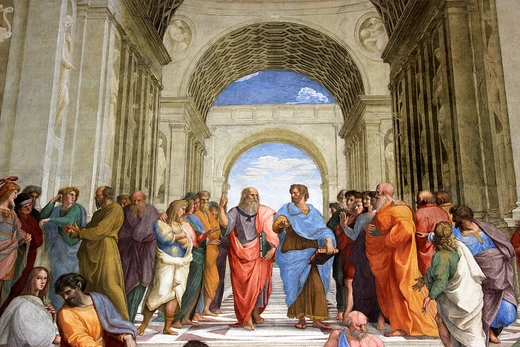
Ancient Greek technology
Ancient Greek technology spanned war, water, mining, and mathematics.

The ancient Greeks began developing their technology in the 5th century BCE, and this progress continued through the Roman era and later. Among the innovations attributed to them are the gear, screw, rotary mills, bronze casting, the water clock, water organ, torsion catapult, steam-powered experimental devices and toys, and a chart for identifying prime numbers. Many of these advances came later in Greek history, often driven by the need for better weapons and military tactics. Yet peaceful applications also emerged early, such as the watermill, which later saw large-scale use under the Romans. The Greeks also made significant strides in surveying and mathematics, and numerous technical achievements were documented by thinkers like Archimedes and Heron.
In water management, Greek efforts focused on urban needs: tapping groundwater, building aqueducts, creating stormwater and wastewater sewer systems, controlling floods, draining land, and constructing fountains, baths, and sanitary facilities, as well as recreational water features. A notable example is a drainage system on the Anatolian west coast, which included a masonry outlet designed to clean itself. This system, part of an extensive underground water supply and drainage network, reflected the Greek awareness of hygiene’s role in public health.
Mining was another key area. The Greeks operated large silver mines at Laurium, whose profits helped fund Athens’ growth. Miners extracted ore from underground galleries, then washed and smelted it to produce metal. At the site, elaborate washing tables remain, fed by rainwater stored in cisterns collected during winter. Mining also supplied metal for coinage. Greek mine tunnels reached depths of up to 330 feet, worked by slaves using picks and iron hammers. Ore was lifted in small skips hauled by rope, sometimes guided by a wheel positioned at the shaft’s rim.
- Field
- Technology and engineering
- Known for
- Gear, screw, rotary mills, bronze casting, water clock, water organ, torsion catapult, steam devices, prime number chart, watermill, mining, surveying, mathematics
- Time period
- 5th century BC through Roman period and beyond
- Key figures mentioned
- Archimedes, Heron
Lore & Background
The Greeks developed extensive silver mines at Laurium, the profits from which helped support the growth of Athens as a city-state. Mining involved extracting ores in underground galleries, washing them, and smelting to produce metal. Elaborate washing tables at the site used rainwater held in cisterns collected during winter. Greek mines had tunnels as deep as 330 feet and were worked by slaves using picks and iron hammers; extracted ore was lifted by small skips hauled by a rope sometimes guided by a wheel placed against the mine shaft rim.
Reader's Guide
Ancient Greek technology is significant for its range of inventions that influenced later Roman and medieval developments. The gear, screw, rotary mills, and bronze casting techniques represent foundational mechanical advances. Water technologies—including aqueducts, drainage systems, fountains, baths, and a self-cleaning drainage outlet on the Anatolian west coast—demonstrate an understanding of public health and hydraulic engineering. The watermill pointed to further large-scale exploitation under the Romans. In warfare, the torsion catapult and experimental steam devices reflect innovation driven by military needs. Mining at Laurium produced silver that supported Athens and contributed to coinage. Surveying and mathematics were advanced, and technical knowledge was published by philosophers such as Archimedes and Heron. The legacy of these technologies persisted through the Roman period and beyond, as documented in sources like Oleson's study of mechanical water-lifting devices.
Did You Know?
- The ancient Greeks developed a chart to find prime numbers.
- They used steam to operate some experimental machines and toys.
- Greek mines at Laurium had tunnels as deep as 330 feet.
- A drainage system on the Anatolian west coast featured a self-cleaning masonry outlet.
Breadth and Timeline of Greek Innovation
The ancient Greek technological tradition spanned an extraordinary arc, beginning in the fifth century BC and extending well into the Roman era and beyond. Over this long period, Greek engineers and craftsmen produced a remarkable catalogue of devices: the gear, the screw, rotary mills, sophisticated bronze casting methods, water clocks, the water organ, the torsion catapult, and even experimental machines and toys driven by steam. They also devised a chart for identifying prime numbers, showing that their ingenuity reached into pure mathematics. A striking pattern emerges when one examines the timing of these breakthroughs. Many of the most dramatic inventions appeared late in the Greek period and were directly motivated by the urgent demands of warfare—improving weapons, refining tactics, and gaining battlefield advantage. Yet the Greeks were not solely driven by conflict. The early development of the watermill stands as a peaceful achievement that foreshadowed the much larger-scale hydraulic engineering the Romans would later pursue. This dual military-and-civilian impetus gave Greek technology a breadth that set the stage for centuries of subsequent innovation.
Water Technology and Urban Engineering
Greek civilization placed extraordinary emphasis on managing water for the daily life of its cities. Their expertise covered an impressive range of applications: tapping groundwater, building aqueducts to deliver fresh supply, designing storm-water and wastewater sewerage networks, protecting communities from flooding, and constructing drainage channels. Beyond mere utility, Greeks built fountains, public baths, and other sanitary facilities, and they even incorporated water into recreational spaces. One particularly elegant example survives on the Anatolian west coast, where a drainage system featured a masonry outlet structure designed to clean itself. This self-cleaning mechanism was embedded within a larger underground water-supply network, revealing how thoroughly Greek engineers understood the link between hygienic conditions and public health. The sophistication of these systems—combining supply, drainage, flood control, and sanitation into integrated urban infrastructure—demonstrates that Greek water technology was not a single invention but a mature, multi-disciplinary field. It also laid groundwork that Roman engineers would expand dramatically, scaling up Greek principles into empire-wide hydraulic works.
Mining at Laurium and Economic Impact
The silver mines at Laurium represent one of the most consequential technological undertakings in the ancient Greek world, because the wealth they generated helped sustain the growth of Athens as a major city-state. The operation was a complex industrial process: workers excavated ore from underground galleries, washed the raw material, and then smelted it into usable metal. Remarkable washing tables still survive at the site, revealing that the Greeks harnessed rainwater stored in cisterns during the winter months to power their washing operations. The tunnels reached depths of as much as 330 feet, and the labor was performed by slaves wielding picks and iron hammers. Ore was hoisted to the surface in small skips pulled by rope, sometimes guided by a wheel set against the rim of the mine shaft—a practical solution to the problem of lifting heavy loads from great depth. The extracted silver was converted into coinage, effectively creating the currency that underpinned Athenian trade and politics. In this way, a single mining operation wove together underground engineering, water management, metallurgy, and monetary economics into a system that shaped the trajectory of an entire civilization.
Intellectual Publication and Enduring Legacy
A distinctive feature of Greek technological culture was the willingness of its leading thinkers to publish their technical work alongside philosophical inquiry. Figures such as Archimedes and Heron did not keep their discoveries locked in workshops; they committed their advances in mechanics, hydraulics, and mathematics to written form, making them available to a wider audience. This tradition of documenting technical knowledge was underpinned by the Greeks' advanced development of surveying and mathematics, which provided the theoretical backbone for practical engineering. The long-term legacy of this intellectual openness is visible in the trajectory of technology after the Greek period. The watermill, for instance, was an early Greek innovation that pointed toward far larger-scale exploitation under Roman rule, suggesting that Greek principles were seeds planted for later harvests. The broader technological lineage extends well beyond antiquity: Roman technology, medieval engineering, and Byzantine inventions all trace threads back to Greek foundations. Even today, the Museum of Ancient Greek Technology and scholarly works by researchers like Kostas Kotsanas keep this heritage alive, reminding modern audiences that many mechanical and hydraulic ideas we take for granted were first articulated in the workshops and lecture halls of the ancient Greek world.
Frequently Asked Questions
What time period does Ancient Greek technology cover?
Greek technological development kicked off in the 5th century BCE and kept advancing well into the Roman era and beyond. The pace of innovation never really stopped, with new breakthroughs building on earlier ones across centuries.
What are the most famous inventions from Ancient Greek technology?
The list includes the gear, the screw, rotary mills, bronze casting, the water clock, the water organ, torsion catapults, and even steam-powered experimental devices. A chart for identifying prime numbers and the watermill round out the highlights.
Who are the key figures behind Ancient Greek technology?
Archimedes and Heron are the two names most closely tied to the field. Their work on mechanics, hydraulics, and engineering set the stage for much of what followed in the Roman period.
Why did the Greeks develop so much military technology?
A major driver was the need for superior weapons and tactics on the battlefield, which pushed inventors toward things like torsion catapults and improved siege equipment. That said, peaceful applications like the watermill also emerged early on.
What fields does Ancient Greek technology span?
It covered a remarkably wide range: warfare, hydraulics and water management, mining, surveying, and pure mathematics. The gear, screw, and prime number chart show how mechanical and mathematical thinking went hand in hand.
More in Greek inventions 1-24
Spotted an error? Know more?
Reader corrections go straight into our review queue. Suggest an edit · How this site is sourced