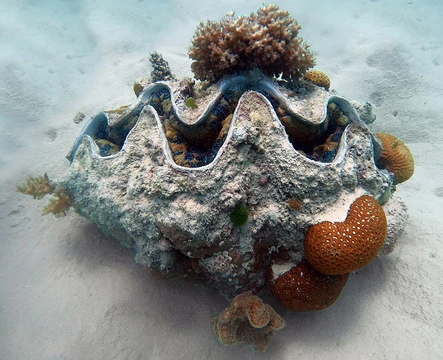
Antarctic scallop
A slow-growing Antarctic scallop with paper-thin, purplish-red valves.
Last updated
Adamussium colbecki is a species of scallop endemic to Antarctic waters, first described in 1902 as Pecten colbecki by British zoologist Edgar Albert Smith.[1] Its shell grows to about 7 cm in length and width, with a nearly circular outline and two thin, purplish-red valves.[2] The species is considered a "foundation species" because its shell provides hard substrate for diverse epifaunal organisms in a region where rocky surfaces are scarce.[3]
Scientific classification
- KingdomAnimalia
- PhylumMollusca
- ClassBivalvia
- OrderPectinida
- FamilyPectinidae
- GenusAdamussium
- SpeciesAdamussium colbecki
Named by (Smith, 1902)
Sources: Wikipedia taxobox: Antarctic scallop (CC BY-SA 4.0) · order, family and genus agree with WoRMS AphiaID 197021 (CC BY 4.0)
How big is it?
Largest length in the source, 0.07 m, next to a 1.8 m person.
Diagram: drawn by Codexery, schematic shapes to scale (not a likeness). Length: Wikipedia: Antarctic scallop
Where the antarctic scallop has been recorded
Each dot is a place where the species has been observed and reported (549 records, half-degree grid) — not a modelled range. 24 inland records left out (institution coordinates).
Map: drawn by Codexery. Data: GBIF occurrence search (records CC0 / CC BY) · Natural Earth basemap (public domain)
Key facts and history
German malacologist Johannes Thiele placed it in the separate genus Adamussium in 1934, based on characteristics distinct from other Pecten species.[1] Although commonly found at depths less than 100 m, one recording placed it at 4840 m.[4] In 1902, the British zoologist Edgar Albert Smith originally named this species Pecten colbecki.[1] The shell, which is nearly circular, grows to about 7 cm in both length and width.[2]
Near the hinge, each valve has an umbo (a raised hump from which ribs radiate), and these umbones are not very prominent.[5] The outside of the valves has fine concentric lines, and the auricles also show fine sculpting with annual growth lines.[5] The interior of the valves is pink, and a fringe of tentacles and a row of simple eyes project from the mantle around the rim.[5] It is commonly found at depths under 100 m but has been recorded as deep as 4840 m, on substrates like sand, gravel, and silt.[4]
In shallow water, it uses byssus threads to attach to hard surfaces, while in deeper water it is usually free-living.[6] Its growth rate is much slower than that of scallops inhabiting warmer waters.[7]
What the cited sources add
The umbo and auricle structure are described in a 2000 Geological Society publication on bivalve evolutionary biology.[5][8] As a suspension feeder, the Antarctic scallop extracts nourishment from surrounding seawater, a feeding mode detailed in a 2011 Elsevier volume on scallops.[9][10] Compared to the temperate scallop Pecten jacobaeus, Adamussium colbecki had higher cadmium levels, while zinc and manganese in its kidney were much lower.[11]
References
- Wikipedia, "Antarctic scallop" (CC BY-SA 4.0), which cites: "Karyology of the Antarctic scallop Adamussium colbecki, with some comments on the karyological evolution of pectinids", Genetica, 2006, p. 341–349; "The First People", Canterbury Museum (original not read by us) en.wikipedia.org
- Wikipedia, "Antarctic scallop" (CC BY-SA 4.0), which cites: "A reassessment of the distribution of the common Antarctic scallop Adamussium colbecki (Smith, 1902)", Deep-Sea Research Part II: Topical Studies in Oceanography, 2006, p. 912–920 (original not read by us) en.wikipedia.org
- Wikipedia, "Antarctic scallop" (CC BY-SA 4.0), which cites: "Feeding adaptations of the foraminiferan Cibicides refulgens living epizoically and parasitically on the Antarctic scallop Adamussium colbecki", Biological Bulletin, 1987, p. 136–159; "Epibiotic demosponges on the Antarctic scallop Adamussium colbecki (Smith, 1902) and the cidaroid urchins Ctenocidaris perrieri Koehler, 1912 in the nearshore habitats of the Victoria Land, Ross Sea, Antarctica", Polar (original not read by us) en.wikipedia.org
- Wikipedia, "Antarctic scallop" (CC BY-SA 4.0), which cites: "Antarctic Invertebrates: Adamussium colbecki", Smithsonian: National Museum of Natural History (original not read by us) en.wikipedia.org
- Wikipedia, "Antarctic scallop" (CC BY-SA 4.0), which cites: "Antarctic Invertebrates: Adamussium colbecki", Smithsonian: National Museum of Natural History; Morton, "Evolutionary Biology of the Bivalvia", Geological Society of London, 2000, p. 252–3 (we also read that source) en.wikipedia.org
- Wikipedia, "Antarctic scallop" (CC BY-SA 4.0), which cites: Adamussium colbecki (Smith, 1902) Antarctic Field Guide. Retrieved 2012-01-07. (original not read by us) en.wikipedia.org
- Wikipedia, "Antarctic scallop" (CC BY-SA 4.0), which cites: "The influence of the epizoic hydroid Hydractinia angusta on the recruitment of the Antarctic scallop Adamussium colbecki", Polar Biology, 2001, p. 577–581; "Exchange between populations of Adamussium colbecki (Mollusca: Bivalvia) in the Ross Sea", Antarctic Science, 2006, p. 645–653 (original not read by us) en.wikipedia.org
- Open Library record, ISBN 9781862390768 ("The evolutionary biology of the Bivalvia"). CC0 (metadata); book content not read. openlibrary.org
- Wikipedia, "Antarctic scallop" (CC BY-SA 4.0), which cites: Shumway, "Scallops: Biology, Ecology and Aquaculture: Biology, Ecology and Aquaculture", Elsevier, 2011, p. 85; "Collins Pocket Guide to the Sea Shore", 1958, p. 148 (we also read that source) en.wikipedia.org
- Open Library record, ISBN 9780080480770 ("Scallops"). CC0 (metadata); book content not read. openlibrary.org
- Wikipedia, "Antarctic scallop" (CC BY-SA 4.0), which cites: "Heavy metals in the Antarctic scallop Adamussium colbecki", Marine Ecology Progress Series, 1990, p. 27–33 (original not read by us) en.wikipedia.org
Each numbered sentence above was checked against the source it cites before publication. Sentences citing Wikipedia adapt text from the English Wikipedia article Antarctic scallop (contributors), used under CC BY-SA 4.0; this entry is available under the same licence. Other sources were used for facts only; no text or images are copied from them.
More in Giant Clams and Marine Bivalves
Test yourself
Three questions drawn from this entry’s sources. Pick an answer to check it.
Answers checked against the source article
Sources
Compiled from Wikipedia and the sources listed below. Text from Wikipedia is available under CC BY-SA 4.0; this entry is adapted from it.
- Wikipedia: Antarctic scallop (CC BY-SA 4.0).
- Classification: the source article's taxobox; order, family and genus checked against WoRMS, the World Register of Marine Species (CC BY 4.0).
- Occurrence records: GBIF (CC0 / CC BY). Basemap: Natural Earth (public domain).
- Word definitions: the , each quoted from its Wikipedia article.
Spotted an error? Know more?
Reader corrections go straight into our review queue. Suggest an edit · How this site is sourced