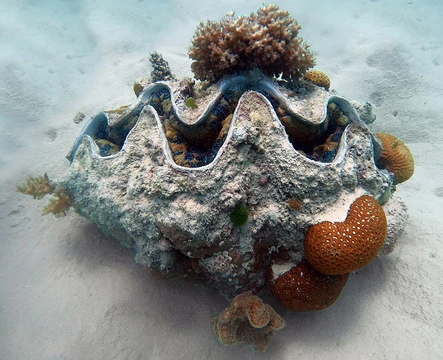
Annachlamys flabellata
A scallop with partial protandric sex reversal and pink, orange or mauve ribs.
Last updated
It grows to between 6 cm and 10 cm in length and has a circular, inequivalve shell with 18 to 20 broad radial ribs.[1] A marine bivalve mollusc belonging to the Pectinidae family, Annachlamys flabellata is a type of scallop.[2]
Scientific classification
- KingdomAnimalia
- PhylumMollusca
- ClassBivalvia
- OrderPectinida
- FamilyPectinidae
- GenusAnnachlamys
- SpeciesAnnachlamys flabellata
Named by (Lamarck, 1819)
Sources: Wikipedia taxobox: Annachlamys flabellata (CC BY-SA 4.0) · order, family and genus agree with WoRMS AphiaID 393954 (CC BY 4.0)
Where the annachlamys flabellata has been recorded
Each dot is a place where the species has been observed and reported (1,007 records, half-degree grid) — not a modelled range. 32 inland records left out (institution coordinates). 3 isolated far-off records not drawn.
Map: drawn by Codexery. Data: GBIF occurrence search (records CC0 / CC BY) · Natural Earth basemap (public domain)
Quick Facts
- Species
- flabellata
Facts from the source article.
Key facts and history
Two broad auricles extend on either side of the umbones, and the hinge line is straight and aligned with the umbones.[1] Concentric growth rings provide additional sculpturing on the shell.[1] Compared to the similar Annachlamys reevei, the inter-rib spaces are narrower.[1] A red tinge or a concentric ring of red dots is often present on the interior of the valve.[1]
Sexual maturity is reached at a length of about 4.5 cm.[3]
What the cited sources add
The same study reported that spawning shows no correlation to sea temperature, salinity changes, or moon phases, and that mature male gonads are cream colored while female gonads are bright red.[3] When ripe, the gonads enlarge and obscure the digestive tract in live animals.[3] External fertilization produces eggs that develop into trochophore larvae, then into veliger larvae which disperse via currents.[3]
References
- Wikipedia, "Annachlamys flabellata" (CC BY-SA 4.0), which cites: Annachlamys flabellata Pecten site. Retrieved 2012-01-06.; Annachlamys flabellata (Lamarck, 1819) Smithsonian: National Museum of Natural History. Retrieved 2012-01-06. (original not read by us) en.wikipedia.org
- Wikipedia, "Annachlamys flabellata" (CC BY-SA 4.0), which cites: Dijkstra, Henk, "Annachlamys flabellata (Lamarck, 1819)", 2010 (original not read by us) en.wikipedia.org
- Wikipedia, "Annachlamys flabellata" (CC BY-SA 4.0), which cites: Lefort, Yves and Jacques Clavier, "Reproduction of Annachlamys flabellata, Comptopallium radula and Mimachlamys gloriosa (Mollusca: Pectinidae) in the south-west lagoon of New Caledonia", Aquatic Living Resources, 1994, (original not read by us) en.wikipedia.org
Each numbered sentence above was checked against the source it cites before publication. Sentences citing Wikipedia adapt text from the English Wikipedia article Annachlamys flabellata (contributors), used under CC BY-SA 4.0; this entry is available under the same licence. Other sources were used for facts only; no text or images are copied from them.
More in Giant Clams and Marine Bivalves
Sources
Compiled from Wikipedia and the sources listed below. Text from Wikipedia is available under CC BY-SA 4.0; this entry is adapted from it.
- Wikipedia: Annachlamys flabellata (CC BY-SA 4.0).
- Classification: the source article's taxobox; order, family and genus checked against WoRMS, the World Register of Marine Species (CC BY 4.0).
- Occurrence records: GBIF (CC0 / CC BY). Basemap: Natural Earth (public domain).
- Word definitions: the Codexery glossary, each quoted from its Wikipedia article.
Spotted an error? Know more?
Reader corrections go straight into our review queue. Suggest an edit · How this site is sourced