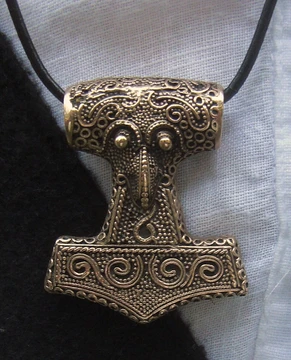
Heathenry (new religious movement)
Last updated
Heathenry, also known as contemporary Germanic Paganism, is a modern pagan new religious movement that seeks to revive the pre-Christian religions of the Germanic peoples. It emerged in early 20th-century Europe and is notable for its polytheistic theology, emphasis on historical reconstruction, and internal divisions over race and ethnicity.
Quick Facts
- Typical group size
- 5 to 15 members
- Gender composition
- 60–70% male in most groups
- Lgbt proportion
- 21%
- Transgender proportion
- 2%
Facts from the source article.
History
Heathenry's origins lie in late 18th- and 19th-century German Romanticism, which glorified pre-Christian Germanic societies. Romanticist intellectuals such as Johann Gottfried Herder, Jacob Grimm, and Wilhelm Grimm promoted these traditions as more natural and organic than Christianity, contributing to the Völkisch movement. In 1900, the Germanist Ernst Wachler called for reviving a racialized ancient German religion. This led to the formation of groups such as the Bund für Persönlichkeitskultur and the Deutscher Orden in 1911, and the Germanische-Deutsche Religionsgemeinschaft in 1912.
List's ideas spread through right-wing groups including the Reichshammerbund and the Germanenorden, from which the Thule Society emerged. In 1933, the German Faith Movement was founded by Jakob Wilhelm Hauer to unite disparate Heathen groups, but it was not declared the official faith of Nazi Germany. Heathenry probably never had more than a few thousand followers during its 1920s heyday, but it exerted wider influence through middle-class intellectuals.
Definition
Heathenry is classified by scholars of religion as a new religious movement and a reconstructionist form of modern Paganism. It is defined as a broad contemporary Pagan new religious movement consciously inspired by the linguistically, culturally, and in some definitions ethnically Germanic societies of Iron Age and early medieval Europe prior to Christianization. Some also draw on archaeological evidence and later folklore, collectively termed the Lore.
These sources are problematic because they were written by Christians and present pre-Christian traditions in a fragmentary, biased manner. The anthropologist Jenny Blain characterizes Heathenry as a religion constructed from partial material, while the religious studies scholar Michael Strmiska describes its beliefs as riddled with uncertainty and historical confusion. Approaches to the material vary: some practitioners seek accurate reconstruction, while others embrace innovation and adapt practices based on unverified personal gnosis or influences from surviving polytheistic religions such as Hinduism and Afro-American religions.
Some practitioners critical of these approaches dismiss eclecticism with the pejorative term Neo-Heathen. Certain Heathens focus on specific geographical or chronological areas, such as Anglo-Saxon England or Viking Age Iceland, while others use elements common across the Germanic-speaking world. Many practitioners romanticize the past, hearkening back to an epic age of ancestors and heroes.
Beliefs
There is no unanimously accepted theology within Heathenry. The religion is usually polytheistic, exhibiting a pantheon of gods and goddesses from pre-Christian Germanic Europe, including Týr, Odin, Thor, Frigg, and Freyja from Scandinavian sources; Wōden, Thunor, and Ēostre from Anglo-Saxon sources; and figures such as Nehalennia from continental sources.
Some practitioners adopt the Norse mythological division of deities into the Æsir and Vanir. Most adherents are polytheistic realists, believing in the literal existence of the deities as individual entities, while others view them as symbols, Jungian archetypes, or racial archetypes, with some deeming themselves atheists. Some groups focus on a particular deity, and many practitioners adopt a patron deity through an oath of dedication known as fulltrúi, describing themselves as that entity's devotee.
Rites and practices
Heathen groups are called kindreds, hearths, fellowships, tribes, or garths, typically containing between five and fifteen members bound by oaths of loyalty. Screening procedures regulate admittance, and some groups remain closed to new members. Kindreds are largely autonomous but often network with other groups. Many practitioners are solitary, communicating through social media.
Priests are called godhi and priestesses gydhja, terms meaning god-man and god-woman; they facilitate and lead ceremonies rather than acting as intermediaries. Some kindreds allow any member to lead rites, while others require formal credentials. Rites often take place in non-public spaces such as homes or on purchased land, which may be a hörg (a sanctified natural place) or a hof (a wooden temple). Heathens have built hofs in several parts of the world, including the Ásaheimur Temple in Efri Ás, Skagafjörður, Iceland, and a temple in a converted 16th-century chapel in Newark, Nottinghamshire.
Archaeological sites such as the Nine Ladies stone circle, the Rollright Stones, and the White Horse Stone in Britain, Gamla Uppsala in Sweden, and Þingvellir in Iceland are also used as places of worship.
Did You Know?
- Heathenry has a greater proportion of LGBT practitioners (21%) than the general population.
- Some Heathen groups focus on a particular deity, such as the Brotherhood of Wolves centering on Fenrir.
- A 2015 survey found that globally, most Heathens were solitary practitioners.
More in Germanic Neopaganism
Sources
Compiled from Wikipedia and the sources listed below. Text from Wikipedia is available under CC BY-SA 4.0; this entry is adapted from it.
- Wikipedia: Heathenry (new religious movement) (CC BY-SA 4.0).
Spotted an error? Know more?
Reader corrections go straight into our review queue. Suggest an edit · How this site is sourced