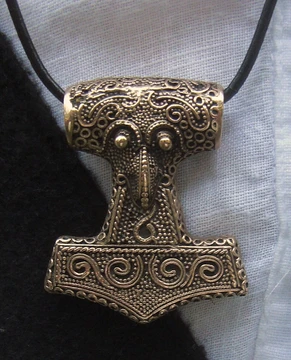
Heathenry in the United Kingdom
Last updated
Heathenry in the United Kingdom encompasses modern pagan movements that seek to revive pre-Christian Germanic religiosities, including those practiced by Anglo-Saxon and Nordic peoples before Christianisation. It is notable for its diversity and the independent development of small groups, often called kindreds or hearths, which maintain contact through networking and the internet.
Quick Facts
- Asatru uk founding moot
- 2013
- Heathenfest location
- Peterborough
- Heathenfest start year
- 2005
Facts from the source article.
Religious belief and practice
Most modern heathens operate in small groups, often called kindreds or hearths, which tend to develop their own approaches independently. The most evident ritual forms are the blot and the sumble. A blot involves offerings to ancestors, land wights, elves, or gods, typically using personal items or mead rather than animal sacrifice. A sumble is always a community event, featuring rounds of toasting, drinking from a horn, and oath-swearing.
Demographics
In the 2001 UK census, 300 people in England and Wales registered as Heathen, with 278 Heathen and 92 Asatru across the UK. Many Heathens followed Pagan Federation advice to describe themselves simply as "Pagan", while others did not specify. The 2011 census allowed self-description as Pagan-Heathen, yielding 1,958 Heathen in England and Wales, plus 251 who identified as Reconstructionist, some possibly reconstructing Germanic paganism.
Heathen groups
Asatru UK (AUK) is an inclusive Heathen community that does not exclude individuals based on gender, sexuality, or ethnicity, representing the mainstream of Heathenry. It organised its first moot in York in 2013 and became a community interest company for religious activities in 2022. The group is run by volunteers and typically holds three moots a year around the country. AUK is open to anyone following Heathenry regardless of nationality or ancestry and has condemned groups such as Woden's Folk, stating opposition to fascist movements using Heathen symbols for hate.
It is a member of the Asatru-EU Network, alongside groups like Samfundet Forn Sed Sverige and Eldaring. In 2015, network members including AUK released a shared statement committing to Asatru as a non-exclusive religious approach and affirming that Heathenry is open to everyone. They vet potential members for far-right associations or unwillingness to practice with transgender, homosexual, or ethnically diverse individuals. AUK does not own land and is carving portable god posts for use in a vé; an Odin post was consecrated in 2021 and a Freyja post in 2022.
Members have hosted or been guests on podcasts promoting accurate information about Germanic Paganism and inclusion of diverse backgrounds. The group also participated in the Norse in the North conference in 2023, discussing mutual benefits between Heathenry and Old Norse scholarship.
Organisation and events
By 2005, Pagan moots commonly included a small number of Heathens, though many Odinists distanced themselves from the wider Pagan movement, which they saw as dominated by Wicca. The internet unified the British Heathen movement through sites like UKHeathenry and Midgard's Web, and social media boosted Asatru UK's popularity.
Heathens helped create the Association of Polytheist Traditions and the International Asatru Summer Camp (IASC), a European coalition; Asatru UK and the Kith of the Tree and the Well are signatories. An annual gathering called Heathenfest ran at Peterborough from 2005, and The Asgardian Heathen Festival was held from 2015 to 2019. Asatru UK now holds at least one large event per year.
More in Germanic Neopaganism
Sources
Compiled from Wikipedia and the sources listed below. Text from Wikipedia is available under CC BY-SA 4.0; this entry is adapted from it.
- Wikipedia: Heathenry in the United Kingdom (CC BY-SA 4.0).
Spotted an error? Know more?
Reader corrections go straight into our review queue. Suggest an edit · How this site is sourced