
Archiv Produktion
German classical label specializing in Early and Baroque music.

Unknown author · Public domain
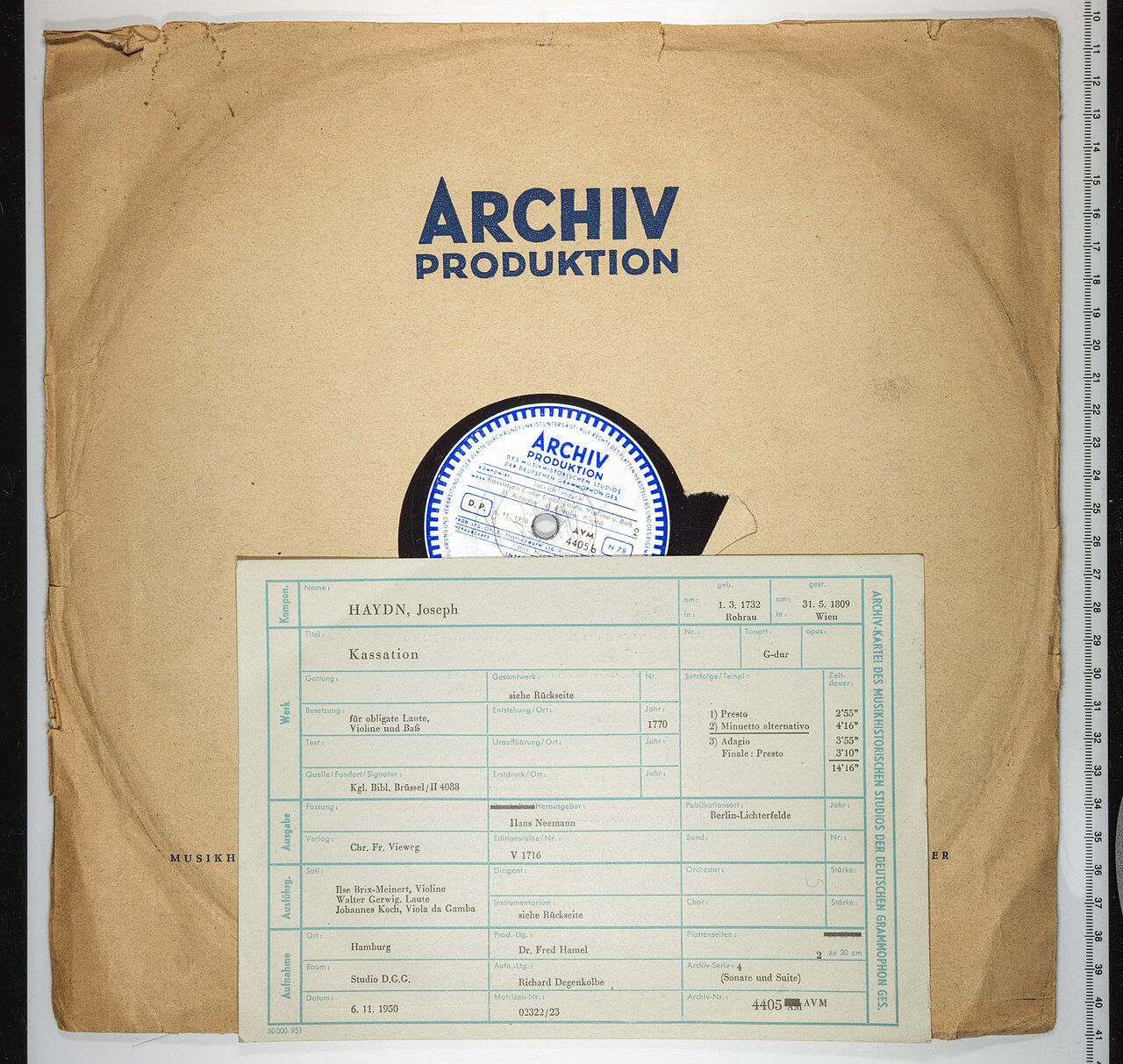
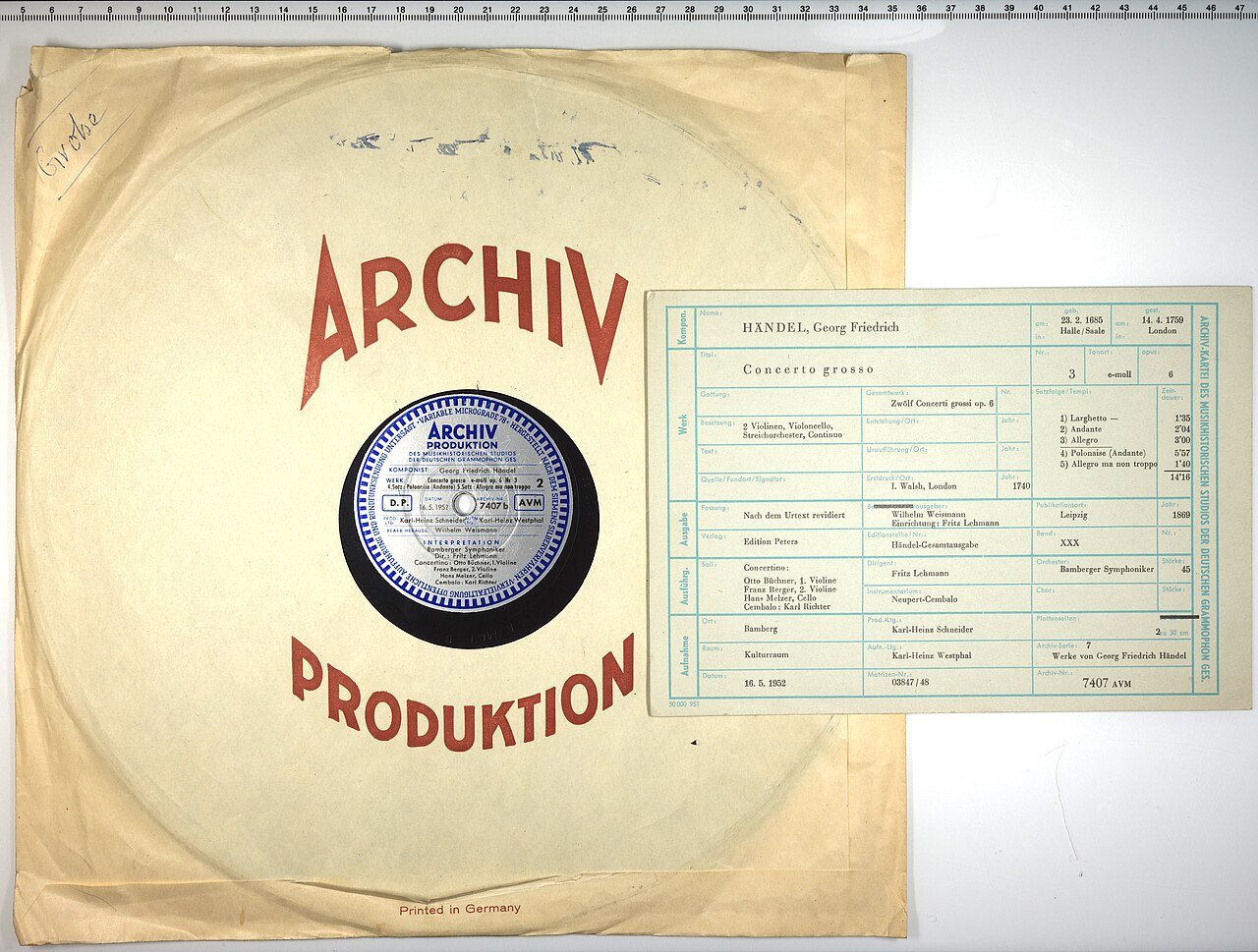
Archiv Produktion is a classical music record label of German origin, established in 1948 as a classical label for the Deutsche Grammophon Gesellschaft (DGG). In 1958 it became a subsidiary of DGG, specializing in recordings of Early and Baroque music, and later developed a focus on historically informed performance and the Early music revival movement of the 20th and 21st centuries.
- field
- Classical music record label
- nationality
- German
- known_for
- Early and Baroque music recordings, historically informed performance
- founded
- 1948
- founder
- Fred Hamel
Lore & Background
Archiv Produktion originated in 1948 as a classical label for the Deutsche Grammophon Gesellschaft (DGG). Its first head was musicologist Fred Hamel, who served from 1948 to 1957 and organized early releases according to 12 research periods, from Gregorian Chant to Mannheim and Vienna. Hamel's successor from 1958 to 1968 was Hans Hickmann, a professor at the University of Hamburg who focused on Bach and Handel. The next director, Andreas Holschneider, served from 1970 to 1991; in December 1991 he gave an interview to Gramophone defending the label's entry into Romantic territory with artists such as John Eliot Gardiner. Peter Czornyj became head in 1992.
Reader's Guide
Archiv Produktion's significance lies in its pioneering role in the Early music revival, issuing recordings that emphasized historically informed performance. Its first recording, of Helmut Walcha playing Bach in 1947 (released 1948), set a standard; Walcha later made two complete series of Bach's organ works. The label built a catalog of key artists across decades, including Ralph Kirkpatrick, the Schola Cantorum Basiliensis, Karl Richter, Musica Antiqua Köln, The English Concert, and the Monteverdi Choir under John Eliot Gardiner. In the 1990s, it expanded into Romantic repertoire, as defended by Holschneider. The label's legacy includes a vast discography of early music that influenced performance practice. In parallel, Decca Records acquired the rights to the Éditions de l'Oiseau-Lyre catalog in 1970 and issued early music recordings under that brand.
Did You Know?
- Archiv Produktion's first release was a recording of the 'Missa in tempore belli' by Joseph Haydn, conducted by Eugen Jochum, released in 1948.
- The first head of Archiv Produktion, Fred Hamel, organized early releases into 12 research periods from Gregorian Chant to Mannheim and Vienna.
- In December 1991, director Andreas Holschneider defended the label's entry into Romantic territory with artists like John Eliot Gardiner.
- Decca Records acquired the rights to the Éditions de l'Oiseau-Lyre catalog in 1970 and issued early music recordings under that brand.
Origins and the Scholarly Foundation
Archiv Produktion traces its roots to 1948, when it was launched as a classical music imprint under the Deutsche Grammophon Gesellschaft umbrella. Its very first release was a 1947 recording of Helmut Walcha performing Bach, issued to the public in 1948. The label's first head, musicologist Fred Hamel, guided releases from 1948 to 1957 by organizing them into twelve research periods spanning from Gregorian Chant through to Mannheim and Vienna. In 1958, Archiv was formally established as a DGG subsidiary with a clear specialization in Early and Baroque music. Hans Hickmann, a professor at the University of Hamburg, took the helm from 1958 to 1968, steering the catalogue toward Bach and Handel. This early scholarly framework gave the label an identity distinct from its parent company, one rooted in musicological rigor rather than commercial breadth, and set a precedent for the decades of period-music specialization that followed.
The Historically Informed Performance Revolution
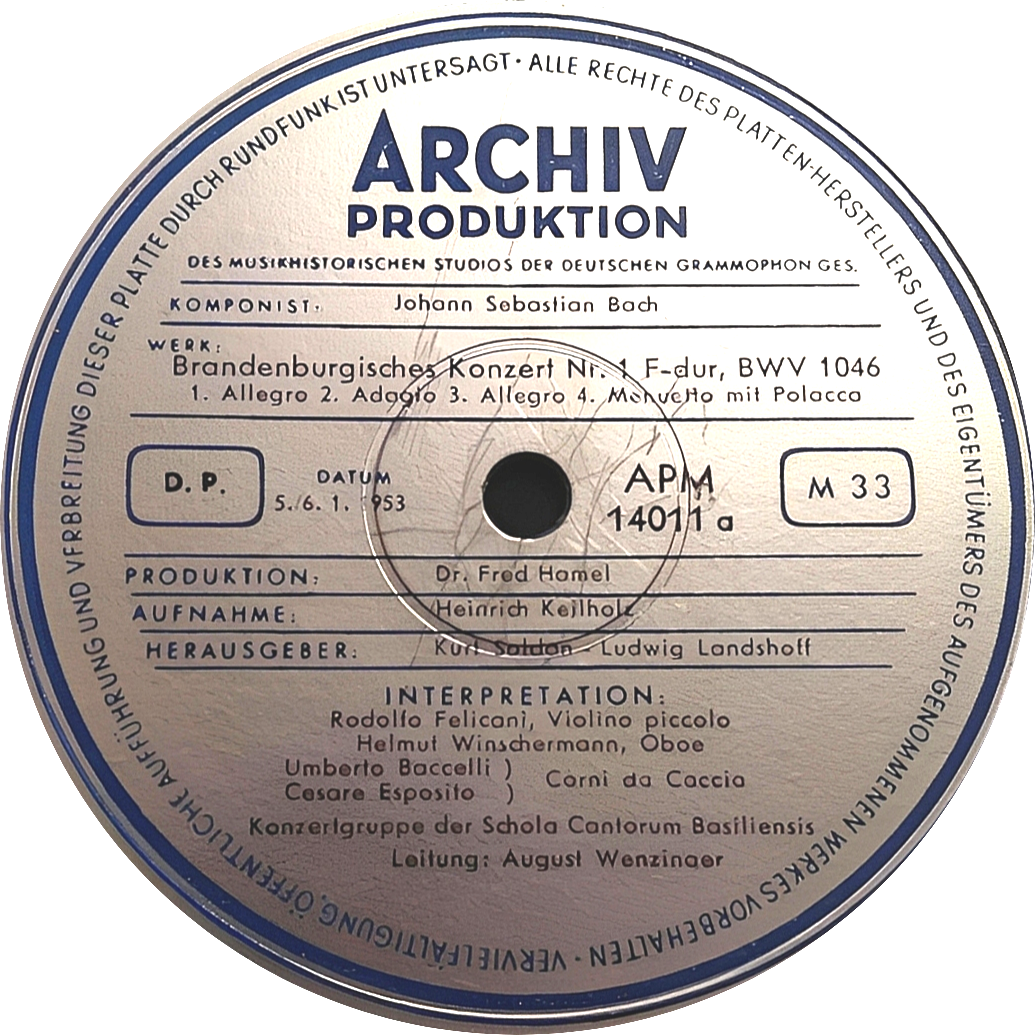
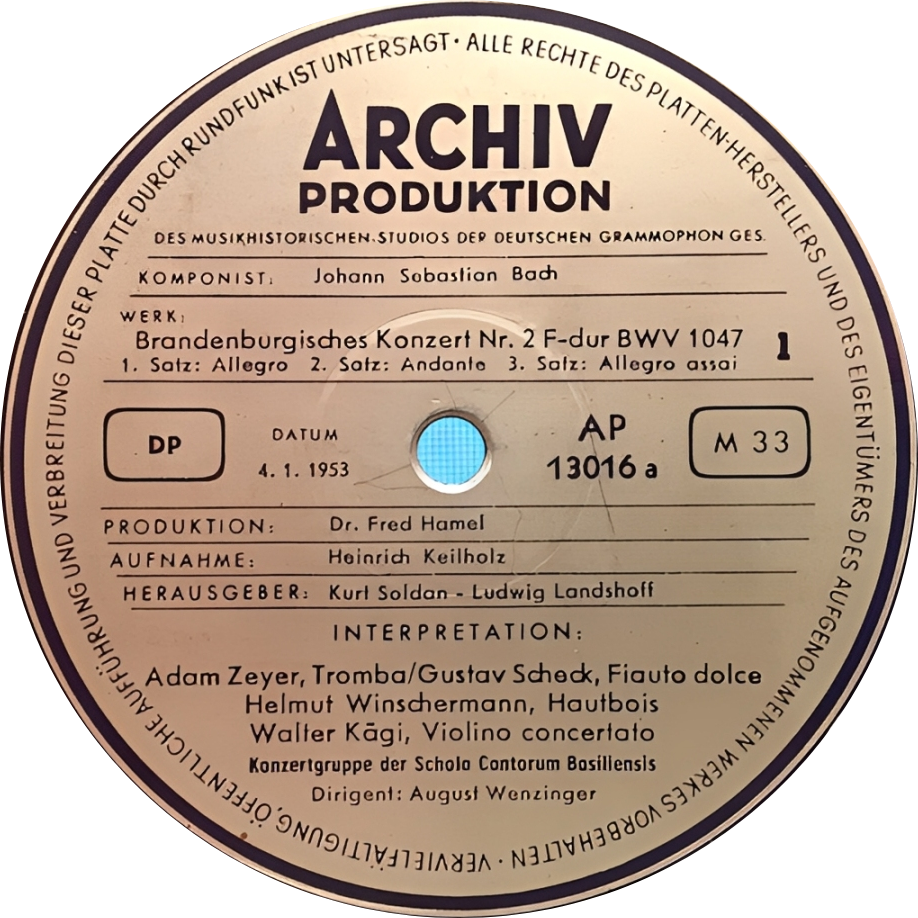
Over the decades, Archiv Produktion became synonymous with historically informed performance and the broader early music revival movement of the twentieth and twenty-first centuries. The label's catalogue grew to encompass artists working on period instruments and historically grounded interpretations, from the Schola Cantorum Basiliensis under August Wenzinger in the 1950s to Trevor Pinnock's English Concert and John Eliot Gardiner's Monteverdi Choir in the 1980s. A defining moment came in December 1991, when director Andreas Holschneider told Gramophone that he defended the entry of 'authentic instrument' specialists like Gardiner into Romantic repertoire such as Schumann and Berlioz. This stance signaled that historically informed performance was no longer confined to pre-Classical music but could inform a far wider range of the Western canon, a position that set Archiv apart from competitors and cemented its reputation as a label of intellectual ambition.
A Constellation of Artists Across Seven Decades
The roster of artists associated with Archiv Produktion reads like a who's who of early music performance. Helmut Walcha recorded two complete series of Bach's organ output for the label—one in mono between 1947 and 1952, another in stereo in the late 1960s and early 1970s—both released to wide acclaim and later reissued on CD. Fine Krakamp contributed solo harpsichord recordings of Buxtehude and Krieger as early as 1948. The 1960s brought Karl Richter with the Münchener Bach-Chor and Münchener Bach-Orchester, Dietrich Fischer-Dieskau, and cello and viola da gamba work by Pierre Fournier. The 1970s featured Charles Mackerras, Heinz Holliger's Camerata Bern, and Pro Cantione Antiqua's long series of fifteenth- and sixteenth-century polyphony. The 1980s and 1990s added Reinhard Goebel's Musica Antiqua Köln, Marc Minkowski's Musiciens du Louvre (debuting with Rameau's Hippolyte et Aricie in 1994), and Paul McCreesh's Gabrieli Consort. By the 2010s, artists like Andrea Marcon, Giuliano Carmignola, and Mahan Esfahani continued the tradition.
Leadership and Institutional Evolution
The trajectory of Archiv Produktion can be traced through its succession of directors, each imprinting a distinct character on the label. Fred Hamel, a musicologist, laid the scholarly groundwork from 1948 to 1957 by structuring releases around twelve historical research periods. Hans Hickmann, a Hamburg professor, narrowed the focus to Bach and Handel during his 1958-to-1968 tenure. Andreas Holschneider (1931–2019) guided the label from 1970 to 1991, a period during which it became a leading home for historically informed performance and period-instrument ensembles. His 1991 Gramophone interview, in which he championed 'authentic instrument' players venturing into Romantic territory, marked a philosophical broadening of the label's scope. Peter Czornyj, born in 1956, assumed the directorship in 1992 and has steered the imprint through the subsequent decades, overseeing releases by ensembles and soloists as diverse as the Orlando Consort, Pomerium, Piffaro, Il Complesso Barocco under Alan Curtis, and the Venice Baroque Orchestra. The label's German origin and its parentage within Deutsche Grammophon have provided institutional stability even as its artistic mission evolved.
Gallery
Frequently Asked Questions
What is Archiv Produktion?
Archiv Produktion is a German classical music record label founded in 1948 by Fred Hamel. It operates as a subsidiary of Deutsche Grammophon and is best known for its catalog of Early and Baroque repertoire.
Who founded Archiv Produktion and when?
Fred Hamel established the label in 1948 as a classical imprint under Deutsche Grammophon Gesellschaft. It was formally made a DGG subsidiary in 1958.
What genres does Archiv Produktion specialize in?
The label focuses almost exclusively on Early music and Baroque-era recordings. It is particularly associated with the historically informed performance approach that defines modern early music practice.
What is the relationship between Archiv Produktion and Deutsche Grammophon?
Archiv Produktion began in 1948 as a classical label created for Deutsche Grammophon Gesellschaft and became an official DGG subsidiary in 1958. It functions as DGG's dedicated arm for early and historically informed recordings.
Why does Archiv Produktion matter to the early music revival?
The label has served as a central publishing home for the 20th- and 21st-century early music revival, giving a platform to performers who champion historically informed interpretation. Its catalog helped bring Baroque and pre-Classical repertoire to a wide international audience.
More in German record labels 1-24
Spotted an error? Know more?
This is a living reference — every entry is fact-audited, and reader corrections feed straight into our audit queue. Suggest an edit · See this site's audit record