
Anker-Record
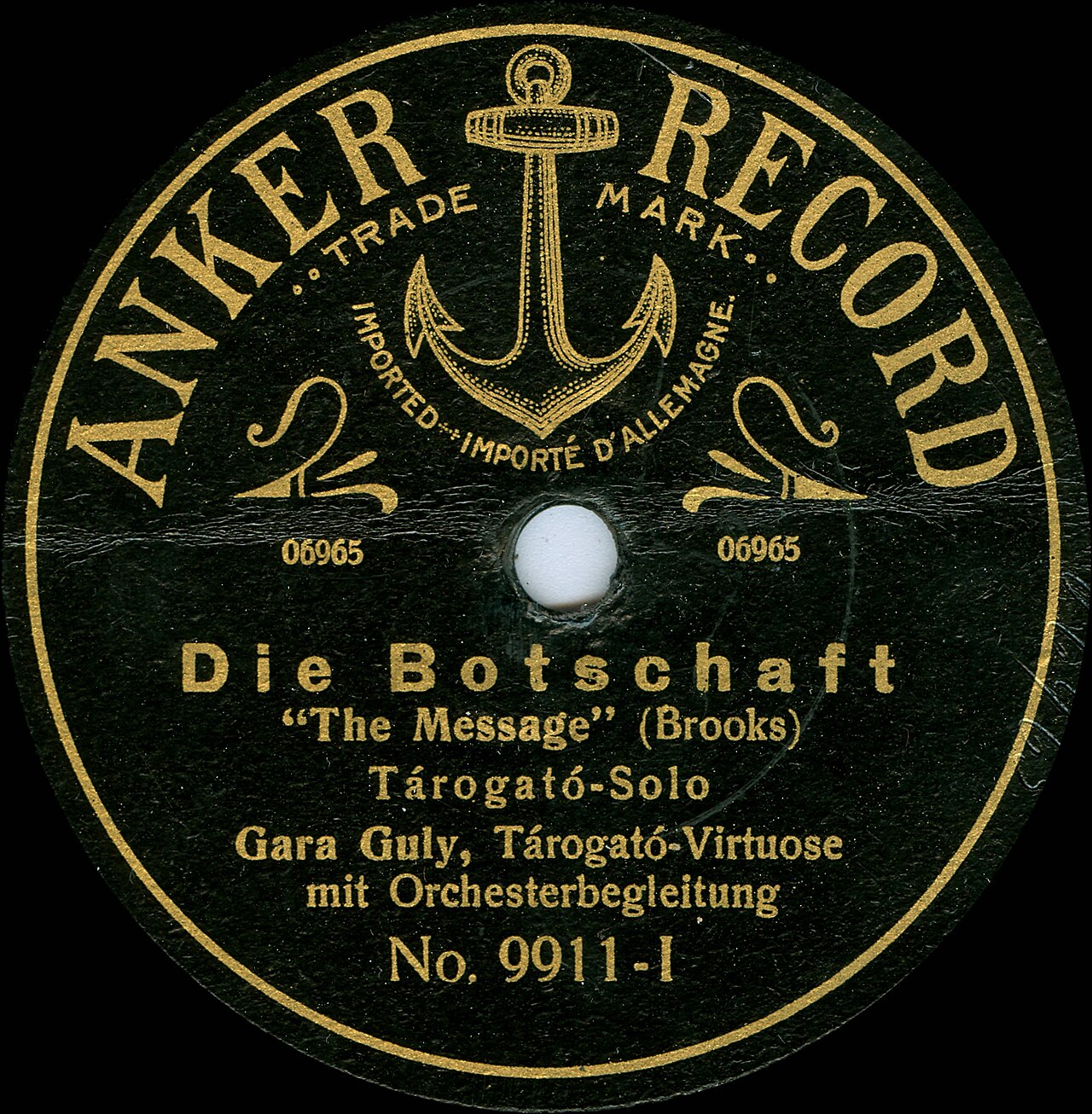
Early 20th-century shellac records bearing an anchor logo.

War Department. The Adjutant General's Office. 3/4/1907-9/18/1947 · Public domain
Anker–Record (also written as Anker-Rekord) was a trademark for early 20th-century shellac gramophone records. Its disc labels sometimes displayed a stylized anchor logo, along with the piece's title, the performer's name, and a sequential catalog number. The trademark originally belonged to F. Adolf Richter & Co. in Rudolstadt, Thuringia. Up to 1906, recordings were produced by National Phonogramm GmbH in Berlin. Starting in December 1907, manufacturing and sales moved to the Berlin-based Anker Phonogramm Gesellschaft. Later, Anker Rekord discs and the patented "Anker-Resonanz-Sprechapparate" gramophones were sold together with products from the Kalliope label through the Berlin firm Menzenhauer & Schmidt, owned by Henry Langfeld. Kalliope Musikwerke AG went insolvent in 1914 and was liquidated in 1917; around 1910-1911, Menzenhauer & Schmidt took over both the Anker and Kalliope brands. The Anker trademark belonged to the same Rudolstadt firm founded by Friedrich Adolf Richter, which also produced Anchor Stone building blocks and "Anker-Pain-Expeller" patent medicine. The Neue Deutsche Biographie notes that from 1876 the company's product line already included music automatons, music boxes, and mechanical phonograph records.
- field
- Gramophone records (shellac records)
- trademark_origin
- F. Adolf Richter & Co., Rudolstadt, Thuringia
- known_for
- Anker-branded shellac records with anchor logo
- associated_brands
- Kalliope
- production_period
- Early 20th century (recordings until 1906; production from December 1907)
Lore & Background
The Anker trademark was originally used by the firm F. Adolf Richter & Co. in Rudolstadt, Thuringia. Recordings were made until 1906 by the Berlin-based National Phonogramm GmbH. From December 1907, production passed to the Anker Phonogramm Gesellschaft, based in Berlin, which recorded the music and also handled sales of the records. Later, 'Anker Rekord' discs, together with the patent-protected 'Anker-Resonanz-Sprechapparate' (a type of gramophone), were manufactured and sold jointly with products of the record label Kalliope, through the Berlin firm Menzenhauer & Schmidt (owner Henry Langfeld). Around 1910-1911, Menzenhauer & Schmidt took over both the Anker and Kalliope brands.
Reader's Guide
Anker–Record represents a notable early 20th-century German trademark in the history of recorded sound, bridging the worlds of toy manufacturing and music. The anchor emblem, already famous from Friedrich Adolf Richter's Anker-Steinbaukasten building blocks and patent medicine, was extended to shellac records, linking industrial production with entertainment. The brand's significance lies in its connection to the broader Richter industrial empire, which from 1876 already produced music automatons, music boxes, and mechanical phonograph records. The eventual merger with Kalliope and takeover by Menzenhauer & Schmidt illustrates the consolidation of early record labels. Anker–Record's legacy is as a niche but illustrative example of how established trademarks diversified into the nascent recording industry, though its specific recordings and performers remain largely obscure outside specialist collections.
Did You Know?
- The label sticker at times featured a stylized anchor as its logo.
- Recordings were made until 1906 by the Berlin-based National Phonogramm GmbH.
- From December 1907, production passed to the Anker Phonogramm Gesellschaft in Berlin.
- The Anker trademark also appeared on Anker-Steinbaukasten building blocks and Anker-Pain-Expeller patent medicine.
Brand Identity & the Anchor Emblem
Anker-Record, also rendered Anker-Rekord, was a trademark applied to gramophone records during the early twentieth century. These were shellac discs, the standard medium of the era before later formats took hold. The label sticker affixed to each disc carried a distinctive visual identity: a stylized anchor served as the logo, immediately associating the product with the broader Anker brand family. Beyond the emblem, the sticker provided practical information for the listener and collector alike—the title of the recorded piece, the name of the performer, and a running serial number that identified the specific title within the catalogue. This combination of branding and cataloguing detail was typical of the period's record labels, but the anchor motif gave Anker-Record a recognizable visual signature on the turntable. The dual spelling, Anker-Record and Anker-Rekord, reflects the German-language market in which the label operated and the commercial reach it sought within that space.
Corporate History & Production Transitions
The production history of Anker-Record records spans several corporate entities over roughly two decades. The trademark was originally held by F. Adolf Richter & Co., a firm based in Rudolstadt, Thuringia. Actual recording work was carried out until 1906 by National Phonogramm GmbH, a Berlin-based company. In December 1907, operations shifted to the Anker Phonogramm Gesellschaft, also in Berlin, which took on both the recording of music and the sales of the finished records. Later, the Anker Rekord discs were manufactured and sold jointly alongside products of the Kalliope record label, with the Berlin firm Menzenhauer & Schmidt—owned by Henry Langfeld—handling the combined operation. Kalliope Musikwerke AG entered insolvency in 1914 and was liquidated in 1917. By 1919, Menzenhauer & Schmidt had absorbed both the Anker and Kalliope brands into their own portfolio, consolidating what had been a partnership into a single ownership structure.
The Richter Empire & the Anchor Brand
The anchor emblem on Anker-Record discs was not an isolated branding choice but part of a much wider industrial identity. The trademark belonged to the same Rudolstadt firm founded by Friedrich Adolf Richter, which marketed a diverse range of consumer goods under the anchor symbol. Among these were the well-known Anker-Steinbaukasten, a line of Anchor Stone building blocks, and the Anker-Pain-Expeller, a patent medicine. The Neue Deutsche Biographie confirms that as early as 1876, the firm's product catalogue already included music automatons, music boxes, and mechanical phonograph records, indicating that the company's involvement in musical entertainment predated the gramophone era by several decades. This long-standing presence in mechanical music production positioned the Richter firm as a natural candidate to enter the shellac disc market when gramophone technology matured in the early 1900s. The anchor thus functioned as a unifying brand mark across toys, medicine, and recorded music.
The Gramophone & Playback Ecosystem
Anker-Record did not exist in isolation from the playback technology that gave its discs meaning. The Anker-Resonanz-Sprechapparate, a patent-protected type of gramophone, was manufactured and sold alongside the records, creating a closed ecosystem in which the consumer could purchase both the disc and the device to play it. This gramophone was produced and distributed jointly with Kalliope label products through the Berlin firm Menzenhauer & Schmidt, under the ownership of Henry Langfeld. The partnership meant that Anker and Kalliope shared manufacturing and sales channels, effectively presenting a combined catalogue of recordings and hardware to the early-twentieth-century German market. When Kalliope Musikwerke AG fell into insolvency in 1914 and was subsequently liquidated in 1917, the joint arrangement was disrupted, and in 1919 Menzenhauer & Schmidt took over both the Anker and Kalliope brands, absorbing the full product range into a single commercial entity.
Gallery
Frequently Asked Questions
What was Anker-Record?
Anker-Record (also spelled Anker-Rekord) was a trademark for shellac gramophone records from the early 1900s. The name originally belonged to F. Adolf Richter & Co., a firm based in Rudolstadt, Thuringia.
Who actually pressed the Anker-Record discs?
Recordings were produced by National Phonogramm GmbH in Berlin up through 1906. From December 1907 onward, both manufacturing and sales were handled by the Berlin-based Anker Phonogramm Gesellschaft.
What did an Anker-Record label look like?
The disc face typically carried a stylized anchor emblem alongside the piece's title, the performer's name, and a sequential catalog number.
What other names or products were linked to the Anker brand?
The label was associated with the Kalliope brand, and the company also marketed patented 'Anker-Resonanz-Sprechapparate,' which were resonance-based sound-reproduction devices.
How long was Anker-Record active?
The imprint operated in the early 20th century, with recordings produced until 1906 and full production and distribution commencing in December 1907 under the Anker Phonogramm Gesellschaft.
More in German record labels 1-24
Spotted an error? Know more?
This is a living reference — every entry is fact-audited, and reader corrections feed straight into our audit queue. Suggest an edit · See this site's audit record