Meissen porcelain
First European hard-paste porcelain, established 1710 in Meissen.
Last updated
Meissen porcelain, also known as Meissen china, was the first European hard-paste porcelain. Its production began in 1710 at a royal factory in Meissen, near Dresden, financed by Augustus the Strong. The factory's crossed-swords mark, introduced in 1720, is one of the oldest trademarks in existence.
Quick Facts
- First production
- 1710
- Location
- Meissen, near Dresden
- Founding patron
- Augustus the Strong, King of Poland and Elector of Saxony
- Key early experimenter
- Ehrenfried Walther von Tschirnhaus (1708)
- Commercial developer
- Johann Friedrich Böttger
- Trademark introduced
- 1720 (crossed swords)
- Current operator
- Staatliche Porzellan-Manufaktur Meissen GmbH (since 1991)
Facts from the source article.
Beginnings
Chinese and Japanese export porcelain, imported by the Dutch East India Company and others, was extremely expensive in Europe and symbolized wealth and taste. European attempts to replicate it, such as Medici porcelain in Florence, had failed. At the start of the 18th century, Johann Friedrich Böttger claimed he could make gold from worthless materials; King Augustus II of Poland kept him in custody to produce gold, which Böttger could not do. Meanwhile, Ehrenfried Walther von Tschirnhaus experimented with glass and porcelain, using kaolin, the essential ingredient for true porcelain, though he could not succeed with it.
Tschirnhaus supervised Böttger, who reluctantly joined the experiments by 1707. He refined the formula, and with Dutch co-workers experienced in firing and painting tiles, production was set. In 1709, the king established the Royal-Polish and Electoral-Saxon Porcelain Manufactory, placed Böttger's laboratory at Albrechtsburg castle in Meissen, and production officially began in 1710.
Early work
Böttger's first ware was a very hard red stoneware called Böttger ware, copying Chinese Yixing ware and used for teapots and coffee pots. It was harder than similar wares by the Dutch or the Elers brothers, retaining crisp detail in cast or applied decoration on bodies polished before firing. Models came from Baroque silver shapes and Chinese ceramics. A softer glazed and decorated stoneware also existed.
Hard-paste white porcelain that could be glazed and painted soon followed, reaching the market in 1713. Böttger's wares never achieved successful painted and fired decoration; early ornaments were gold applied on the fired body and engraved before a second firing. Lacy frameworks known as Laub- und bandelwerk in red, gold, or puce were common. Augustus II first charged Johann Jakob Irminger with vessel design.
In 1720 Johann Gregor Herold became director and in 1723 introduced brilliant overglaze colors, expanding the palette and beginning the classic phase of Meissen porcelain. His enamel paints remain the basis for modern ceramic paints. Early painting mostly imitated oriental designs, though some European landscapes appeared from early on.
Figures
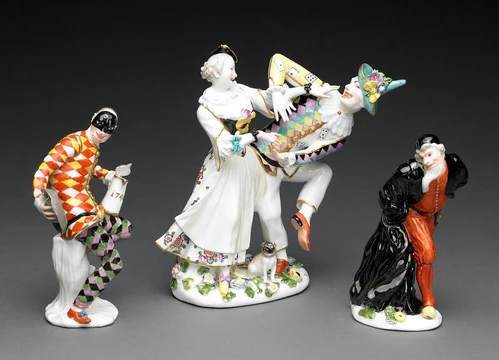
The earliest Meissen figurines included a small white statue of Augustus II the Strong, made under Böttger. Johann Joachim Kändler later created many of the factory’s most iconic pieces. These were first designed to replace sugar sculptures on grand dining tables, usually left white. They quickly became affordable living-room decorations, cheaper than a full dinner service and reaching a broader audience across regions and social ranks.
Kändler soon added bright paint, boosting their appeal. His human figures depicted courtiers, shepherds and shepherdesses (the Dresden shepherdess became a well-known phrase), commedia dell’arte characters, animals, and allegorical subjects like seasons, virtues, or continents, as well as figures in Chinese and Turkish costumes. More realistic urban workers came from print series of street vendors in Paris, London, and elsewhere. A large series of miners appeared in the 1750s.
Meissen’s style shaped other European porcelain factories, and the porcelain figure became a key Rococo object. Kändler also made a model of Augustus III of Poland on horseback, meant for a life-size city statue. A white Triumph of Amphitrite in Berlin is the only figure signed by Kändler.
Augustus II ordered a huge animal menagerie for his Japanese Palace in the 1720s; Kändler took over in 1733 and modeled most pieces, many far larger than usual, creating major technical challenges. The assembled group amazed visitors. Smaller animal figures, especially birds, were also popular.
Tableware patterns
Böttger foresaw tableware production, and the first services were made in the 1720s. Initial services were plain, but Kaendler soon introduced matching decorations. He produced the 1745 New Cutout pattern with a wavy edge and is presumed to have designed the much-copied osier pattern with a relief border imitating woven wicker. Small tea and coffee services were initially most produced, but from the 1730s large armorial porcelain dinner services were made, first for Augustus, then for other buyers in Germany and abroad, and used as diplomatic gifts.
Maria Amalia of Saxony, granddaughter of Augustus, married the king of Naples and Sicily (later Charles III of Spain); her dowry reportedly included 17 Meissen table services, inspiring the couple to found the Capodimonte porcelain factory in Naples. The most famous service is the Swan Service (Schwanenservice), made 1737–1743 for Count Heinrich von Brühl, eventually numbering over a thousand pieces. After World War II its pieces were scattered, but the pattern continues to be made from existing moulds.
The Möllendorff Dinner Service of the 1760s is another huge service divided among many collections. The Blue Onion pattern, effectively designed by Höroldt in 1739 and inspired by a Chinese bowl from the Kangxi period, has been in production for nearly three centuries and copied by over sixty companies; the German Supreme Court ruled in 1926 that the pattern was in the public domain. Court Dragon and Red Dragon patterns feature Chinese dragons in underglaze red with gilt details; a version was used in Hitler's Kehlsteinhaus retreat. Other popular patterns still in production include the Purple Rose and Vine-leaf patterns.
Did You Know?
- The Albrechtsburg was used to protect the secrets of porcelain manufacture, and few workers knew the full arcanum.
- Samuel Stöltzel, head craftsman at Meissen, sold the secret recipe involving kaolin to a competing Vienna factory in 1717.
- Count Camillo Marcolini ran the factory from 1774 to 1813, a period marked by Sèvres styles and unglazed biscuit porcelain.
More in German Porcelain
Sources
Compiled from Wikipedia and the sources listed below. Text from Wikipedia is available under CC BY-SA 4.0; this entry is adapted from it.
- Wikipedia: Meissen porcelain (CC BY-SA 4.0).
Spotted an error? Know more?
Reader corrections go straight into our review queue. Suggest an edit · How this site is sourced