Royal Porcelain Factory, Berlin
Royal Porcelain Manufactory Berlin, founded 1763 by Frederick the Great.
Last updated
The Royal Porcelain Factory in Berlin (Königliche Porzellan-Manufaktur, abbreviated as KPM) was founded in 1763 by King Frederick II of Prussia. Its origins lie in three private enterprises that, under crown patronage, attempted to establish porcelain production in Berlin from the mid-18th century. The company is known for its cobalt blue sceptre logo and for producing dishware forms and figurines, some of which have remained unchanged for over 200 years.
History
Before KPM was founded, two earlier attempts to establish a porcelain manufactory in Berlin had occurred. In 1751, wool manufacturer Wilhelm Caspar Wegely received a royal privilege to set up a manufactory, along with duty exemptions and a guarantee of no competition. He hired craftsmen from competitors and appointed Ernst Heinrich Reichard as chief modeller. Technical difficulties and the Seven Years’ War between Prussia and Saxony led to the enterprise's failure, and in 1757 Wegely dissolved the company, selling its inventories and equipment to Berlin businessman Johann Ernst Gotzkowsky.
In 1761, Gotzkowsky started a second manufactory, reaching an agreement with Reichard, who held the secret arcanum formula. Reichard received 4,000 thaler for the arcanum and 3,000 for stock and materials, and agreed to work as keeper of the arcanum and manager.
Gotzkowsky appointed Friedrich Elias Meyer, a pupil of Meissen's Johann Joachim Kändler, as chief modeller, and Carl Wilhelm Boehme as head of the painting department. However, Gotzkowsky's finances deteriorated, and the end of the war also ended his manufactory. Porcelain pieces marked with a W for Wegely or a G for Gotzkowsky are now rare collector's items.
Brand
When Frederick the Great took over the manufactory from Johann Ernst Gotzkowsky on 19 September 1763, he provided the brand emblem: the cobalt blue sceptre from the electoral coat-of-arms of Brandenburg. The mark is applied after the first firing and before glazing, following strict quality control. Initially, the trademark was applied in blue on white porcelain and in brown on painted porcelain. In 1837, the letters KPM were added to protect against counterfeits, and later the royal Prussian eagle became part of the trademark.
During production in Selb (1944–1957), an “S” was placed under the sceptre. In 2000, the letters KPM were reintroduced.
Since 1803, painted porcelain has received an additional overglaze mark confirming décor authenticity; today an imperial orb is usually stamped next to the sceptre. The orb's colour indicates décor type: red for floral and figurative scenes, green for non-floral decorative elements, blue for high-temperature dishwasher-safe items, and black for printed décor. All painted pieces are signed by the painter.
Products
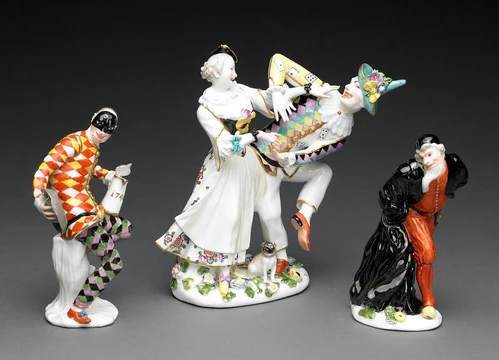
KPM has created numerous services, vases, and figurines, drawing from a stock of over 150,000 moulds, some in production unmodified since the company's founding. Among current table services are three Rococo forms commissioned by Frederick the Great for his palaces: ROCAILLE, NEUZIERAT, and NEUOSIER. ROCAILLE, created in 1767 by Friedrich Elias Meyer for Breslau Palace, was later named under Frederick William IV and is used today at state banquets in Bellevue Palace.
NEUZIERAT, Frederick the Great's favourite service, was designed for the New Palace, Potsdam, and is known for its faint-blue Bleu mourant colour, developed over four years and still produced by secret formula. NEUOSIER from 1770, inspired by French osier wickerwork, features a basket-weave relief and branch-shaped handles; it was made for Crown Prince Frederick William in 1780 and later used at Sanssouci Palace. The manufactory also produces modern animal sculptures such as the miniature Buddy Bear and Knut the Bear.
Frequently Asked Questions
Where is Royal Porcelain Factory, Berlin headquartered?
Royal Porcelain Factory, Berlin is headquartered in Berlin, Germany.
What industry is Royal Porcelain Factory, Berlin in?
Royal Porcelain Factory, Berlin operates in the Ceramic products industry.
Who owns Royal Porcelain Factory, Berlin?
Royal Porcelain Factory, Berlin is owned by Jörg Woltmann.
More in German Porcelain
Sources
Compiled from Wikipedia and the sources listed below. Text from Wikipedia is available under CC BY-SA 4.0; this entry is adapted from it.
- Wikipedia: Royal Porcelain Factory, Berlin (CC BY-SA 4.0).
Spotted an error? Know more?
Reader corrections go straight into our review queue. Suggest an edit · How this site is sourced