Permafrost
Frozen ground that stores carbon and threatens infrastructure when thawed.

NASA's Scientific Visualization Studio - KBR Wyle Services, LLC/Kathryn Mersmann · Public domain
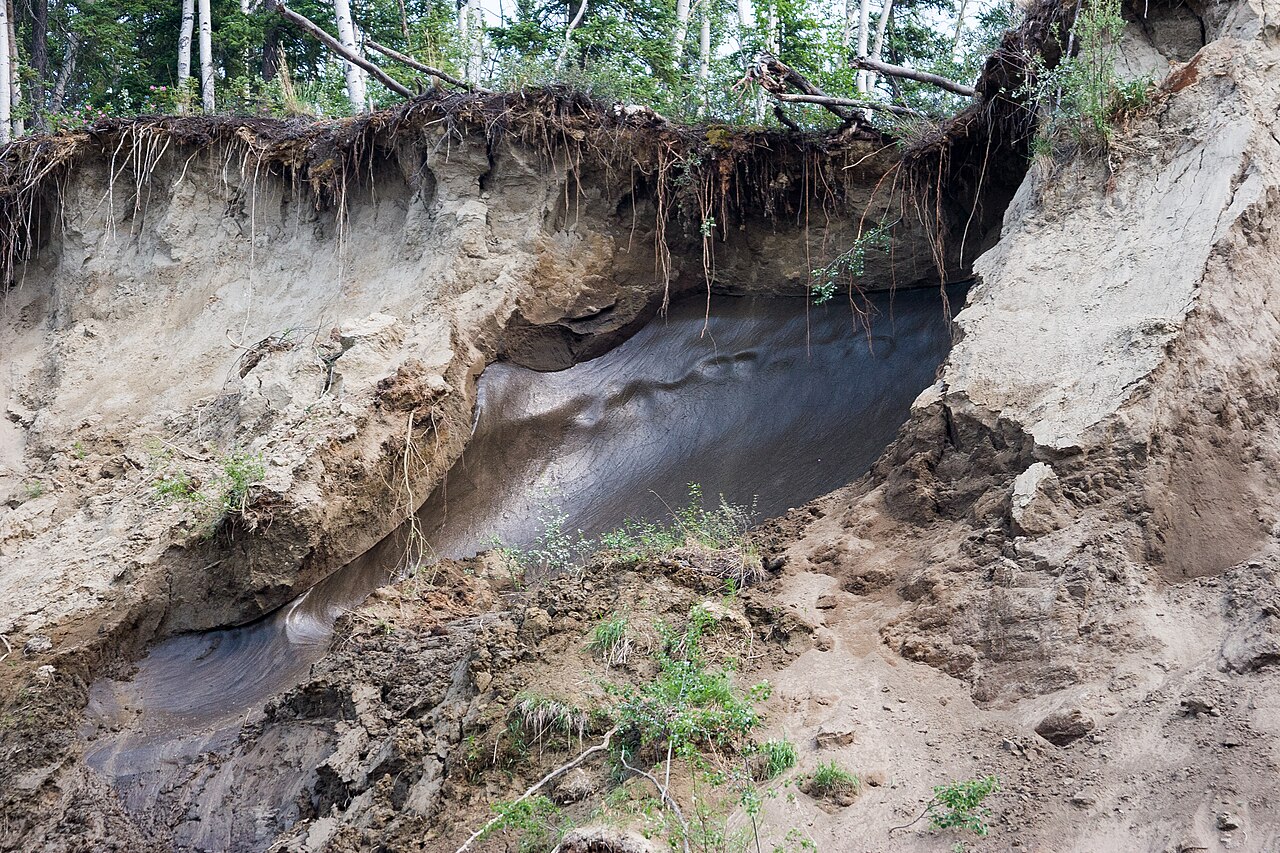
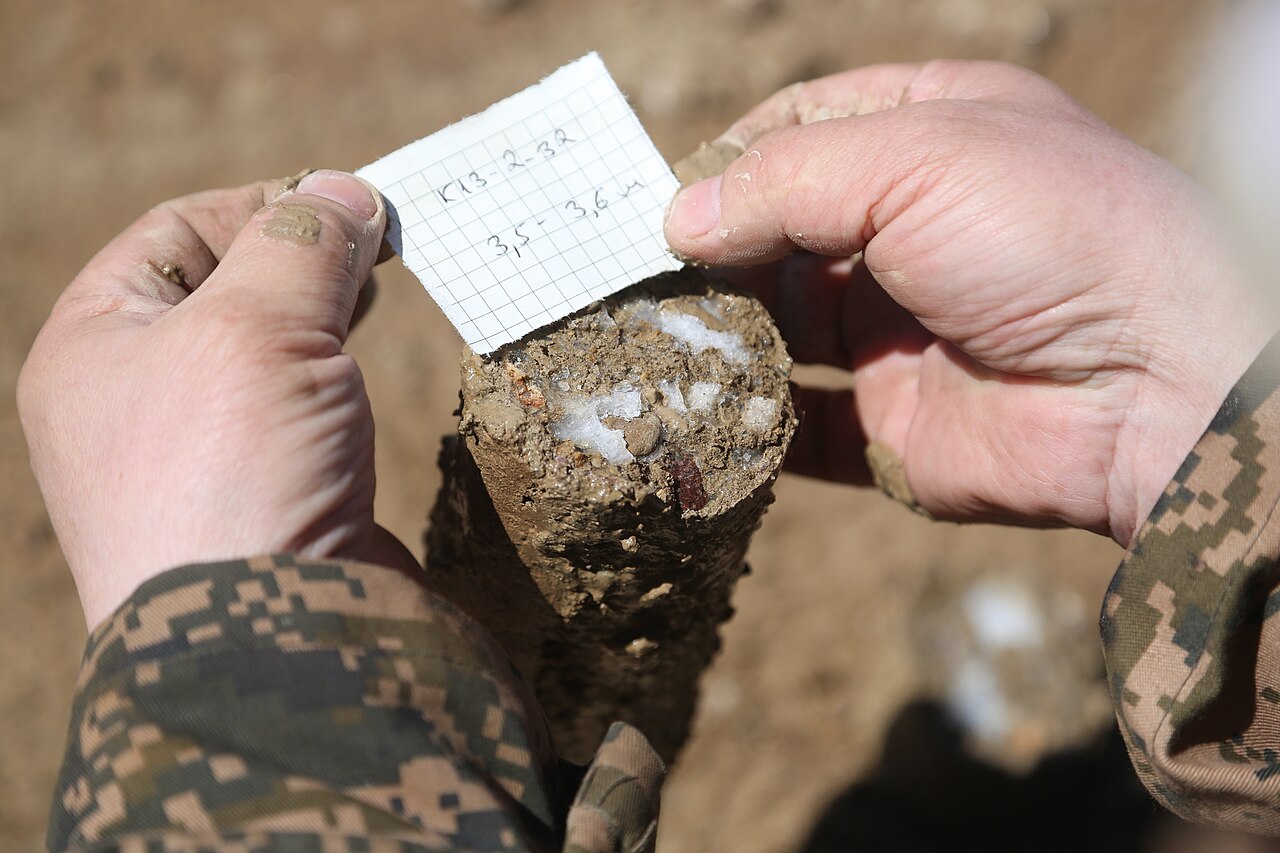
Permafrost is ground—soil, rock, or underwater sediment—that stays frozen at or below 0 °C (32 °F) for at least two years straight. The oldest known permafrost has remained frozen for roughly 700,000 years. Its thickness varies widely: the shallowest is less than a meter deep, while the deepest extends more than 1,500 meters. Permafrost zones can be as small as a narrow mountain summit or as vast as entire Arctic regions. The ground under glaciers and ice sheets is not usually considered permafrost; on land, it sits beneath a surface layer called the active layer, which freezes and thaws seasonally.
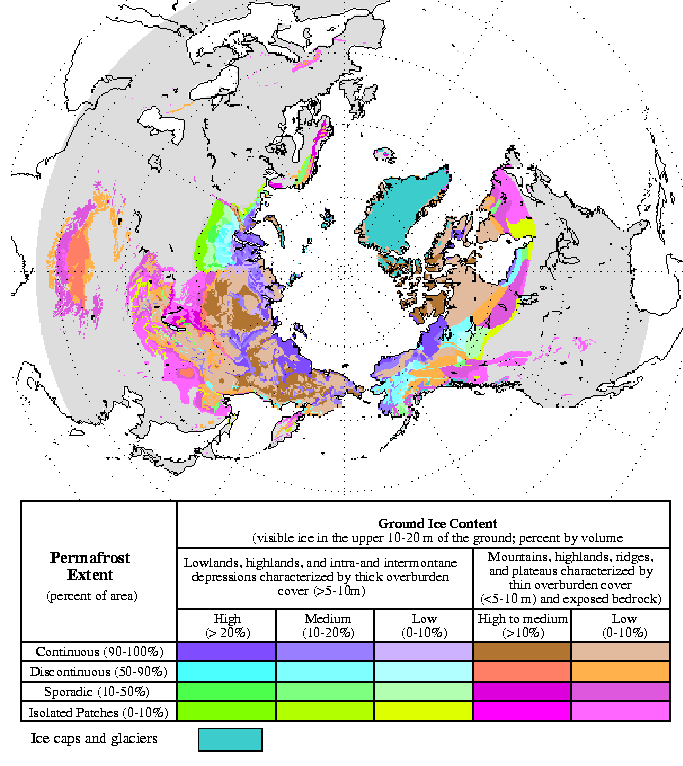
About 15% of the Northern Hemisphere’s ice-free land—and 11% of all land on Earth—is underlain by permafrost, totaling around 18 million square kilometers. This includes large parts of Alaska, Canada, Greenland, and Siberia, as well as high mountain areas like the Tibetan Plateau. In the Southern Hemisphere, permafrost is rare, found only on mountain slopes such as the Patagonian Andes, New Zealand’s Southern Alps, and the highest peaks of Antarctica.
Permafrost holds vast amounts of dead plant matter that has built up over millennia without fully decomposing, making tundra soil a carbon sink. As global warming thaws the frozen ground, decomposition resumes, releasing either carbon dioxide or methane depending on conditions. These greenhouse gas emissions create a feedback loop that amplifies climate change. Thawing permafrost will affect global carbon budgets, though exactly how much gas will be released is hard to predict because the processes involved remain uncertain. Scientists broadly agree that these emissions will be smaller than human-caused ones and won’t cause runaway warming; instead, annual permafrost emissions are likely comparable to global deforestation or the yearly emissions of major countries like Russia, the United States, or China.
Beyond its climate effects, thawing permafrost poses other risks. Frozen ground often contains enough ice that when it melts, the ground becomes oversaturated and can shift or collapse. Many buildings and infrastructure built on stable permafrost are now vulnerable; estimates suggest nearly 70% of such structures could be at risk by 2050, with repair costs reaching tens of billions of dollars later this century. Additionally, between 13,000 and 20,000 toxic waste sites lie in permafrost, along with natural mercury deposits, all of which could leak as warming continues. There are also concerns about ancient pathogens surviving thaw and causing pandemics, but scientific reviews consider this risk generally low.
- definition
- Soil or sediment frozen for two or more consecutive years
- global_land_coverage
- ~11%
- northern_hemisphere_land_coverage
- ~15%
- total_area
- ~18 million km²
- deepest_permafrost_depth
- >1,500 m
- shallowest_permafrost_depth
- <1 m
Lore & Background
Permafrost typically forms in any climate where the mean annual air temperature is lower than the freezing point of water, though exceptions occur in humid boreal forests where snow acts as an insulating blanket. The shallowest permafrost has a vertical extent of below a meter (3 ft), while the deepest is greater than 1,500 m (4,900 ft). On land, permafrost is generally located beneath a so-called active layer of soil which freezes and thaws depending on the season. Around 15% of Northern Hemisphere land that is not completely covered by ice is directly underlain by permafrost; 22% is defined as part of a permafrost zone or region. Slightly more than half of this area is defined as a continuous permafrost zone (90%–100% coverage), around 20% is discontinuous permafrost (50%–90% coverage), and the remaining <30% consists of sporadic zones (10%–50%) and isolated patches (10% or less). Most of this area is found in Siberia, northern Canada, Alaska and Greenland.
Reader's Guide
Permafrost contains large amounts of dead biomass that has accumulated throughout millennia without having had the chance to fully decompose and release its carbon, making tundra soil a carbon sink. As global warming heats the ecosystem, frozen soil thaws and becomes warm enough for decomposition to start anew, accelerating the permafrost carbon cycle. Depending on conditions at the time of thaw, decomposition can release either carbon dioxide or methane, and these greenhouse gas emissions act as a climate change feedback. The emissions from thawing permafrost will have a sufficient impact on the climate to impact global carbon budgets. It is difficult to accurately predict how much greenhouse gases the permafrost releases because the different thaw processes are still uncertain. There is widespread agreement that the emissions will be smaller than human-caused emissions and are not large enough to result in runaway warming. Instead, the annual permafrost emissions are likely comparable with global emissions from deforestation, or to annual emissions of large countries such as Russia, the United States or China. Apart from its climate impact, permafrost thaw brings more risks. Formerly frozen ground often contains enough ice that when it thaws, hydraulic saturation is suddenly exceeded, so the ground shifts substantially and may even collapse outright. Many buildings and other infrastructure were built on permafrost when it was frozen and stable, and so are vulnerable to collapse if it thaws. Estimates suggest nearly 70% of such infrastructure is at risk by 2050, and that the associated costs could rise to tens of billions of dollars in the second half of the century. Furthermore, between 13,000 and 20,000 sites contaminated with toxic waste are present in the permafrost, as well as natural mercury deposits, which are all liable to leak and pollute the environment as the warming progresses. Lastly, concerns have been raised about the potential for pathogenic microorganisms surviving the thaw and contributing to future pandemics. However, this is considered unlikely, and a scientific review on the subject describes the risks as 'generally low'.
Did You Know?
- The oldest permafrost has been continuously frozen for around 700,000 years.
- The deepest permafrost is greater than 1,500 m (4,900 ft).
- Around 15% of the exposed land surface of the Northern Hemisphere is underlain by permafrost.
- Between 13,000 and 20,000 sites contaminated with toxic waste are present in the permafrost.
- A scientific review describes the risk of pathogenic microorganisms causing future pandemics from thawing permafrost as 'generally low'.
Gallery


Frequently Asked Questions
What is Permafrost?
Permafrost is any soil or sediment that has remained frozen for at least two consecutive years. It ranges from less than a metre deep to over 1,500 metres, making it one of the most variable frozen-ground features on Earth.
Where does Permafrost appear on the map?
It blankets roughly 15 % of exposed Northern Hemisphere land and about 11 % of all global land surface, totalling around 18 million km². Major regions include Alaska, Canada, Greenland, Siberia, and high-elevation zones like the Tibetan Plateau.
What role does Permafrost play in the climate system?
It locks away enormous quantities of dead organic matter, effectively serving as a long-term carbon sink. When warming causes it to thaw, that stored carbon is released as greenhouse gases, feeding a positive feedback loop that accelerates further warming.
How does Permafrost affect human infrastructure?
As it thaws, the ground loses structural integrity, causing roads, pipelines, and buildings in Arctic and sub-Arctic areas to sink, crack, or shift unexpectedly. This makes thaw a major engineering and economic concern for communities built on or near permafrost.
Why is Permafrost considered a key entry in the Geology & Earth Surface series?
It sits at the intersection of cryosphere dynamics, carbon-cycle science, and climate feedback, making it a central case study for how surface geology interacts with global warming. Its sheer area and carbon payload mean even small changes in its stability ripple through the entire Earth system.
More in Geology & Earth Surface 1-23
Spotted an error? Know more?
This is a living reference — every entry is fact-audited, and reader corrections feed straight into our audit queue. Suggest an edit · See this site's audit record