Nintendo 64 controller
A three-grip controller with a thumb-operated control stick.
Last updated

InclusiveGameLab · CC BY-SA 4.0
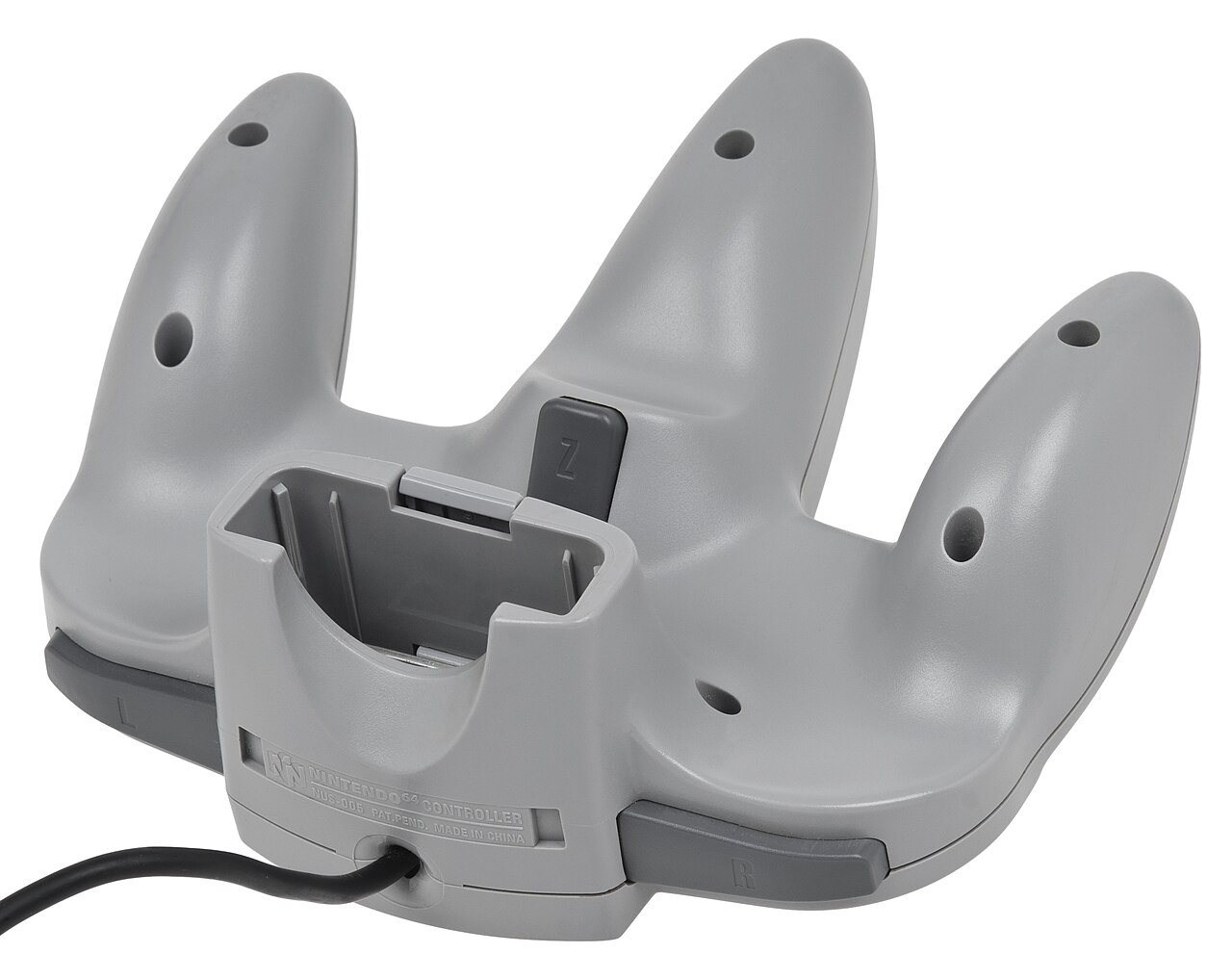
The standard controller for the Nintendo 64 home console, model number NUS-005, was produced and released by Nintendo. It launched alongside the console in Japan on June 23, 1996, then in North America on September 29, 1996, and finally in Europe and Australia on March 1, 1997. Succeeding the Super Nintendo controller, it has an "M"-shaped body, ten buttons, a control stick, a D-pad, and a port on the back for connecting accessories.
Design
The controller was created by Nintendo R&D3, with instructions to experiment with new ideas that broke away from typical game controllers. Early visual designs were mocked up in clay, and extensive test groups were conducted before and during the design phase. The final shape was settled alongside Shigeru Miyamoto's gameplay mechanics in Super Mario 64. While Miyamoto tested the controller while making that game, the controller was not built around it, though it did influence the game's movement mechanics.
Nintendo of America's head designer, Lance Barr, noted that the design studies showed most games use a few buttons for primary actions like jumping, shooting, accelerating, or braking. This is why the A and B Buttons are placed for easiest access and are larger than the others—they get the most use.
On top of the controller are four "C-buttons," originally meant to control the camera in 3D game worlds. Because the pad has only three other face buttons, the C-buttons can be assigned to other functions. For example, in The Legend of Zelda: Ocarina of Time, three C-buttons can hold secondary items, the upper C-button calls Navi for help, and the Z-trigger locks focus on enemies and centers the camera behind the player.
Control stick
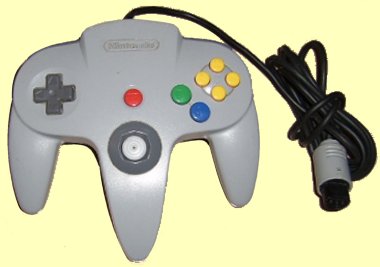
The Nintendo 64 controller was among the first to feature a "control stick" as a central part, designed to give the user a wider range of control for movement and camera work. Unlike a D-pad, which detects only eight directions, this stick registers 360 degrees of movement, allowing more precise control in games. Joysticks had been used in gaming for a while—appearing in the Atari 5200, Sega's arcade systems and the Mission Stick for the Saturn (1995), and Sony's PlayStation Analog Joystick (1996)—but the Nintendo 64 stood out by using a thumb-operated stick. Before this, the only console accessory with a thumbstick was the Mega Drive's XE-1 AP, a third-party device from Dempa in 1989.
Lore & Background
The controller was designed by Nintendo R&D3, under direction to try new ideas that would break from typical game controllers. Original visual designs were mocked up in clay form, and extensive test group studies were performed before and during the design phase. The controller's design was eventually solidified in tandem with Shigeru Miyamoto's gameplay mechanics in Super Mario 64. Though Miyamoto tested the controller while developing Super Mario 64, the controller was not designed around the game, while it did influence its mechanics like movement.
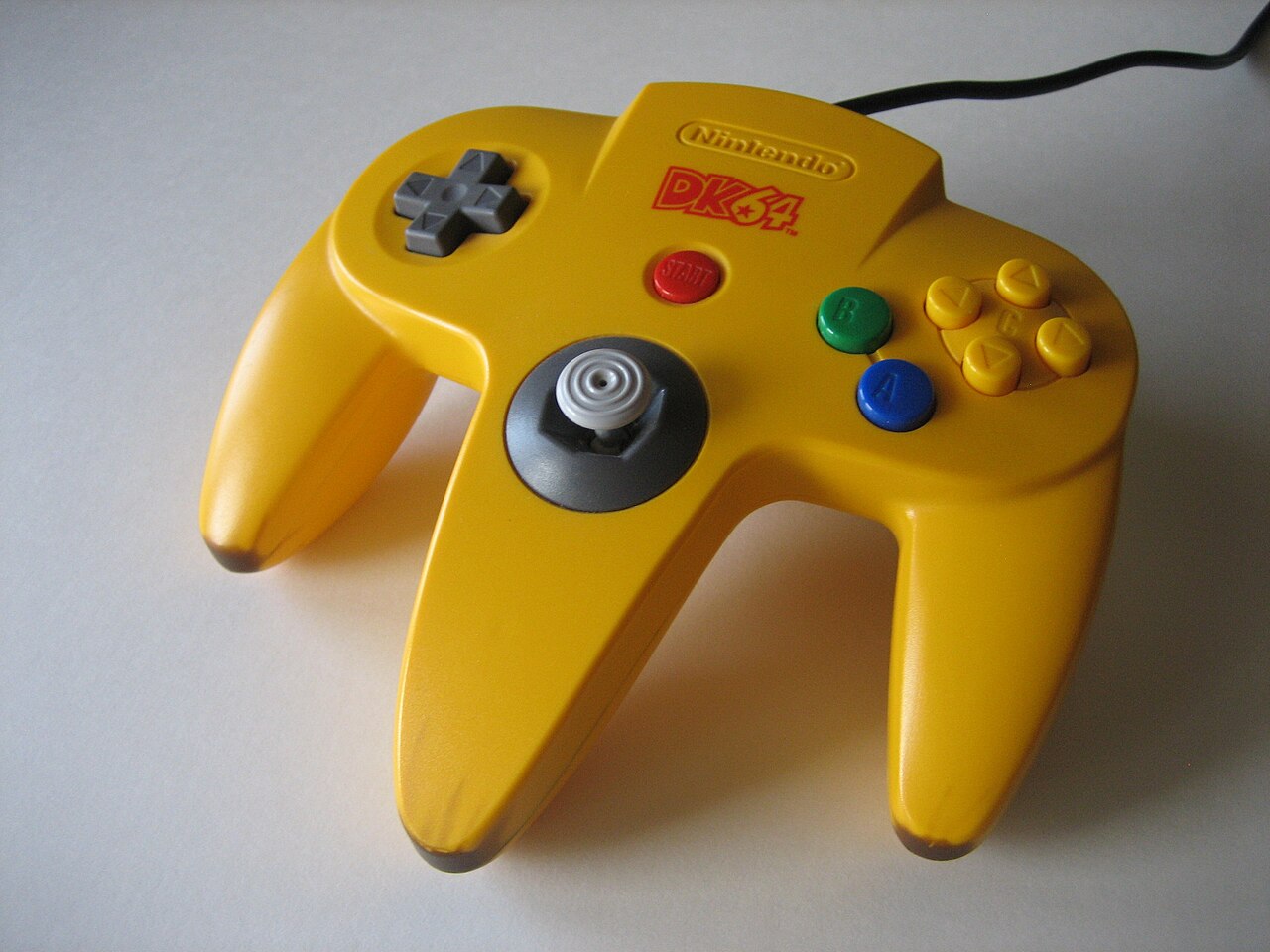
The controller has four C-buttons on the top, originally intended to control the camera in three-dimensional game environments. Because the pad only contains three other face buttons, the C-buttons may be assigned to alternate functions.
The control stick was among the first to feature a thumb-operated stick as a central component, intended to provide a wider range of functions such as mobility and camera control. Unlike a D-pad, which detects only 8 directions, this stick could register 360 degrees of movement. Though functionally similar to an analog stick, the control stick is digital; it operates like a ball mouse, turning a chopper wheel that interrupts a light beam detected by a photodiode.
The controller was designed to be held in three different positions: by the two outer grips (for 2D games), by the center and right-hand grip (for 3D games), and by the center and left-hand grip (for first-person shooters). This design is controversial, as by its nature it generally prevents the use of all of its features with the player's hands in any one position.
Design Philosophy and Development
The Nintendo 64 controller emerged from a deliberate push to break away from conventional gamepad layouts. Nintendo's R&D3 division was tasked with exploring fresh ideas, and the team produced clay mockups of original visual concepts before committing to a final form. Extensive test-group studies were conducted both before and during the design phase to refine the layout. The final "M"-shaped silhouette was solidified in close coordination with Shigeru Miyamoto's work on Super Mario 64, though the controller was not designed around that specific title.
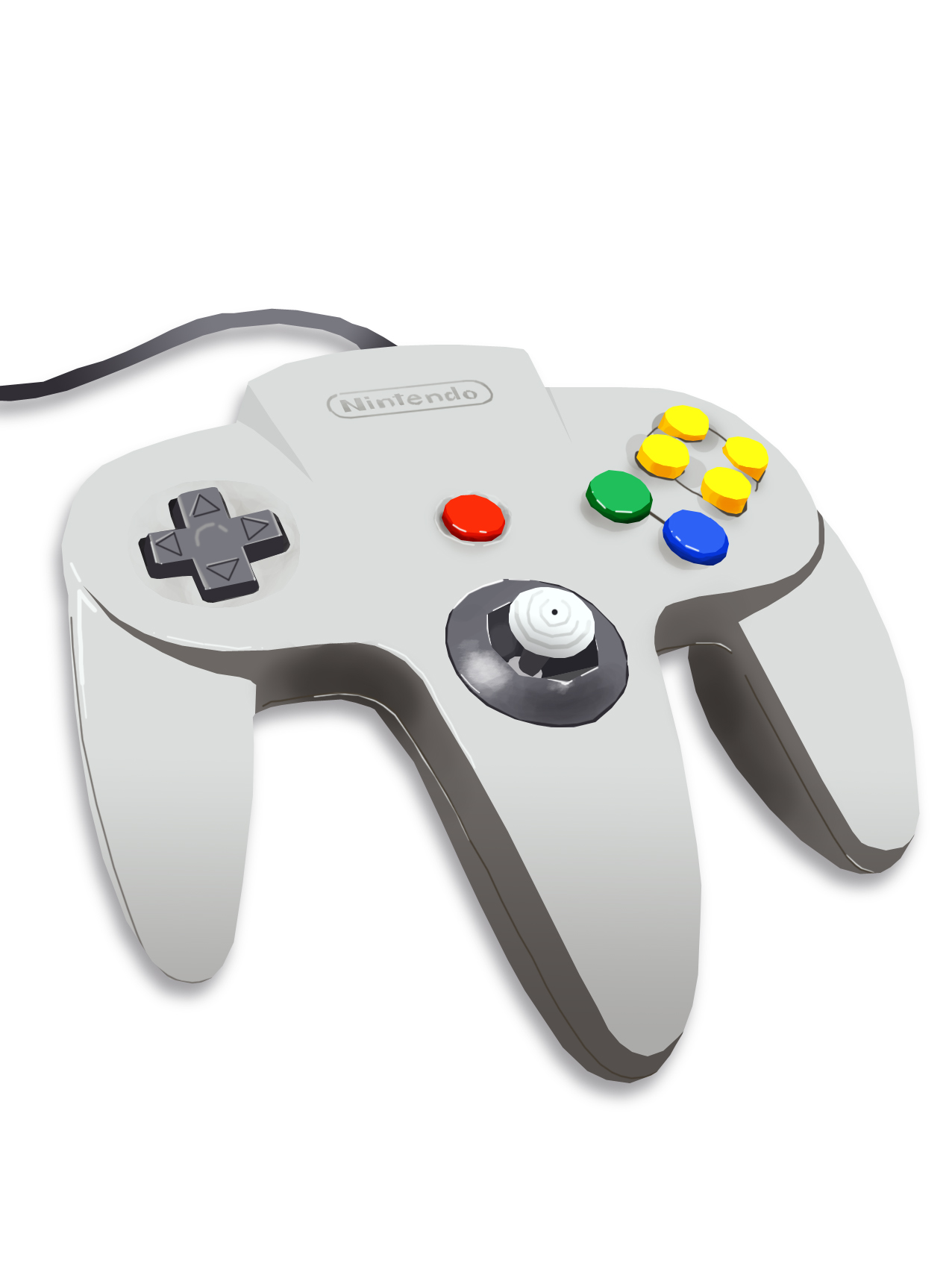
Miyamoto did test the pad during development, and it influenced his movement mechanics. Lance Barr, head designer at Nintendo of America, explained that research showed most games rely on just a few buttons for core actions like jumping or accelerating, which is why the A and B buttons were made larger and placed for the easiest reach. The result was a ten-button layout with a D-pad, a central control stick, four C-buttons on top, and a rear Z-trigger, all wrapped in a distinctive shape that departed sharply from the simpler predecessor on the Super Nintendo.
The Control Stick Innovation
One of the NUS-005's most significant contributions was its thumb-operated control stick, a component that placed the Nintendo 64 among the earliest consoles to integrate such a device as a standard feature. While joysticks had appeared in gaming before—on the Atari 5200, in Sega arcade cabinets, on the Saturn's Mission Stick, and in Sony's 1996 PlayStation Analog Joystick—none of those were thumb-operated console controllers. The only prior example was the XE-1 AP, a third-party Mega Drive accessory from Dempa in 1989. The N64 stick registered 360 degrees of movement, far exceeding the eight-directional limit of a traditional D-pad, enabling smoother mobility and camera control in three-dimensional titles.
Mechanically, however, the stick was digital rather than truly analog. It worked on a principle similar to a ball mouse, where a rotating chopper wheel broke a light beam that a photodiode detected. Because it tracked only relative motion, the system assumed a centered position at startup; if the stick drifted, players could recalibrate by holding L, R, and Start simultaneously, or by restarting the console with the stick properly centered.
Hand Positioning and Ergonomic Controversy
The NUS-005 was engineered to be gripped in three distinct ways, each unlocking a different subset of its controls. Holding the two outer grips gave access to the D-pad, right-hand face buttons, and both shoulder triggers, but excluded the Z-trigger and control stick—a setup ideal for two-dimensional titles that echoed the Super NES feel. Gripping the center and right-hand sections enabled the stick, right-side buttons, the R shoulder, and the rear Z-trigger, a configuration aimed at three-dimensional games. A third grip, using the center and left-hand sections, combined the D-pad, L shoulder, stick, and Z-trigger, a layout adopted by first-person shooters like GoldenEye 007.
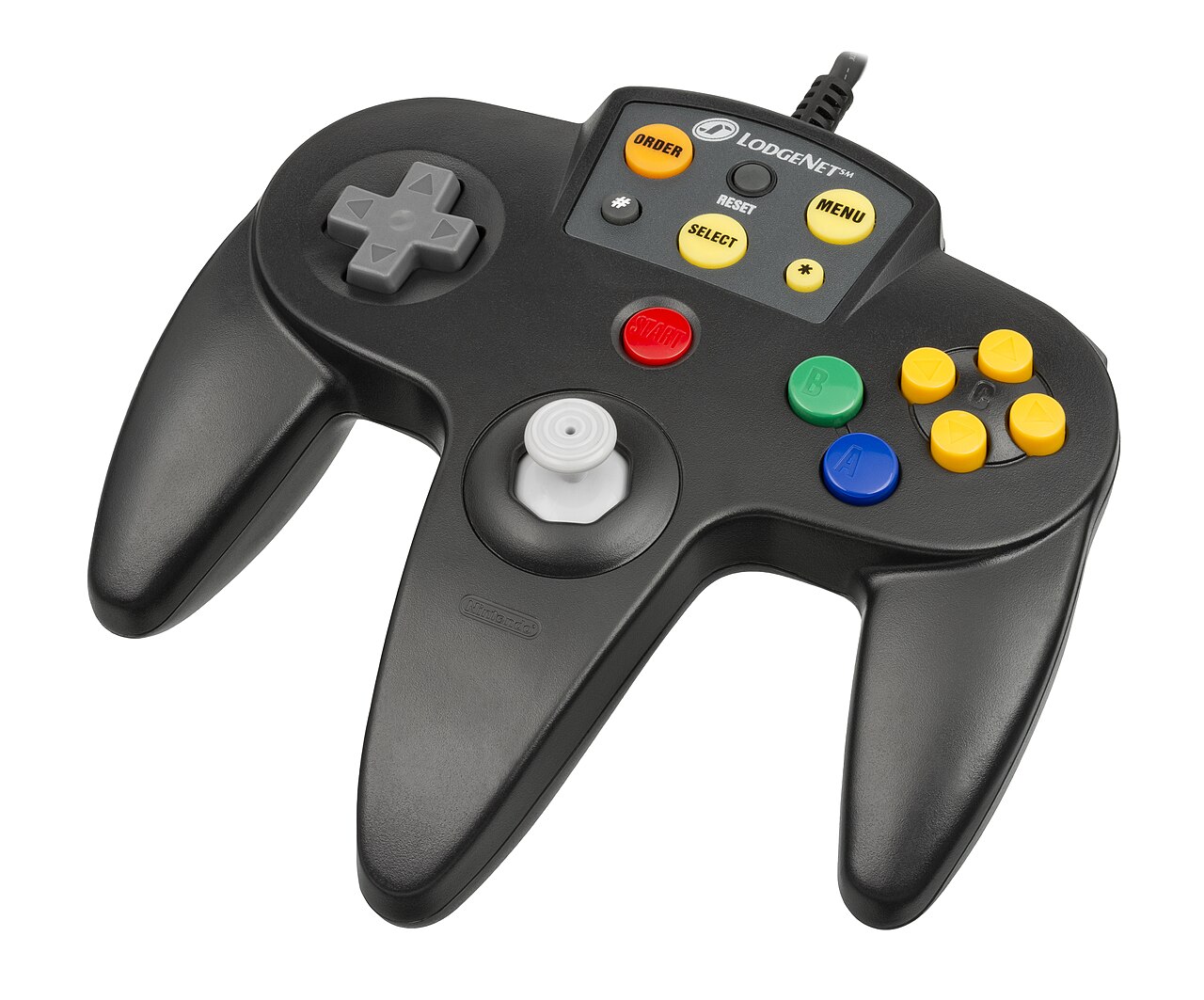
This multiplicity is the source of the controller's most persistent criticism: no single hand position allows simultaneous use of the D-pad, L shoulder, stick, and Z-trigger, forcing players to shift their grip mid-game. Some enthusiasts found a workaround by gripping the outer handles and assigning index fingers to the shoulder triggers, middle fingers to the Z-trigger, and thumbs to the face buttons and stick. In Robotron 64, a single player could even use two controllers simultaneously, one per hand, to control a single avatar.
Legacy and Impact on Controller Design
The NUS-005's influence on subsequent gamepad design is both direct and indirect. When Sony released the Dual Analog and later the DualShock for the PlayStation, it retained the two-handled ergonomic philosophy but repositioned the analog sticks below and inside the primary D-pad and face buttons, letting players transition between directional input and analog movement without releasing their grip. Nintendo largely followed this approach with the GameCube's stock controller, though it swapped the positions of the stick and D-pad.
That left-stick-dominant layout eventually became the industry standard, as the left analog stick was universally adopted as the primary movement control for three-dimensional games across all consoles. The N64's four C-buttons, originally conceived for camera control in 3D spaces, also found creative repurposing; in The Legend of Zelda: Ocarina of Time, three were assigned to secondary items, the upper C-button summoned Navi, and the Z-trigger locked focus on enemies. The controller's rear port for accessories and its overall philosophy of offering multiple input methods for different game genres set a template that shaped the next generation of console controllers.
Reader's Guide
The Nintendo 64 controller was among the first to feature a thumb-operated control stick as a central component, distinguishing itself from earlier joysticks used in gaming. While joysticks had appeared in the Atari 5200, Sega's arcade systems and Mission Stick for the Saturn, and Sony's PlayStation Analog Joystick, the Nintendo 64 controller was released contemporaneously with Sega's 3D Pad for their Saturn system, and was followed during the fifth generation by Sony's Dual Analog and DualShock controllers. The controller's design influenced the layout of later Nintendo controllers; Nintendo would largely follow suit with the stock controller for its GameCube console, swapping the positions of the analog stick and D-pad.
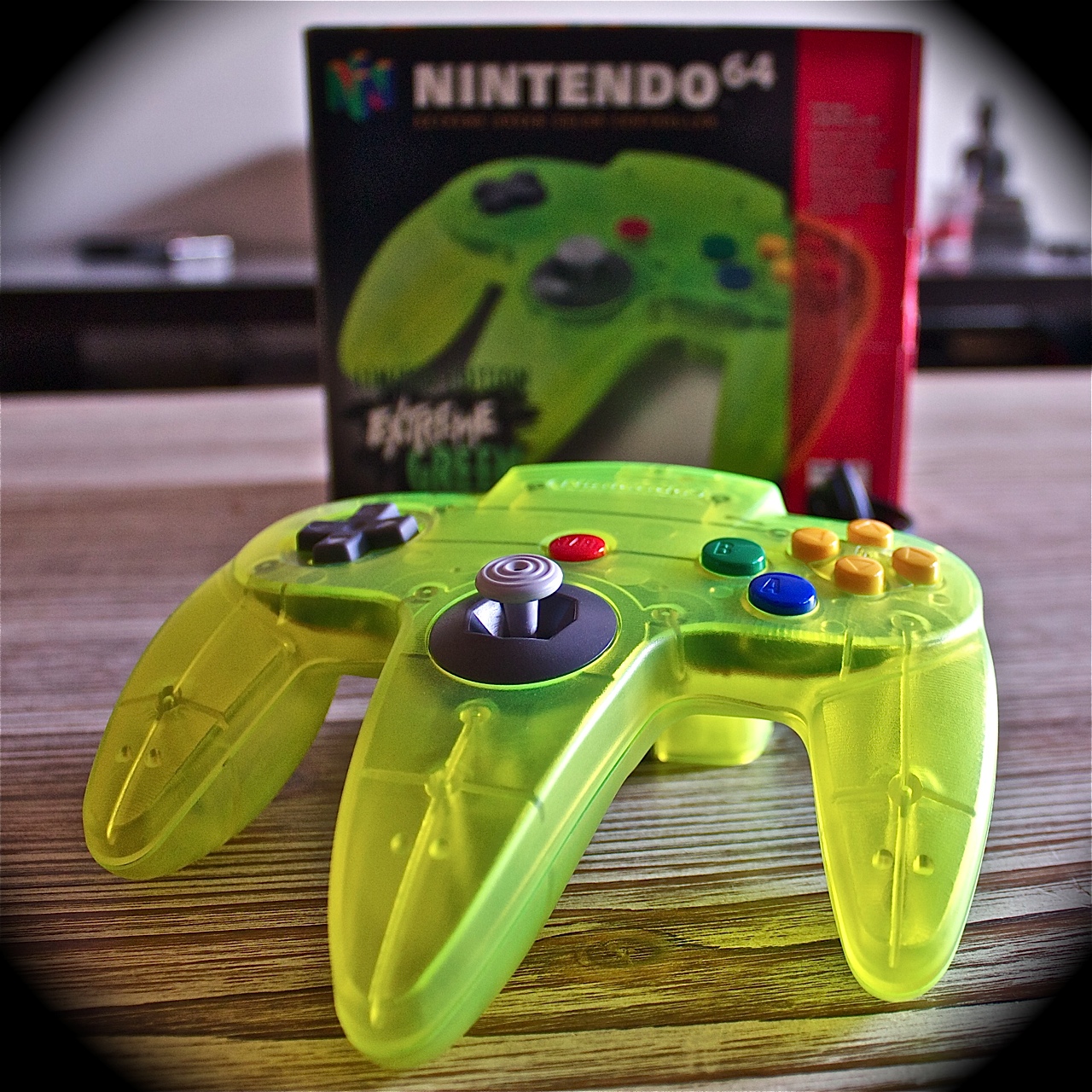
Such a layout would become dominant in gamepad design, as by that time the left analog stick had become universally accepted as the primary movement control on 3D games across all consoles. The controller's expansion port allowed for accessories such as the Controller Pak (an external memory card), the Rumble Pak (providing haptic feedback), and the Transfer Pak (enabling connectivity between Game Boy and Nintendo 64 titles). The controller initially came in six colors (grey, black, red, green, yellow and blue), with other colors released later including smoke black and watermelon red.
Did You Know?
- The Transfer Pak was originally bundled with Pocket Monsters Stadium and Pokémon Stadium.
Frequently Asked Questions
What is the Nintendo 64 controller?
It is the standard gamepad that shipped with the Nintendo 64 console, carrying the model number NUS-005. Manufactured by Nintendo, it replaced the Super Nintendo controller and introduced a three-grip, M-shaped body with a thumb-operated analog stick.
Who designed the Nintendo 64 controller?
The hardware was developed by Nintendo's internal R&D3 team. Nintendo specifically tasked that group with pushing past conventional controller layouts, which is why the final design features ten buttons, a D-pad, and the now-iconic central analog stick.
More in Game Controllers and Accessories
Sources
Compiled from Wikipedia and the sources listed below. Text from Wikipedia is available under CC BY-SA 4.0; this entry is adapted from it.
- Wikipedia: Nintendo 64 controller (CC BY-SA 4.0).
Spotted an error? Know more?
Reader corrections go straight into our review queue. Suggest an edit · How this site is sourced