Pathogenic fungus
Fungi that cause disease in humans and other organisms.
Last updated
Pathogenic fungi are fungi that cause disease in humans or other organisms. Although many are eukaryotic microorganisms, approximately 300 species are pathogenic to humans. Fungal infections are estimated to kill about two million people per year, more than either tuberculosis or malaria.
Yeasts
Yeasts are single-celled fungi that multiply mainly by budding or splitting, and many are important causes of disease in humans. Some yeast types are normally found on or in the human body or in the environment, but they can turn into opportunistic pathogens when a person's immune defenses are weakened. Candida species are a major cause of fungal infections, especially in people with compromised immune systems, and they can lead to both surface-level and internal infections.
Candida
Candida albicans is a common diploid yeast that lives in the human gut without causing harm, but it can overgrow abnormally in immunocompromised individuals. This species has a parasexual cycle that seems to be triggered by environmental stress. Candida auris, identified in 2009, is notable for being resistant to many common antifungal drugs, disinfectants, and heat, making it very hard to eliminate. It primarily affects people with weakened immunity, and when it enters the bloodstream or internal organs, the death rate is around 50%.
Cryptococcus
Other Candida species that can cause disease include Candida stellatoidea, C. tropicalis, C. pseudotropicalis, C. krusei, C. parapsilosis, and C. guilliermondii. Cryptococcus neoformans can lead to severe meningitis and meningo-encephalitis in people with HIV or AIDS. Most Cryptococcus species live in soil and don't cause illness, but C. neoformans is a major pathogen for humans and animals. Papiliotrema laurentii and Naganishia albida, once classified as Cryptococcus, can occasionally cause moderate to severe disease in immunocompromised patients.
Cryptococcus gattii is found in tropical parts of Africa and Australia and can infect people with healthy immune systems. When C. neoformans infects the lungs, it is usually taken up by alveolar macrophages. Some of these fungal cells are killed by oxidative and nitrosative molecules released by the macrophages, but others survive inside them. This ability to survive within macrophages likely influences how long the infection stays dormant, how it spreads, and how resistant it becomes to antifungal drugs.
To endure the harsh environment inside the macrophage, C. neoformans turns on genes that help it cope with oxidative stress.
Thermally dimorphic fungi
Thermally dimorphic fungi exist as molds in the environment but shift into a yeast or yeast-like form once inside a warm-blooded host. Infection usually starts when someone breathes in airborne spores from soil or other environmental sources, leading to a lung infection that can spread to other parts of the body. Several of these fungi are found only in certain regions and can sicken both healthy people and those with weakened immune systems. Histoplasma capsulatum causes histoplasmosis in humans, dogs, and cats, and is most common in the Americas, India, and southeastern Asia, including parts of the United States.
This fungus thrives in soil rich in bird or bat droppings, where it grows as a mold and releases infectious spores. Inhaling these spores causes a primary lung infection, and how severe it gets depends on how many spores are inhaled and the person’s immune status. Many cases have been linked to people who handle birds or work in areas where birds roost, and spelunkers often get exposed from bat guano in caves. Coccidioides species cause coccidioidomycosis, or Valley fever, with Coccidioides immitis and Coccidioides posadasii responsible for human illness.
Coccidioides
These fungi live in dry soils of the Western Hemisphere and produce infectious arthroconidia that become airborne when the ground is disturbed. After inhalation, the arthroconidia turn into unique spherules filled with endospores, a feature that sets Coccidioides apart from other thermally dimorphic fungi. Most infections cause no symptoms or just a mild respiratory illness, but some lead to lung complications or spread to the skin, bones, joints, or central nervous system.
Blastomyces
Blastomyces dermatitidis causes blastomycosis, an infection caught by inhaling spores from the environment, and is endemic to the Ohio and Mississippi river valleys in the United States. About half of infected people have no symptoms, but when the fungus spreads, it most often affects the skin.
Aspergillus
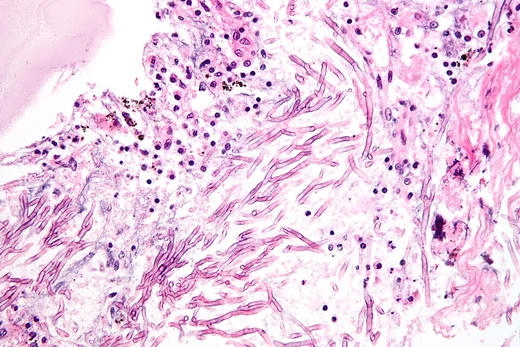
Aspergillus fumigatus and Aspergillus flavus are the most common disease-causing species. Aspergillus flavus produces aflatoxin, a substance that is both poisonous and cancer-causing, and can taint foods like nuts. Allergic reactions can be triggered by Aspergillus fumigatus and Aspergillus clavatus. Certain Aspergillus species also harm grain crops, particularly maize, and generate mycotoxins such as aflatoxin.
The illnesses caused by Aspergillus are called aspergillosis, with signs including fever, cough, chest pain, or shortness of breath. Only people with compromised immune systems or pre-existing lung conditions are usually at risk.
The spores of Aspergillus fumigatus are found everywhere in the air. This fungus is an opportunistic pathogen, capable of causing deadly invasive infections in those with weakened immunity. It possesses a complete sexual cycle, producing cleistothecia and ascospores.
Host defense mechanisms
Mammals' ability to maintain a high and stable body temperature provides a strong general defense against most fungi. Research comparing genomes found that, aside from tolerating 37 degrees Celsius, opportunistic fungi lack consistent specialized traits for causing human disease. Common infection sites include the skin, respiratory tract, gastrointestinal tract, and genital-urinary tract.
Individuals with more immune cells like monocytes, macrophages, dendritic cells, and invariant natural killer T-cells show better control of fungal growth and resistance to systemic infection. Pattern recognition receptors help trigger immune responses by detecting specific fungi. For mucosal candidiasis, cells producing IL-17 are crucial for innate immunity, while Th1-type cell-mediated immunity is necessary to clear a fungal infection.
Did You Know?
- Human pathogenic fungi do not form a single taxonomic group but are distributed across multiple fungal lineages.
- Molds of the order Mucorales cause mucormycosis, a rapidly progressive invasive infection characterized by angioinvasion, tissue necrosis, and high mortality.
- Dermatophytes are highly adapted to colonizing keratinized tissue; their infectious structures include arthroconidia.
More in Fungal Diseases
Sources
Compiled from Wikipedia and the sources listed below. Text from Wikipedia is available under CC BY-SA 4.0; this entry is adapted from it.
- Wikipedia: Pathogenic fungus (CC BY-SA 4.0).
- Word definitions: the , each quoted from its Wikipedia article.
Spotted an error? Know more?
Reader corrections go straight into our review queue. Suggest an edit · How this site is sourced