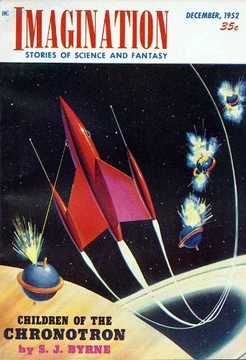
The End of Illa
A novella reinterpreting Atlantis through technological self-destruction.

The End of Illa (French: La fin d'Illa) is a 1925 novella by French author José Moselli. It blends scientific marvel and utopian fiction, reimagining the Atlantis myth while exploring how technological progress can shape society.
The story opens in 1875, when the American whaler *Grampus*, commanded by Captain Ellis, discovers an uncharted Pacific islet. On it, the crew finds ruins of an ancient civilization, a strange violet stone, and a manuscript in an unknown script. Back in San Francisco, no one believes Captain Ellis’s tale. The stone and manuscript are sold cheaply to Doctor Akinson. For thirty years, Akinson exhausts his savings trying to decipher the manuscript. In April 1905, he finally translates the first part, which tells of Xié, a resident of the lost, highly advanced city of Illa. Akinson sends this translation to a colleague in Washington on May 5, 1905, and later reports decoding a second part containing Illa’s scientific knowledge and new mathematical formulas. But Akinson’s servant, thinking him insane, throws both the manuscript and the violet stone into a fire. The stone explodes, destroying much of San Francisco. The translation reaches Professor Isambard Fullen at Harvard, but he dies before reading it; the document is sold to a New York bookstore and eventually reaches readers.
The manuscript itself is written by Xié, Illa’s military chief, to explain his city’s destruction. It begins with a meeting of the Grand Supreme Council, where Illa’s dictator, Rair, announces war against the neighboring city of Nour. Rair has invented “blood machines” and wants to fuel them with Nourians instead of animals, extending Illians’ lifespans. Disgusted, Xié returns home to find his daughter Silmée has survived an assassination attempt. Xié and Toupahou, Silmée’s fiancé and Rair’s grandson, suspect Rair ordered the attack. Xié then joins Fangar, head of the air force, to prepare for war. He learns Rair plans to use genetically modified “monkey men”—who do Illa’s hardest labor—to pilot flying shells. When Xié returns home, Silmée has vanished. After agonizing hours, Xié…
The novella was first serialized in the magazine *Sciences and Voyages* from January 29 to July 9, 1925, with illustrations by André Galland. It was reprinted many times in France during the second half of the 20th century, but not translated into English until the 21st.
Quick Facts
- Author
- José Moselli
- Cover Artist
- John Schoenherr
- Country
- France
- Language
- French
- Genre
- Science fiction / Utopia
- Published
- 1925
- Publisher
- Sciences et Voyages
Facts from the source article.
Lore & Background
The story begins with marines discovering a manuscript on a Pacific atoll, revealing an advanced civilization that no longer exists. The narrator, military chief Xié, recounts the last days of the city of Illa under dictator Rair, who goes to war against neighboring Nour. The novella explores how dictatorship and moral decadence accompany scientific progress, leading to Illa's self-destruction.
Published initially in serial form in the magazine Sciences and Voyages between January 29 and July 9, 1925, it was illustrated by André Galland. The novel was republished numerous times in France during the second half of the 20th century but was not translated into English until the 21st century.
At the time of publication, the Offenstadt brothers were involved in a defamation lawsuit against abbot Calippe, who had categorized Sciences and Voyages as dangerous for youth. The Amiens court rejected the lawsuit on May 27, 1924, ruling the magazine's content had nothing scientific about it. Science fiction essayist Jacques Van Herp believed this case may have led Moselli to self-censor and reduce the scope of described inventions in the novel.
Reader's Guide
The End of Illa is significant as a French scientific marvel novella that reinterprets the Atlantis myth through a lens of technological hubris and social decay. It reflects early 20th-century anxieties about unchecked scientific progress and authoritarianism, themes that resonate with later dystopian literature. The work also illustrates the legal and cultural pressures on early science fiction in France, as the Offenstadt brothers faced lawsuits over the perceived dangers of such fiction for youth. The novella's delayed English translation until the 21st century highlights its initial obscurity outside France, despite multiple French republications. Its inclusion in the Sciences and Voyages magazine, alongside Moselli's other conjectural novels, marks it as part of a foundational period for French speculative fiction.
Did You Know?
- The story includes 'monkey men,' genetically modified individuals used for the most thankless jobs in Illa.
- The manuscript in the story is discovered on an unlisted Pacific islet by the American whaler Grampus in 1875.
- The violet stone from the manuscript explodes and destroys a large portion of San Francisco.
Narrative Architecture & the Fall of Illa
The novella opens with a maritime discovery: in 1875, the American whaler Grampus stumbles upon an uncharted Pacific islet where the crew finds a violet stone of unknown composition alongside a manuscript in an undecipherable script. After three decades of painstaking work, Doctor Akinson finally cracks the text in 1905, revealing the story of Illa—a technologically brilliant city that has vanished entirely from the world's memory. The manuscript's author is Xié, the military chief, who chronicles the final days of his civilization. Under the iron rule of dictator Rair, Illa embarks on a genocidal war against the neighboring city of Nour, driven by the dictator's plan to feed his life-extending blood machines with human victims rather than animals. Xié, horrified by his leader's ambitions, attempts to resist but is arrested, imprisoned, and ultimately freed by his ally Fangar. The narrative weaves personal betrayal—his daughter Silmée's disappearance, her fiancé Toupahou's loyalty—with the broader collapse of a society that consumed itself through tyranny and unchecked ambition.
Thematic Resonance & the Atlantis Parallel
Critics and scholars have situated The End of Illa within the tradition of scientific marvel and utopian literature, noting its deliberate reinterpretation of the ancient Atlantis myth. Where Plato's lost island represents a cautionary tale about hubris, Moselli transposes that warning into a speculative framework where the source of destruction is not divine punishment but the internal logic of unchecked technological progress. The novella traces a clear causal chain: scientific advancement enables the construction of powerful machines, those machines concentrate power in the hands of a single dictator, and the resulting regime descends into moral corruption that ultimately triggers the civilization's self-annihilation. Rair's blood machines, which initially extend life using animal subjects, become instruments of genocide when he decides to feed them with the people of Nour. The genetically modified monkey men, relegated to the most degrading labor, embody the social stratification that accompanies such progress. Moselli thus poses a question that remains urgently relevant: does a society that masters nature inevitably lose its humanity?
Publication Journey & the Long Wait for English Readers
The End of Illa first reached audiences not as a bound book but as a serialized narrative in the French magazine Sciences and Voyages, running from January 29 to July 9, 1925. The serial was brought to life visually by the artist André Galland, whose illustrations accompanied Moselli's text throughout the magazine's pages. For decades afterward, the novella maintained a steady presence in the French-speaking world, seeing multiple republications during the second half of the twentieth century. Yet despite this domestic longevity, the work remained entirely inaccessible to English-language readers until the twenty-first century, when it finally received an English translation. This gap is notable given the novella's place in the broader canon of early speculative fiction and its engagement with themes—technological hubris, authoritarian collapse, civilizational self-destruction—that resonate across linguistic and cultural boundaries. The serial format also means the text was shaped by the rhythms of periodic publication, a constraint that may have influenced its pacing and structure in ways distinct from a novel conceived for immediate book release.
Moselli's World & the Offenstadt Machine
Before becoming a household name in French popular fiction, José Moselli spent his early career in the merchant marine. His literary life began in 1910 when he met one of the Offenstadt brothers, who recognized his storytelling talent and suggested he write an adventure novel. The partnership proved enormously productive: Moselli rapidly became a leading voice for the Offenstadt publishing empire, churning out nearly a hundred episodic novels for their stable of magazines, including The Splendid, The Intrepid, The Little Illustrated, and Cry-Cry. When the brothers launched Sciences and Voyages in September 1919, they turned to Moselli for fantastic and speculative short works, and he delivered a steady stream of conjectural novels between 1919 and 1929. The Offenstadts were also fierce protectors of their youth market, filing defamation lawsuits against critics who questioned their content. One such case, involving the abbot Calippe, was dismissed in 1924. Science fiction scholar Jacques Van Herp has speculated that this legal pressure may have prompted Moselli to temper the scope of his technological inventions in The End of Illa, a theory that adds a layer of institutional context to the novella's creative choices.
Frequently Asked Questions
What is 'The End of Illa' (La fin d'Illa)?
It is a 1925 French novella by José Moselli that reimagines the Atlantis legend through the lens of technological self-destruction, blending scientific speculation with utopian ideals. The work was originally serialized in the magazine Sciences et Voyages between January 29 and July 9, 1925.
Who wrote La fin d'Illa and who illustrated it?
José Moselli authored the novella, and the illustrated edition featured artwork by André Galland. It first reached readers as a serial in the French periodical Sciences et Voyages in 1925.
What is the basic plot of The End of Illa?
The narrative opens in 1875 when the crew of the whaler Grampus, led by Captain Ellis, lands on an uncharted Pacific islet and uncovers the ruins of a vanished civilization along with a violet stone and a manuscript in an undecipherable script. Disbelieved in San Francisco, the artifacts are eventually acquired by Doctor Akinson, who pieces together the island's true history.
How does The End of Illa reinterpret the traditional Atlantis myth?
Instead of attributing the civilization's fall to divine wrath, Moselli presents its destruction as a direct consequence of its own technological overreach. The novella thus reframes the Atlantis story as a cautionary tale about self-inflicted collapse driven by unchecked scientific ambition.
What central themes does La fin d'Illa explore?
The novella sits at the crossroads of scientific-marvel fiction and utopian literature, using speculative technology to examine how advanced knowledge reshapes social hierarchies and collective life. Its core question is whether the very innovations that elevate a society can simultaneously become the instrument of its ruin.
More in French science fiction novels 1-24
Spotted an error? Know more?
Reader corrections go straight into our review queue. Suggest an edit · How this site is sourced