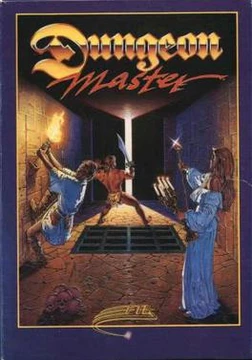
The Bard's Tale III: Thief of Fate
A party of adventurers seeks artifacts across parallel worlds.
The third chapter in the Bard's Tale series, Thief of Fate, is a fantasy role-playing game from 1988. Interplay Productions published it, with Rebecca Heineman, Bruce Schlickbernd, and Michael A. Stackpole handling design. Players could find it on the Amiga, Apple II (64k), Commodore 64, and MS-DOS.
Quick Facts
- Developer
- Interplay Productions; Krome Studios (remaster)
- Publisher
- Electronic Arts; inXile Entertainment (remaster)
- Director
- Brian Fargo
- Producer
- David Albert
- Designer
- Rebecca Heineman
- Bruce Schlickbernd
- Michael A. Stackpole
- Brian Fargo
- Programmer
- Rebecca Heineman
- Artist
- Nancy L. Fong; Todd J. Camasta
- Writer
- Michael A. Stackpole
Facts from the source article.
Plot
The adventure begins when a dying man sends a letter to the party. He explains that while they were celebrating their victory over the evil wizard Mangar, Mangar's true master, the Mad God Tarjan, appeared and released monstrous creatures that wiped out the town of Skara Brae. The game's box cover describes the aftermath: Skara Brae lies in ruins. Roscoe's Energy Emporium is empty. The Equipment Shoppe collapsed so fast that Garth was crushed. The Bard has not stopped whimpering since he realized every tavern is closed. Some force has sealed the city's fate with an evil so immense that even a host of Paladins and an army of Archmages cannot stand against it. Hard times call for a different approach. Smaller is better. Sneakier is better. What the world needs is a thief. The Thief of Fate.
The game starts in a refugee camp located outside the destroyed Skara Brae, which takes the place of the adventurer's guild from earlier games. The wilderness around the ruins contains a temple for healing, a tavern, and several special locations where the party will begin missions to other worlds. Skara Brae itself has been greatly reduced in size. Its ruins now occupy a 16x16 map tile area, compared to the 30x30 layout from The Bard's Tale I, though the original layout can still be recognized. Inside the ruins of the Review Board, an old man who is the only survivor tells the party to first kill Brilhasti ap Tarj, a servant of the Mad God Tarjan, in the "Mad God" dungeon beneath Skara Brae. This is a starting quest meant to help the characters gain power, but it can be skipped if the party has brought over powerful characters from previous games. After that, the old man instructs the group to retrieve artifacts from several other worlds. He also teaches them chronomancer spells, which they must use at specific points in the wilderness to travel to parallel dimensions and return.
Development
The Bard's Tale III was developed without series creator Michael Cranford, who had left Interplay to study philosophy and theology. Programmer Heineman revealed the game was originally planned as Tales of the Unknown - Volume III: The Thief's Tale. He later tried to make new Bard's Tale games but could not secure the rights from Electronic Arts. Michael A. Stackpole wrote the game's storyline and created its maps. He went on to become a well-known author, writing many novels for the Star Wars and BattleTech series.
Reception
A 1988 review in Computer Gaming World noted that Bard's Tale III was an improvement on its predecessor, though it remained "still too heavily oriented towards mega-combat." The same publication later stated in 1993 that "the series redeemed itself with the third installment, flawed though it was," adding that "the best parts are the quests themselves ... worth playing." A common frustration with the game was the apparent absence of a way to instantly recharge spell points for a fee, as had been possible at Roscoe's Energy Emporium in the first two titles. In reality, spellcasters can restore spell points by stepping on any "magic regeneration square" found in dungeons, but the manual mentions this only in passing, and the effect produces no sound or visual cue unless a high-level spell is cast. The game received a 3 out of 5 star rating in Dragon #138 (1988) from Hartley, Patricia, and Kirk Lesser in "The Role of Computers" column. A retrospective review from AllGame gave it a 3.5 out of 5, calling it a larger and improved version of Bard's Tale II, but noted that the puzzles are less diverse and the storyline is weak.
Legacy
The remastered edition of The Bard's Tale III: Thief of Fate arrived as part of The Bard's Tale Trilogy on February 26, 2019. This project began when inXile, during its Kickstarter for a new fourth game, partnered with Rebecca Heineman’s Olde Sküül to update the original trilogy for modern Mac and Windows computers, rather than using emulated versions. Development hit a deadlock, so Olde Sküül and inXile handed the work over to Krome Studios. After Microsoft acquired inXile, the remastered trilogy came to Xbox One on August 13, 2019, and supports Xbox Play Anywhere.
Frequently Asked Questions
Who published The Bard's Tale III: Thief of Fate?
The Bard's Tale III: Thief of Fate was published by Electronic Arts and inXile Entertainment (remaster).
What platforms is The Bard's Tale III: Thief of Fate available on?
The Bard's Tale III: Thief of Fate was released for Amiga, Apple II, Commodore 64, MS-DOS, PC-98, Windows and Xbox One.
Who designed The Bard's Tale III: Thief of Fate?
The Bard's Tale III: Thief of Fate was designed by Rebecca Heineman, Bruce Schlickbernd, Michael A. Stackpole and Brian Fargo.
More in First-person Party-based Dungeon Crawler Video Games
Spotted an error? Know more?
Reader corrections go straight into our review queue. Suggest an edit · How this site is sourced