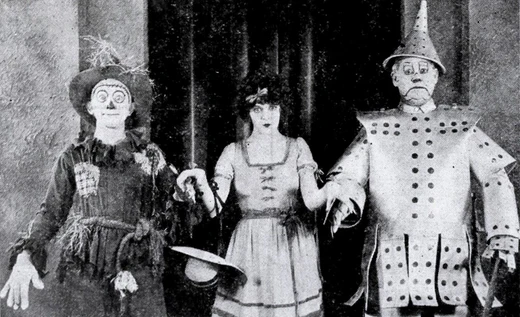
The Fairylogue and Radio-Plays
An early mixed-media Oz adaptation with live Baum.
Last updated
The Fairylogue and Radio-Plays was an early mixed-media adaptation of L. Frank Baum's Oz books, combining live actors, hand-tinted lantern slides, and film. Baum himself appeared on stage as a lecturer, interacting with characters both live and on screen. It is notable in film history for containing the earliest documented original film score.
Michael Radio Color
The films were hand-tinted by Duval Frères of Paris in a process called "Radio-Play," noted for lifelike coloring. Baum claimed a Frenchman named Michael Radio colored them, but no evidence of such a person exists. The term "Radio" did not refer to radio technology but evoked novelty, like later uses of "high-tech." The "Fairylogue" part likened the show to a travelogue, a popular documentary format at the time.
Adaptation
The production drew from Baum's books The Wonderful Wizard of Oz, The Marvelous Land of Oz, Ozma of Oz, and John Dough and the Cherub. Intermission slides previewed Dorothy and the Wizard in Oz, not yet sold.
Francis Boggs directed the Oz material; Otis Turner directed John Dough and the Cherub. Romola Remus played the first film Dorothy. The Woggle-Bug was absent, having been the title character of a failed musical three years earlier.
Production
The New York Times ran a full-page article on the show in late 1909, over a year after its run. In New York, the Times listed it with plays rather than films, highlighting Baum's live stage appearances. The Radio-Play Company of America produced it, with John B. Shaw, Jr. as general manager.
Sets were by E. Pollack, costumes by Fritz Schultz and Chicago Costuming Co., properties by Charles van Duzen, mechanical effects by Paul Dupont, wigs by Hepner, shoes by Marshall Field & Co., and jewels loaned by C.D. Peacock. Selig Polyscope Company was involved in film production, leading to erroneous conclusions that later Oz films derived from this material. Otis Turner likely directed both film versions of John Dough and the Cherub, both lost; they may have been the same film, but that is considered unlikely, as Fairylogue was probably a single print discarded by the Baum family after decomposition.
Did You Know?
- The score debuted four months before Camille Saint-Saëns's score for The Assassination of the Duke of Guise.
- Baum, in a white suit, would step behind the screen and into the film, pulling actors on stage.
- The show cost more to produce than sold-out houses could bring in.
Frequently Asked Questions
Who stars in The Fairylogue and Radio-Plays?
The Fairylogue and Radio-Plays stars L. Frank Baum, Romola Remus, Frank Burns, George E. Wilson, Joseph Schrode, Burns Wantling and Grace Elder.
When was The Fairylogue and Radio-Plays released?
The Fairylogue and Radio-Plays was released on 24 September 1908.
Who composed the music for The Fairylogue and Radio-Plays?
The music for The Fairylogue and Radio-Plays was composed by Nathaniel D. Mann.
More in Films Based on The Wonderful Wizard of Oz
Sources
Compiled from Wikipedia and the sources listed below. Text from Wikipedia is available under CC BY-SA 4.0; this entry is adapted from it.
- Wikipedia: The Fairylogue and Radio-Plays (CC BY-SA 4.0).
Spotted an error? Know more?
Reader corrections go straight into our review queue. Suggest an edit · How this site is sourced