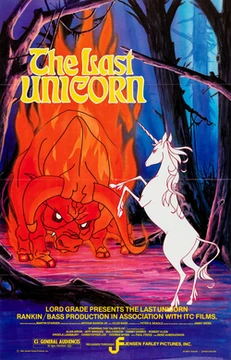
The Last Unicorn (film)
A 1982 animated fantasy film based on Peter S. Beagle's novel.

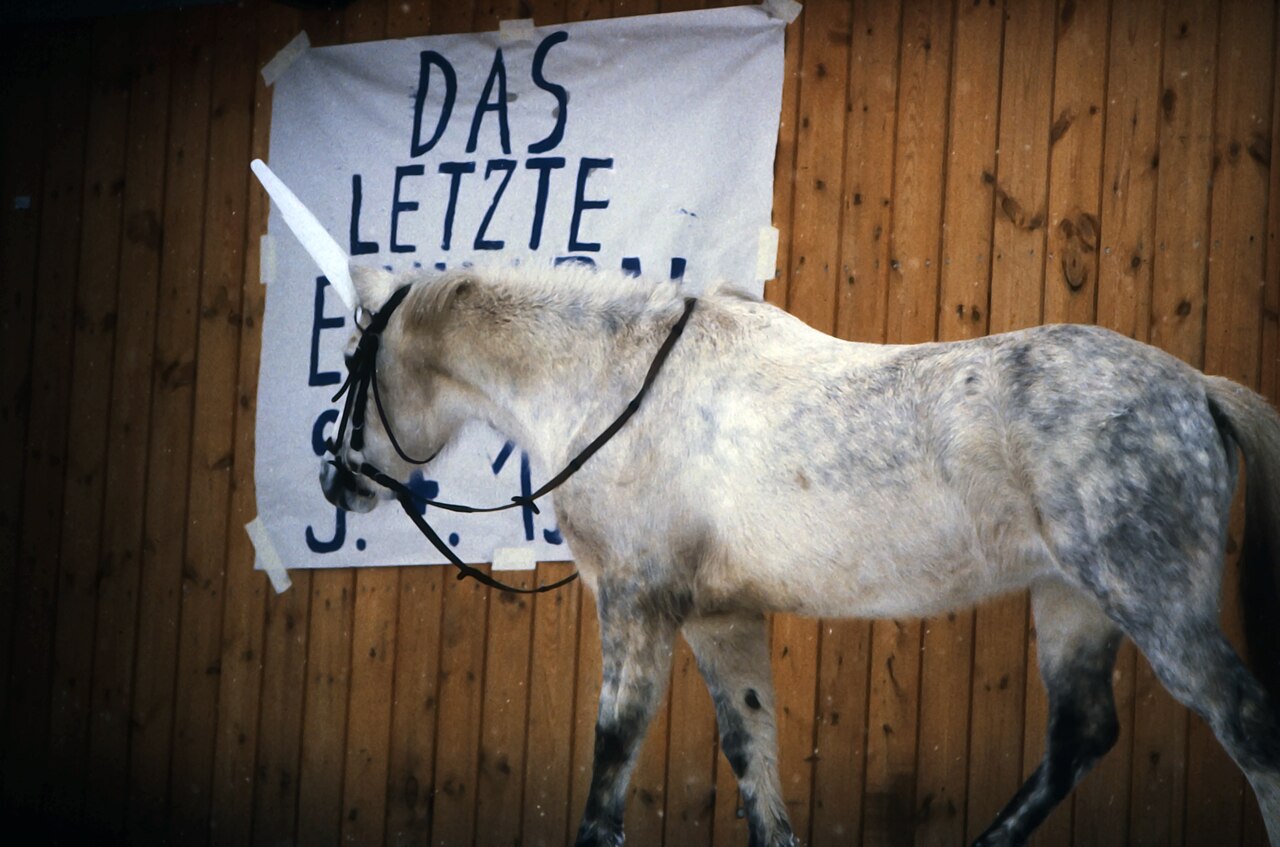
Rüdiger Stehn from Kiel, Deutschland · CC BY-SA 2.0
In 1982, the animated fantasy film *The Last Unicorn* was directed and produced by Arthur Rankin Jr. and Jules Bass. Peter S. Beagle wrote the screenplay, adapting it from his own 1968 novel of the same name. The story follows a unicorn who discovers she is the last of her kind and sets out to find the others. The film was produced by Rankin/Bass Productions for ITC Entertainment, with animation handled by Topcraft.
The voice cast includes Mia Farrow, Alan Arkin, Jeff Bridges, Angela Lansbury, and Christopher Lee. Jimmy Webb composed and arranged the soundtrack, with songs performed by the group America and the London Symphony Orchestra, plus additional vocals from Lucy Mitchell.
Critics generally gave the film positive reviews, but it was a commercial disappointment, earning $6.5 million in the United States. Over time, it developed a cult following.
The plot begins when a female unicorn learns from a butterfly that she is the last of her kind. A malevolent entity called the Red Bull has herded nearly all unicorns to the ends of the earth, so she sets off to find them. She is captured by the witch Mommy Fortuna and displayed in her Midnight Carnival, where most attractions are ordinary animals disguised by illusions. Fortuna uses a spell to create a false horn on the unicorn’s head, since visitors cannot see her true form. Fortuna also keeps the immortal harpy Celaeno captive, considering the risk worth the prestige. The unicorn befriends Schmendrick, an incompetent magician working for Fortuna, and with his help she escapes, freeing the other animals. Celaeno kills Fortuna.
The unicorn and Schmendrick continue traveling until Schmendrick is captured by bandits led by Captain Cully and tied to a tree. While trying to free himself, he brings the tree to life, and it attempts to seduce him until the unicorn arrives and frees him. Molly Grue, Cully’s lover, weeps at the sight of the unicorn and abandons Cully to join them. Near King Haggard’s castle, they encounter the Red Bull, a monstrous fire elemental. It attacks the unicorn, and Schmendrick transforms her into a woman to save her. The Bull loses interest and leaves, but the unicorn panics over her new mortality. Schmendrick promises to reverse the change once their quest is complete.
Quick Facts
- Director
- Arthur Rankin Jr. · Jules Bass
- Producer
- Arthur Rankin Jr. · Jules Bass · Masaki Iizuka
- Screenplay
- Peter S. Beagle
- Based On
- The Last Unicorn · Peter S. Beagle
- Starring
- Alan Arkin / Jeff Bridges / Mia Farrow / Tammy Grimes / Robert Klein / Angela Lansbury / Christopher Lee / Keenan Wynn / Paul Frees / René Auberjonois
- Music
- Jimmy Webb
- Editing
- Tomoko Kida
- Cinematography
- Hiroyasu Omoto
- Studio
- Rankin/Bass Productions / Topcraft / ITC Films
- Distributor
- Jensen Farley Pictures
- Released
- 19 November 1982
- Runtime
- 93 minutes
Facts from the source article.
Lore & Background
The film follows a female unicorn who learns from a butterfly that she is the last of her kind after a malevolent entity called the Red Bull herded nearly all unicorns to the ends of the earth. She sets off on a journey to find them. She is captured by the witch Mommy Fortuna and displayed in her Midnight Carnival, but escapes with the help of Schmendrick, an incompetent magician. They are joined by Molly Grue, who abandons her lover Captain Cully to travel with them. Near King Haggard's castle, the Red Bull attacks the unicorn, and Schmendrick transforms her into a woman to save her. The now-human unicorn, called Lady Amalthea, enters Haggard's court and falls in love with his adopted son Prince Lír.
Reader's Guide
Although critical reviews were generally positive, the film was a commercial failure, grossing $6.5 million in the United States. It has since maintained a cult following. In 2003, the Online Film Critics Society ranked the film as the 96th greatest animated film of all time. The soundtrack was composed and arranged by Jimmy Webb, with songs performed by the group America and the London Symphony Orchestra, and additional vocals by Lucy Mitchell. Voice performers include Alan Arkin, Jeff Bridges, Mia Farrow, Angela Lansbury, and Christopher Lee. Peter S. Beagle initially was 'horrified' by the deal with Rankin/Bass but later came to feel the film is 'a good deal more than I had originally credited.' The film's legacy endures through its loyal fanbase and recognition as a notable animated work.
Production & Creative Collaboration
The 1982 animated feature was a collaborative effort spanning multiple creative houses. Arthur Rankin Jr. and Jules Bass directed and produced the project through their Rankin/Bass Productions banner, with ITC Entertainment handling distribution. The animation was outsourced to Topcraft, the Dutch studio known for its work in the field. Peter S. Beagle adapted his own 1968 novel into the screenplay, giving the project a strong literary foundation. The musical score was composed and arranged by Jimmy Webb, with songs performed by the folk-rock group America alongside the London Symphony Orchestra, and Lucy Mitchell contributing additional vocal work. The voice cast assembled a remarkable ensemble: Mia Farrow as the Unicorn, Alan Arkin as the bumbling magician Schmendrick, Jeff Bridges as Prince Lír, Angela Lansbury as the witch Mommy Fortuna, and Christopher Lee as King Haggard. Tammy Grimes voiced Molly Grue, and Robert Klein provided the voice of the Butterfly, completing a cast that elevated the material well beyond typical animated fare of the period.
Narrative Arc & Thematic Depth
The story follows a female unicorn who, after learning from two hunters and a butterfly that she is the sole survivor of her species, embarks on a quest to discover what became of her kin. The Red Bull, a monstrous fire elemental, is responsible for herding nearly all unicorns to the edges of the earth. Along the way, the Unicorn is captured by the witch Mommy Fortuna and displayed at her Midnight Carnival, where most mythical attractions are merely ordinary animals enhanced by illusion. She escapes with the help of Schmendrick, an incompetent magician in Fortuna's employ. Later, the Red Bull attacks, and Schmendrick transforms the Unicorn into a human woman to save her, granting her mortality and the capacity to feel regret and love. At King Haggard's castle, she falls for Prince Lír and nearly abandons her quest. In the climax, Lír is killed defending her from the Bull, and the Unicorn, enraged, drives the Bull into the sea, freeing the imprisoned unicorns and causing Haggard's castle to collapse. She revives Lír and departs, having learned what it means to love and to grieve.
Reception, Box Office & Enduring Legacy
Despite generally favorable critical reception upon its 1982 release, The Last Unicorn proved a commercial disappointment, earning approximately $6.5 million in the United States. This gap between critical appreciation and audience box-office performance proved typical for the film's trajectory. Over the decades that followed, the picture cultivated a devoted cult following that sustained its cultural presence long after its initial theatrical run. In 2003, the Online Film Critics Society recognized its lasting significance by ranking it the 96th greatest animated film of all time, a testament to how the work resonated with viewers well beyond the constraints of its release window. The film's blend of literary source material, a distinguished voice cast, and Jimmy Webb's evocative score gave it a quality that transcended the typical animated feature of its era. Its themes of mortality, loss, and the bittersweet nature of love continue to find new audiences, ensuring the Unicorn's journey remains a touchstone for fans of fantasy animation.
Voice Performances & Character Interpretations
The film's voice ensemble brought distinctive energy to each role, though not without creative friction. Peter S. Beagle noted some disappointment with Alan Arkin's portrayal of Schmendrick, feeling the performance came across as too flat for the character's intended depth. Conversely, Beagle expressed deep gratitude toward Tammy Grimes, whose vocal work on Molly Grue compensated for the lack of detailed backstory he had written for the character, breathing life into a role that might otherwise have remained thin. Jeff Bridges delivered Prince Lír with an emotional directness captured in the declaration that he loves whom he loves, a line that anchors the romantic core of the story. Christopher Lee, whom Beagle called the last of the great twentieth-century actors and either the most or second-most literate performer of his generation, brought gravitas to King Haggard. Mia Farrow carried the dual identity of the Unicorn and Lady Amalthea, while Angela Lansbury's Mommy Fortuna and Robert Klein's Butterfly added memorable color to the supporting cast.
Gallery
Frequently Asked Questions
Who made The Last Unicorn (film)?
Arthur Rankin Jr. and Jules Bass both directed and produced the 1982 animated feature under their Rankin/Bass Productions banner, with Topcraft handling the animation work.
What is The Last Unicorn (film) about?
It follows a unicorn who discovers she is the very last of her kind and sets out on a journey to find the others who have vanished.
Who voices the characters in The Last Unicorn (film)?
Mia Farrow lends her voice to the unicorn, joined by Alan Arkin, Jeff Bridges, Angela Lansbury, and Christopher Lee in the supporting roles.
What is The Last Unicorn (film) based on?
The screenplay was written by Peter S. Beagle, who adapted it directly from his own 1968 novel of the same name.
Who composed the music for The Last Unicorn (film)?
Jimmy Webb handled both the composition and arrangement of the soundtrack, with the vocal performances delivered by the film's cast.
More in Films about unicorns 1-22
Spotted an error? Know more?
Reader corrections go straight into our review queue. Suggest an edit · How this site is sourced