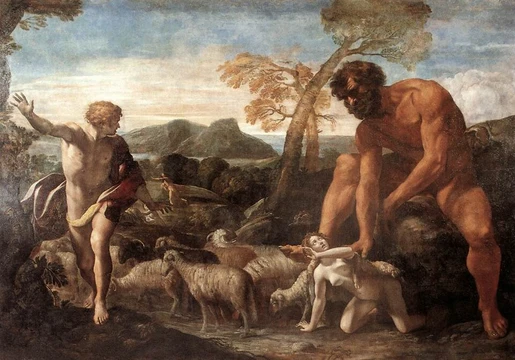
The Three Sisters (fairy tale)
A maiden cures a prince after overhearing an ogre's secret.
"The Three Sisters" or "Green Meadow" (Italian: Verde Prato) is an Italian literary fairy tale by Giambattista Basile, published in his 1634 work the Pentamerone. It follows a maiden who uses magic for secret meetings with a prince, his near-fatal injury, and her quest to heal him. The tale is classified as Aarne-Thompson-Uther type ATU 432, "The Prince as Bird."
Quick Facts
- Alternate title
- Green Meadow (Verde Prato)
- Author
- Giambattista Basile
- Published in
- Pentamerone
- Year
- 1634
- Atu type
- ATU 432 (The Prince as Bird)
Facts from the source article.
Synopsis
A woman had three daughters. The two older ones were very unlucky, but the youngest, Nella, was very fortunate. A prince married Nella and kept her hidden from his cruel mother, visiting her secretly. Whenever Nella threw a special powder into the fire, the prince could travel to her along a crystal road. Her sisters discovered this trick and shattered the road, causing the prince to be badly hurt as he came to her. He lay dying. The king, his father, announced that anyone who could heal the prince would marry him if female, or receive half the kingdom if male. Nella heard the news and left home. She climbed a tree and hid, where she overheard an ogre telling his wife that only the fat from their own bodies could cure the prince. Nella came down and knocked on their door, pretending to be a beggar. The ogre, wanting to eat her, convinced his wife to let her stay. While they slept, Nella killed them both and took their fat. She brought the fat to the king and healed the prince. The prince said he could not marry her because he was already married. Nella asked if he wanted to be married to the person who caused his injury, and the prince blamed her sisters. Then Nella revealed she was his wife. Her sisters were thrown into an oven.
Variants
A Roman tale collected by Rachel Harriette Busk, known as "Il Vaso di Persa" or "The Pot of Marjoram," follows a rich merchant with three daughters. Before leaving for market, he asks what they want. The eldest requests shawls woven with golden threads, the middle one coverlets of bird plumage, and the youngest a simple pot of marjoram. The merchant finds the elder gifts but cannot locate the flower pot. On his way home, a strange-looking man approaches and offers the pot for three hundred thousand scudi. The merchant buys it. Back home, the youngest takes the pot to her room and stays shut inside for some time. Learning of the cost, the elder sisters grow jealous and decide to destroy the pot. They convince their father to take their sister for a walk, and while she is away, they throw the pot out the window, shattering it. Discovering this, the girl leaves home. She meets a fairy (Busk's translation of the original "fata"), who gives her male clothing and provisions. She travels into a dense forest and climbs a tree to rest. A couple of bears stop by the tree and begin talking. Thanks to the fairy's powers, the girl overhears them discussing how the king of Persia fell from a high tower, broke his bones, and has glass shards embedded in him. The only cure, the bears say, is fat from their bodies melted with honey and wax, followed by a warm water bath to remove the glass. The girl kills the bears, takes their fat, melts it with honey and wax (also provided by the fairy), and goes to Persia to cure the king. She follows the bears' instructions and spends time in the palace. The king takes her as his queen.
More in Fairy Tales About Ogres
Spotted an error? Know more?
Reader corrections go straight into our review queue. Suggest an edit · How this site is sourced