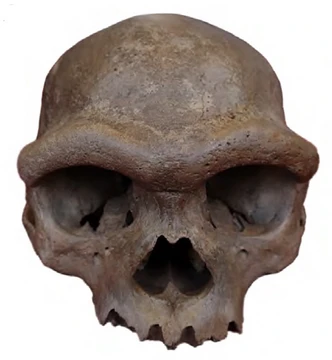
Australopithecus africanus
Early hominin from South Africa; first evidence of human evolution in Africa.
Last updated
Its anatomy combined human-like bipedal traits with ape-like features such as long arms and a sloping face.[1] Between roughly 3.3 and 2.1 million years ago, during the Late Pliocene to Early Pleistocene, an extinct australopithecine species known as Australopithecus africanus existed in South Africa.[2]
Scientific classification
- KingdomAnimalia
- PhylumChordata
- InfraclassPlacentalia
- OrderPrimates
- SuperfamilyHominoidea
- FamilyHominidae
- Genus†Australopithecus
- SpeciesAustralopithecus africanus
Named by Dart, 1925
Close relatives
Other species of Australopithecus with a Codexery entry.
- Australopithecus afarensis Australopithecus afarensis
- Australopithecus anamensis Australopithecus anamensis
- Australopithecus bahrelghazali Australopithecus bahrelghazali
- Australopithecus deyiremeda Australopithecus deyiremeda
- Australopithecus garhi Australopithecus garhi
Sources: Wikipedia taxobox: Australopithecus africanus (CC BY-SA 4.0)
Quick Facts
- Species
- africanus
Facts from the source article.
Key facts and history
Dart’s claim that it was a human ancestor was rejected because most scientists then believed large brains evolved before bipedalism.[3] A 1946 monograph by Broom and Schepers, plus papers by Wilfrid Le Gros Clark, turned scientific opinion in favor of A. africanus as a human ancestor.[4] Wider acceptance led to the 1953 exposure of the Piltdown Man hoax.[4] The species is considered a grade taxon, and its relation to other hominins remains unclear.[5]
Sir Arthur Keith was a prominent figure among those who rejected A. africanus, instead classifying it as belonging to the gorilla or chimpanzee lineages.[3]
What the cited sources add
That same source states that no stone tools have been found with A. africanus fossils, though researchers long believed it was a hunter.[1] According to the humanorigins.si.edu account, A. africanus possessed a cranium that was more rounded and teeth that were smaller than those of A. afarensis.[1] The humanorigins.si.edu account clarifies that broken animal bones once thought to be weapons used by A. africanus were actually the result of feeding by predators like lions and hyenas.[1] The humanorigins.si.edu source states that A. africanus ate a diet similar to that of modern chimpanzees, which included fruit, plants, nuts, seeds, roots, insects, and eggs.[1]
Dental microwear studies, as reported by humanorigins.si.edu, revealed that A. africanus teeth had more scratches than pits, which suggests they ate tough foods and had a diet that varied.[1] The humanorigins.si.edu source reports that A. africanus is, at present, the most ancient early human species known from southern Africa.[1]
References
- "Australopithecus africanus", humanorigins.si.edu, 3 January 2024. facts only, no text reused. humanorigins.si.edu
- Wikipedia, "Australopithecus africanus" (CC BY-SA 4.0), which cites: "Australopithecus africanus", humanorigins.si.edu, 3 January 2024 (we also read that source) en.wikipedia.org
- Wikipedia, "Australopithecus africanus" (CC BY-SA 4.0), which cites: Tobias, "Ape-Like Australopithecus After Seventy Years: Was It a Hominid?", The Journal of the Royal Anthropological Institute, 1998, p. 283–308 (original not read by us) en.wikipedia.org
- Wikipedia, "Australopithecus africanus" (CC BY-SA 4.0), which cites: Tobias, "Ape-Like Australopithecus After Seventy Years: Was It a Hominid?", The Journal of the Royal Anthropological Institute, 1998, p. 283–308; Broom, "Further Remains of the Sterkfonstein Ape-Man, Plesianthropus", Nature, 1947, p. 430; Tobias, "Ape-Like Australopithecus After Seventy Years: Was It a Hominid?", The Journal of the Royal Anthropological Institute, 1998, p. 283–308 (original not read by us) en.wikipedia.org
- Wikipedia, "Australopithecus africanus" (CC BY-SA 4.0), which cites: McNulty, "Hominin Taxonomy and Phylogeny: What's In A Name?", Nature Education Knowledge, 2016, p. 2 (original not read by us) en.wikipedia.org
Each numbered sentence above was checked against the source it cites before publication. Sentences citing Wikipedia adapt text from the English Wikipedia article Australopithecus africanus (contributors), used under CC BY-SA 4.0; this entry is available under the same licence. Other sources were used for facts only; no text or images are copied from them.
More in Extinct Hominins
Sources
Compiled from Wikipedia and the sources listed below. Text from Wikipedia is available under CC BY-SA 4.0; this entry is adapted from it.
- Wikipedia: Australopithecus africanus (CC BY-SA 4.0).
- Word definitions: the , each quoted from its Wikipedia article.
Spotted an error? Know more?
Reader corrections go straight into our review queue. Suggest an edit · How this site is sourced