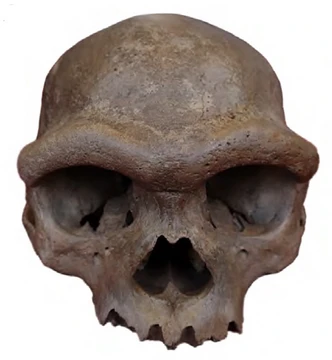
Ardipithecus ramidus
Early hominin with mixed bipedal and arboreal adaptations.
Last updated
Ardipithecus ramidus is a fossil hominin species discovered in Ethiopia from 1992 to 1993, with remains dated to about 4.4 million years ago.[1] The female specimen known as "Ardi" (catalog number ARA-VP 6/500) is the most complete fossil found, with an estimated height between 117 and 124 cm and a weight of 51 kg.[2][1] Academic understanding of the chimpanzee–human last common ancestor was transformed by the discovery of Ardipithecus, along with Miocene apes.[3]
Scientific classification
- KingdomAnimalia
- PhylumChordata
- InfraclassPlacentalia
- OrderPrimates
- SuperfamilyHominoidea
- FamilyHominidae
- Genus†Ardipithecus
- SpeciesArdipithecus ramidus
Named by (White, Suwa & Asfaw, 1994)
Close relatives
Other species of Ardipithecus with a Codexery entry.
- Ardipithecus kadabba Ardipithecus kadabba
Sources: Wikipedia taxobox: Ardipithecus ramidus (CC BY-SA 4.0)
Where the ardipithecus ramidus has been recorded
Map: drawn by Codexery. Data: Natural Earth basemap (public domain) · place coordinates: Wikipedia (CC BY-SA 4.0)
Quick Facts
- Species
- ramidus
Facts from the source article.
Key facts and history
In 2001, older fossils from the Middle Awash were classified as a subspecies, later split into the species A. kadabba, considered the direct ancestor of A. ramidus.[4] A. ramidus had a small brain of 300–350 cc, slightly smaller than a modern chimp brain.[5] Its upper canine teeth showed little size difference between males and females, unlike chimpanzees.[5] The species had a grasping big toe adapted for tree climbing but also adaptations for bipedality.[6][7]
In 1994, the species was first placed in the genus Australopithecus and given the name ramidus, taken from the Afar word for "root".[1] A corrigendum published in 1995 reassigned the species to a new genus, Ardipithecus, whose name comes from the Afar word for "ground".[1] At As Duma in the Gona Western Margin, remains from at least nine individuals were excavated between 1993 and 2003.[8]
What the cited sources add
Herbivore teeth from the Gona Western Margin, analyzed for carbon isotopes, show those animals ate mostly C4 plants and grasses.[9] Bushland and grasslands appear to have been present in that same region.[9]
References
- Wikipedia, "Ardipithecus ramidus" (CC BY-SA 4.0), which cites: White, "Australopithecus ramidus, a new species of early hominid from Aramis, Ethiopia", Nature, 1994, p. 306–312; White, "Corrigendum: Australopithecus ramidus, a new species of early hominid from Aramis, Ethiopia", Nature, 1995, p. 88; White, "Neither chimpanzee nor human, Ardipithecus reveals the surprising ancestry of both", Proceedings of the National Academy of Sciences of the United States of America, 2015, p. 4877–4884 (original not read by us) en.wikipedia.org
- Wikipedia, "Ardipithecus ramidus" (CC BY-SA 4.0), which cites: Lovejoy, "The Great Divides: Ardipithecus ramidus Reveals the Postcrania of Our Last Common Ancestors with African Apes", Science, 2009, p. 73–106; White, "Neither chimpanzee nor human, Ardipithecus reveals the surprising ancestry of both", Proceedings of the National Academy of Sciences of the United States of America, 2015, p. 4877–4884 (original not read by us) en.wikipedia.org
- Wikipedia, "Ardipithecus ramidus" (CC BY-SA 4.0), which cites: White, "Neither chimpanzee nor human, Ardipithecus reveals the surprising ancestry of both", Proceedings of the National Academy of Sciences, 2015-04-21, p. 4877–4884 (original not read by us) en.wikipedia.org
- Wikipedia, "Ardipithecus ramidus" (CC BY-SA 4.0), which cites: Haile-Selassie, "Late Miocene hominids from the Middle Awash, Ethiopia", Nature, 2001, p. 179–181; Haile-Selassie, "Late Miocene Teeth from Middle Awash, Ethiopia, and Early Hominid Dental Evolution", Science, 2004, p. 1503–1505; Lovejoy, "Ardipithecus and Early Human Evolution in Light of Twenty-First-Century Developmental Biology", Journal of Anthropological Research, 2014, p. 337–363 (original not read by us) en.wikipedia.org
- Wikipedia, "Ardipithecus ramidus" (CC BY-SA 4.0), which cites: Suwa, "The Ardipithecus ramidus skull and its implications for hominid origins", Science, 2009, p. 68, 68e1–68e7; White, "Neither chimpanzee nor human, Ardipithecus reveals the surprising ancestry of both", Proceedings of the National Academy of Sciences of the United States of America, 2015, p. 4877–4884; Suwa, "Paleobiological implications of the Ardipithecus ramidus dentition", Science, 2009, p. 69, 94–99 (original not read by us) en.wikipedia.org
- Wikipedia, "Ardipithecus ramidus" (CC BY-SA 4.0), which cites: White, "Ardipithecus ramidus and the Paleobiology of Early Hominids", Science, 2009, p. 75–86; Lovejoy, "Combining Prehension and Propulsion: The Foot of Ardipithecus ramidus", Science, 2011, p. 72–72e8; Sarmiento, "Behavioral and phylogenetic implications of a narrow allometric study of Ardipithecus ramidus", Homo, 2011, p. 75–108 (original not read by us) en.wikipedia.org
- Wikipedia, "Ardipithecus ramidus" (CC BY-SA 4.0), which cites: White, "Neither chimpanzee nor human, Ardipithecus reveals the surprising ancestry of both", Proceedings of the National Academy of Sciences of the United States of America, 2015, p. 4877–4884; Prang, "The African ape-like foot of Ardipithecus ramidus and its implications for the origin of bipedalism", eLife, 2019; Lovejoy, "Combining Prehension and Propulsion: The Foot of Ardipithecus ramidus", Science, 2011, p. 72–72e8; Simpson, "Ardipithecus ramidus postcrania from the Gona Project area, Afar Regional State, Ethiopia", Journal o en.wikipedia.org
- Wikipedia, "Ardipithecus ramidus" (CC BY-SA 4.0), which cites: Semaw, "Early Pliocene hominids from Gona, Ethiopia", Nature, 2005, p. 301–305 (original not read by us) en.wikipedia.org
- Wikipedia, "Ardipithecus ramidus" (CC BY-SA 4.0), which cites: Levin, "The Geology of Early Humans in the Horn of Africa", Geological Society of America Special Paper, 2008, p. 215–234 (we also read that source) en.wikipedia.org
Each numbered sentence above was checked against the source it cites before publication. Sentences citing Wikipedia adapt text from the English Wikipedia article Ardipithecus ramidus (contributors), used under CC BY-SA 4.0; this entry is available under the same licence. Other sources were used for facts only; no text or images are copied from them.
More in Extinct Hominins
Sources
Compiled from Wikipedia and the sources listed below. Text from Wikipedia is available under CC BY-SA 4.0; this entry is adapted from it.
- Wikipedia: Ardipithecus ramidus (CC BY-SA 4.0).
- Occurrence records: GBIF (CC0 / CC BY). Basemap: Natural Earth (public domain).
- Word definitions: the , each quoted from its Wikipedia article.
Spotted an error? Know more?
Reader corrections go straight into our review queue. Suggest an edit · How this site is sourced