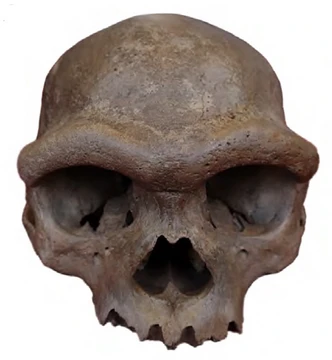
Australopithecine
Extinct close relatives of modern humans, ancestral to Homo.
Last updated
Modern humans and the genus Homo together with these extinct, close relatives form the human clade.[1] The related genera Australopithecus and Paranthropus generally encompass any species considered australopithecines.[2]
Scientific classification
- KingdomAnimalia
- PhylumChordata
- InfraclassPlacentalia
- OrderPrimates
- SuperfamilyHominoidea
- FamilyHominidae
Named by Gregory & Hellman, 1939
Sources: Wikipedia taxobox: Australopithecine (CC BY-SA 4.0)
Quick Facts
- Type species
- Australopithecus africanus
Facts from the source article.
Key facts and history
All known australopithecines are from Africa.[3] The oldest australopithecines are known from about 4.37-3.82 Ma, and the youngest up to 0.87 Ma.[3] They occurred in the Late Miocene sub-epoch and were bipedal.[4] Evidence from their post-cranial skeletons indicates they were capable of bipedal locomotion, though their gait differed from that of humans.[5]
Compared to other hominins, they possessed a higher forearm-to-upper arm ratio, one that approximated the Golden Ratio.[5] The degree of size difference between males and females in australopithecines was intermediate: more than what is seen in Homo or Pan, but less than in Gorilla or Pongo.[6][7] Estimates for their average stature range from 1.2 to 1.5 meters, with body mass falling between 30 and 55 kilograms.[6][7] Their cranial capacity is thought to have been between 350 and 600 cubic centimeters.[6][7]
What the cited sources add
The GEOL 204 account describes australopithecines as "plains apes" adapted to life outside the forest.[3] It notes they are associated with the Oldowan toolkit, a simple set of stone-tools.[3] Szpak's investigation states the robust australopithecines possessed greatly enlarged cheek teeth with very thick enamel compared to gracile forms.[7] Szpak also notes that extant primate species with thick enamel tend to feed on hard objects, and a similar diet has been proposed for australopithecines.[7]
The GEOL 204 account states that habilines show a marked increase in brain size over their australopithecine relatives.[3]
References
- Wikipedia, "Australopithecine" (CC BY-SA 4.0), which cites: "GEOL 204 The Fossil Record: The Scatterlings of Africa: the Origins of Humanity", www.geol.umd.edu (we also read that source) en.wikipedia.org
- Wikipedia, "Australopithecine" (CC BY-SA 4.0), which cites: ; ; (original not read by us) en.wikipedia.org
- "GEOL 204 The Fossil Record: The Scatterlings of Africa: the Origins of Humanity", www.geol.umd.edu. facts only, no text reused. geol.umd.edu
- Wikipedia, "Australopithecine" (CC BY-SA 4.0), which cites: Mai Owl Kersting 2005, p. ; Szpak, "Evolution of the Australopithecines", Tree of Life, 2007 (we also read that source) en.wikipedia.org
- Wikipedia, "Australopithecine" (CC BY-SA 4.0), which cites: Wang, "A Special Golden Curve in Human Upper Limbs' Length Proportion: A Functional Partition Which Is Different from Anatomy", BioMed Research International, 2017-01-23; Wang, "A Special Golden Curve in Human Upper Limbs' Length Proportion: A Functional Partition Which Is Different from Anatomy", BioMed Research International, 2024-04-05, p. 1–6 (original not read by us) en.wikipedia.org
- Wikipedia, "Australopithecine" (CC BY-SA 4.0), which cites: Szpak, "Evolution of the Australopithecines", Tree of Life, 2007 (we also read that source) en.wikipedia.org
- Szpak, "Evolution of the Australopithecines", Tree of Life, 2007. facts only, no text reused. tolweb.org
Each numbered sentence above was checked against the source it cites before publication. Sentences citing Wikipedia adapt text from the English Wikipedia article Australopithecine (contributors), used under CC BY-SA 4.0; this entry is available under the same licence. Other sources were used for facts only; no text or images are copied from them.
More in Extinct Hominins
Sources
Compiled from Wikipedia and the sources listed below. Text from Wikipedia is available under CC BY-SA 4.0; this entry is adapted from it.
- Wikipedia: Australopithecine (CC BY-SA 4.0).
- Word definitions: the Codexery glossary, each quoted from its Wikipedia article.
Spotted an error? Know more?
Reader corrections go straight into our review queue. Suggest an edit · How this site is sourced