
Vasco da Gama
Portuguese explorer who opened the sea route to India.

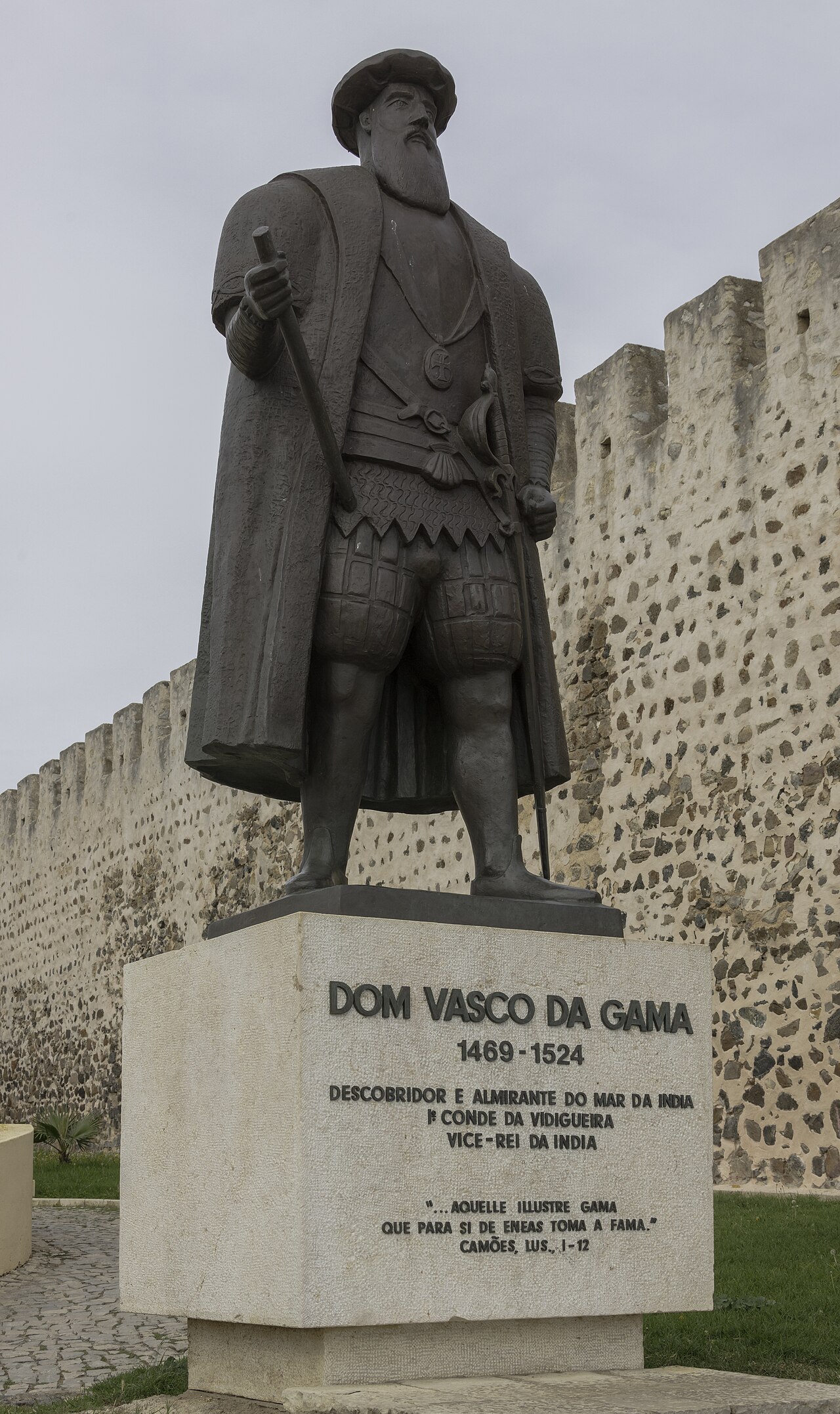
Diego Delso · CC BY-SA 4.0
Vasco da Gama was a Portuguese mariner, explorer, and nobleman who commanded the first expedition to link Europe and Asia by an ocean route that rounded the southern tip of Africa. Although earlier Portuguese sailors had already passed the Cape of Good Hope, da Gama’s voyage from 1497 to 1499 was the first to complete the full journey to India, landing at Kozhikode on 20 May 1498. This achievement allowed Portugal to bypass the contested Mediterranean Sea and the overland trade routes controlled by Arab merchants, opening direct access to the spice trade of Southeast Asia. The outward and return trips were the longest ocean voyages ever undertaken at that time. Da Gama’s success marked the beginning of a sea-based phase of international eastern trade and an era of global imperialism, enabling Portugal to establish a colonial empire along the route from Africa to Asia at the expense of existing Arab networks. The main spices initially obtained were pepper and cinnamon, and Portugal maintained a commercial monopoly over these commodities for several decades before other European powers could challenge its naval supremacy. Da Gama led two of the Portuguese India Armadas, the first and the fourth, the latter being the largest. For his accomplishments, he was ennobled as the Count of Vidigueira in 1519 and appointed Governor of India with the title of Viceroy in 1524. He remains a leading figure in exploration, celebrated in homages worldwide and honored in the Portuguese national epic poem *Os Lusíadas* by Luís de Camões.
- born
- c. 1460s, Sines, Portugal
- field
- Maritime exploration
- nationality
- Portuguese
- known_for
- First direct sea route from Europe to India
Lore & Background
Vasco da Gama was born in the town of Sines, a seaport on the Alentejo coast of southwest Portugal. His father, Estêvão da Gama, was a knight in the household of Ferdinand, Duke of Viseu, and later served as civil governor of Sines and a tax receiver for the military Order of Santiago. His mother, Isabel Sodré, came from a family with English descent that was well-connected to the household of Infante Diogo, Duke of Viseu, and prominent in the Order of Christ. Da Gama was the third of five sons; his brothers included Paulo da Gama and João Sodré, and he had one sister, Teresa da Gama. Little is known of his early life, though he may have studied in Évora, where he could have learned mathematics and navigation. Around 1480, he followed his father into the Order of Santiago, whose master was Prince John, later King John II. In 1492, John II sent da Gama to seize French ships in Portuguese ports as retaliation for attacks on Portuguese shipping, a task he performed quickly and effectively. Da Gama is celebrated for discovering the first direct maritime route from Europe to India, rounding the southern tip of Africa and crossing the Indian Ocean from Malindi to Kozhikode. This voyage, the longest known ocean voyage at the time, linked Europe and Asia by sea, allowing Portugal to avoid Mediterranean and Arab trade routes and opening a sea-based phase of international eastern trade. He led two of the Portuguese India Armadas, the first and the fourth, and was later appointed Governor of India with the title of Viceroy, as well as being ennobled as the Count of Vidigueira. The Portuguese national epic poem, *Os Lusíadas*, was written in his honor.
Reader's Guide
This route allowed the Portuguese to avoid sailing across the disputed Mediterranean Sea and trading with Arab Eastern Mediterranean ports. His voyage marked the beginning of a sea-based phase of international eastern trade and an age of global imperialism. The Portuguese later established a long-lasting colonial empire along the route from Africa to Asia at the expense of the existing Arab eastern trade network. Unchallenged access to the Indian spice routes boosted the economy of the Portuguese Empire, which previously was based along North and coastal West Africa. Portugal maintained a commercial monopoly of these commodities for several decades. Da Gama led two of the Portuguese India Armadas, the first and the fourth. He remains a leading figure in the history of exploration; the Portuguese national epic poem, Os Lusíadas, was written in his honor by Luís de Camões.
Did You Know?
- Da Gama's first voyage was the longest known ocean voyage ever completed at the time.
- The primary spices sought were pepper and cinnamon from India and Sri Lanka, and cloves and nutmeg from Southeast Asia (the Moluccas).
The Historic First Voyage (1497–1499)
For decades, sailors had risked their lives attempting to reach the Indies by sea, with thousands perishing in shipwrecks and attacks. Although other Portuguese mariners had previously rounded the Cape of Good Hope, da Gama was the first to complete the full oceanic passage connecting the two continents. The strategic brilliance of the route lay in its ability to bypass the contested Mediterranean Sea and the Arab trading ports of the eastern Mediterranean, which had long funneled goods overland across the perilous Arabian Peninsula. Both the outward and return legs of this journey constituted the longest known ocean voyages ever completed up to that point in history, marking the dawn of a sea-based era in international eastern trade.
Reshaping Global Trade & Portuguese Power
Before da Gama's breakthrough, the lucrative spice trade between Europe and Asia was controlled almost entirely by overland networks. The Republic of Venice dominated these routes, moving goods through Levantine and Egyptian ports, across the Red Sea, and into the spice markets of India. By opening a direct sea passage, da Gama shattered this centuries-old arrangement. Unchallenged access to the Indian spice routes transformed the Portuguese economy, which had previously relied on gold and slave trade along North and coastal West Africa. The principal spices initially brought from Southeast Asia were pepper and cinnamon, though other commodities new to European markets were quickly added to the trade. Portugal held a commercial monopoly on these goods for several decades, and it was not until roughly a century later that rival European powers managed to contest Portugal's dominance and naval supremacy along the Cape Route. The Portuguese went on to build a long-lasting colonial empire stretching from Africa to Asia, displacing the existing Arab eastern trade network in the process.
A Noble Birth & Royal Patronage
Vasco da Gama entered the world in the 1460s in Sines, a modest seaport on the Alentejo coast of southwest Portugal, in a house near the church of Nossa Senhora das Salas. His father, Estêvão da Gama, had served as a knight in the household of Ferdinand, Duke of Viseu, before rising through the ranks of the military Order of Santiago. His mother, Isabel Sodré, came from a well-connected family of English descent with deep ties to the Order of Christ and the household of Infante Diogo. Vasco was the third of five sons.
Honors, Command & Enduring Legacy
Beyond his legendary first voyage, da Gama commanded two of the great Portuguese India Armadas: the inaugural fleet and the fourth, the latter being the largest of its kind, which departed for India three years after his return from the first expedition. His impact on world history extends far beyond the political and economic spheres. He is widely regarded as a leading figure in the annals of exploration, and homages around the globe have celebrated his achievements across the centuries. Perhaps the most enduring tribute is the Portuguese national epic poem Os Lusíadas, composed by Luís de Camões specifically in his honor. His discovery of the sea route to India is considered a landmark event and a turning point in world history, inaugurating an age of global imperialism and reshaping the commercial landscape of the entire planet.
Common Misconceptions (Editorial)
A common misconception is that da Gama was born in the late 1460s as a fixed, certain year. In fact, the record states his birth as "c. 1460s," meaning the exact year is uncertain. Another misconception is that his voyage was a short or routine journey; in reality, his first voyage was the longest known ocean voyage ever completed at the time.
Why It Matters (Editorial)
Vasco da Gama’s achievement of opening the first direct sea route from Europe to India fundamentally reshaped global trade and power dynamics, breaking the monopoly of overland routes controlled by intermediaries. His voyages launched centuries of European maritime empire-building in Asia, making him a pivotal figure whose legacy is central to understanding the interconnected history of exploration, commerce, and colonialism.
Notable Quotes (Wikiquote)
"Sita Ram Goel, in Papacy: Its Doctrine and History quoted from Ishwar Sharan. The Myth of Saint Thomas and the Mylapore Shiva Temple. Third edition. 2010." — Vasco da Gama "Empires of the Monsoon; The History of the Indian Ocean and its invaders; by Richard Hall; Harper Collins; pages 575; chapter 22." — Vasco da Gama "Empires of the Monsoon; The History of the Indian Ocean and its invaders; by Richard Hall; Harper Collins; pages 575; chapter 22." — Vasco da Gama "Empires of the Monsoon; The History of the Indian Ocean and its invaders; by Richard Hall; Harper Collins; pages 575; chapter 22." — Vasco da Gama
Gallery
Frequently Asked Questions
Who is Vasco da Gama?
Vasco da Gama was a Portuguese nobleman and sailor active in the late 1400s and early 1500s. He is best remembered for commanding the expedition that first linked Europe to India by an all-sea voyage.
What was Vasco da Gama's greatest achievement?
He charted the first direct maritime route from Europe to India by rounding the Cape of Good Hope and crossing the Indian Ocean. That breakthrough in the early 1500s launched centuries of European trade with the Indian subcontinent.
When and where was Vasco da Gama born?
He was born sometime in the 1460s in Sines, a small coastal town in Portugal. His exact birth year is not recorded, but he grew up in a noble family on the Atlantic coast.
Why is Vasco da Gama considered a turning point in world history?
By proving that India could be reached entirely by sea, he broke the overland trade monopoly long held by Middle Eastern merchants. This opened the door to a new era of global maritime commerce and European expansion into Asia.
More in Great Explorers 1-22
Spotted an error? Know more?
This is a living reference — every entry is fact-audited, and reader corrections feed straight into our audit queue. Suggest an edit · See this site's audit record