AB Aurigae b
A directly imaged protoplanet candidate in the AB Aurigae disk.
Last updated

SCIENCE: NASA, ESA, Thayne Currie (Subaru Telescope, Eureka Scientific Inc.) IMA · Public domain
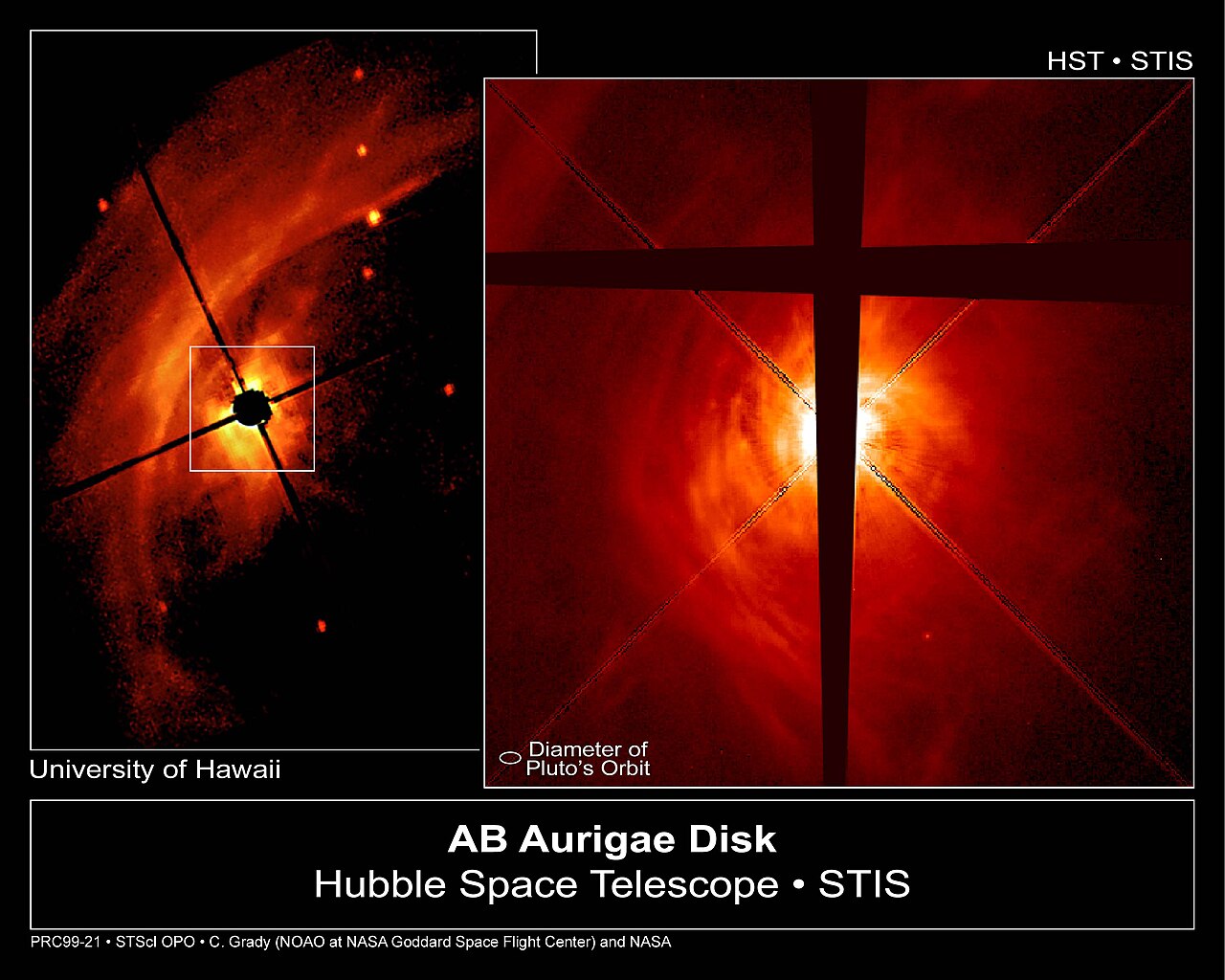
AB Aurigae b is a directly imaged object—either a protoplanet or a proto-brown dwarf—located within the protoplanetary disk of the young Herbig Ae/Be star AB Aurigae, roughly 508 light-years from Earth.
Lore & Background
AB Aurigae b was discovered by a team led by Thayne Currie, Kellen Lawson, and Glenn Schneider using the Subaru Telescope on Mauna Kea, Hawaii and the Hubble Space Telescope. The Subaru data utilized the SCExAO extreme adaptive optics system and the CHARIS integral field spectrograph.
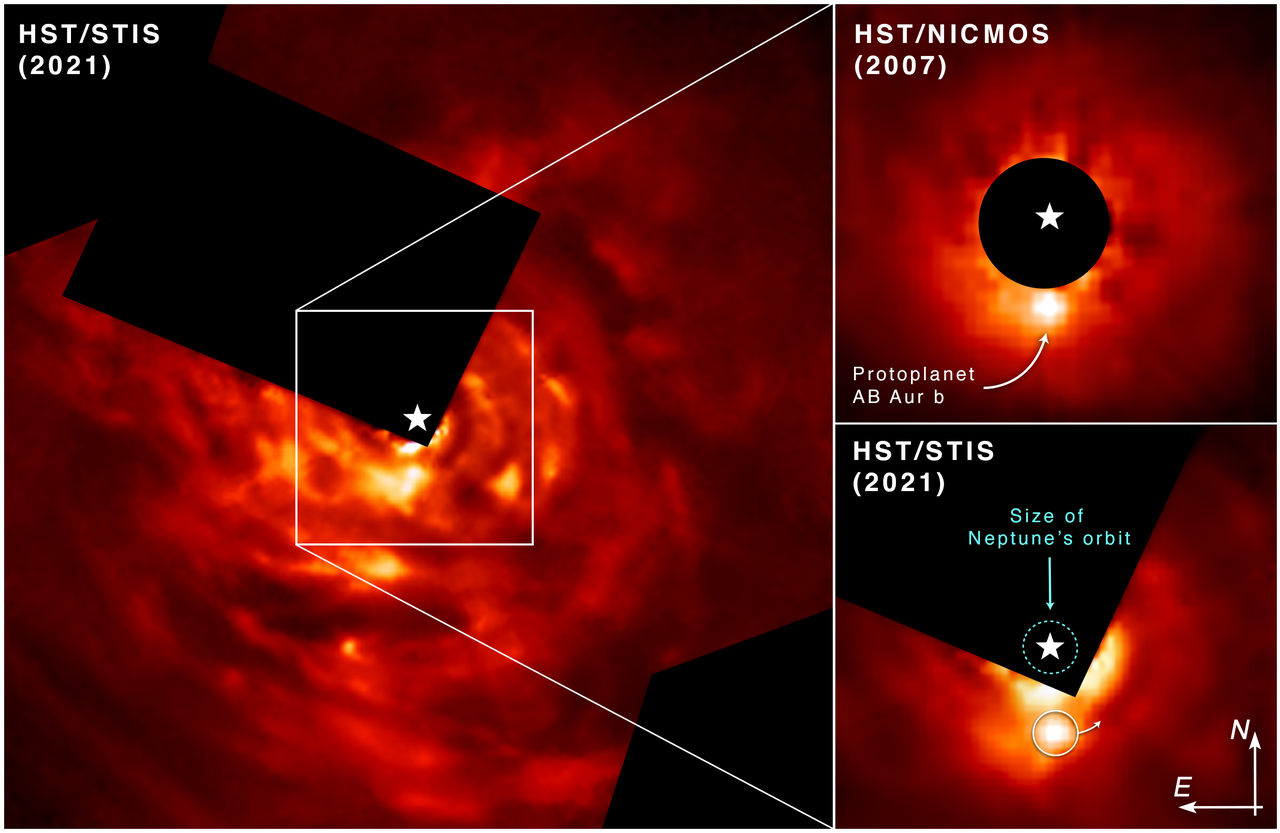
The companion was initially detected in 2016, but the team believed the signal came from a piece of the protoplanetary disk, not a newly forming planet. Subsequent SCExAO/CHARIS data over four years showed that AB Aur b's spectrum is dissimilar to that of the disk, with a temperature similar to predicted values for a newborn planet. A detection with HST/STIS and an archival detection with NICMOS from 2007 confirmed that AB Aur b orbits the star.
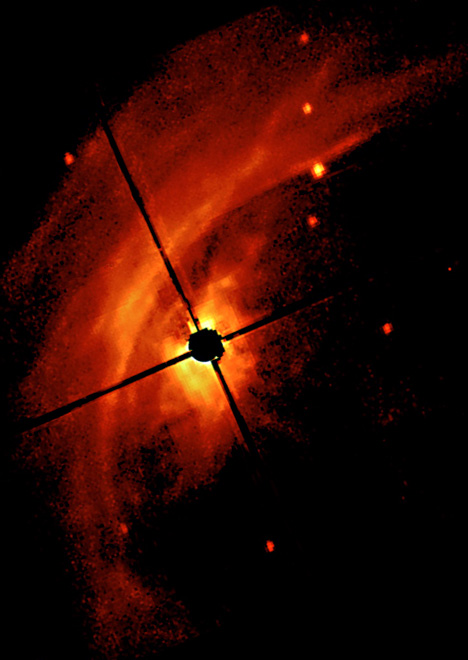
The planet's existence was disputed by two studies in 2023. One found that the ultraviolet and optical emission is consistent with scattered light and that the planet's existence would be superfluous.
The other did not detect significant emission in Paβ wavelengths, which would be expected for an actively accreting protoplanet. However, it was later found that the non-detection resulted from low-quality images and an inaccurate source model. A 2024 study found that the infrared spectral energy distribution is inconsistent with scattered light.
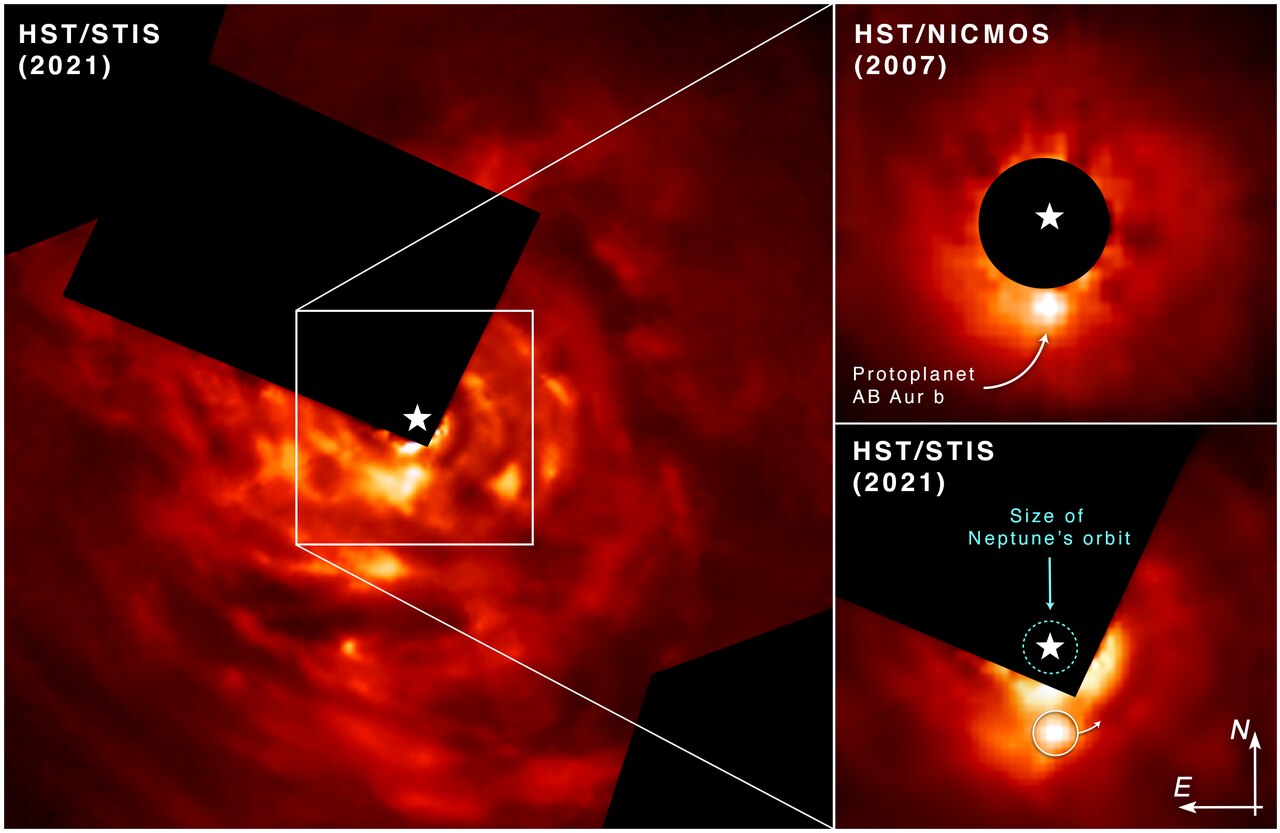
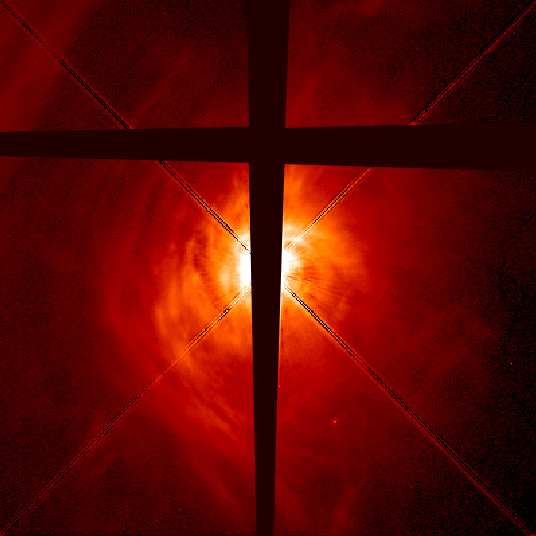
AB Aur b appears as a bright, spatially-extended source about 0.6 arcseconds from the star, contrasting with the point-source nature of other directly imaged planets. This morphology is likely due to light being intercepted and reprocessed by the protoplanetary disk.
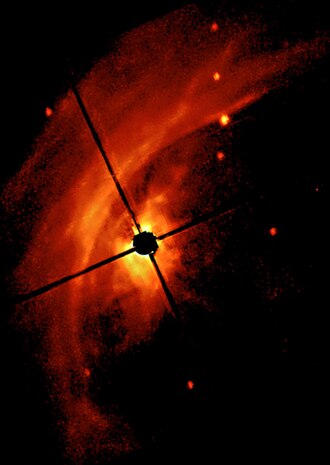
Its orbit is not well constrained, but modeling suggests an inclination of about 43 degrees, possibly coplanar with the disk. The companion's H-alpha detection could be due to active accretion or scattered light. Observations showed the star varied by only 15% while the planet candidate varied by 330%, which excludes scattered light as the only emission source.
Reader's Guide
AB Aurigae b is significant as a candidate for planet formation by disk instability, a mechanism distinct from core accretion. The numerous spiral arms in AB Aur's protoplanetary disk are consistent with models of disk instability, and a paper published in September 2024 reported ALMA observations showing evidence of gravitational instability in the disk. The companion's mass likely lies in the brown dwarf regime; assuming a hot-start evolutionary model and a planetary mass, AB Aur b would be younger than 3 million years to have its observed luminosity, inconsistent with the star's age, possibly implying delayed planet formation.
Another study gives a higher mass in the brown dwarf regime, arguing that gravitational instability operates on short timescales and the object might be as old as the star. The spectral energy distribution suggests a lower mass of 9 Jupiter masses, but this is uncertain as the observed spectrum might be that of a circumplanetary disk. The system AB Aurigae made a brief appearance in the 2021 film 'Don't Look Up' during depicted Subaru observations, though the companion is not visible on the displayed image.
Frequently Asked Questions
What is AB Aurigae b?
It is a directly imaged young object embedded in the protoplanetary disk surrounding the Herbig Ae/Be star AB Aurigae, about 508 light-years from Earth. Astronomers have not yet settled whether it is best called a protoplanet or a proto-brown dwarf.
How far is AB Aurigae b from its host star?
The object sits at a projected separation of roughly 93 astronomical units from AB Aurigae, well outside the main debris ring of the disk. That makes it one of the more distantly separated directly imaged candidates known to date.
What are AB Aurigae b's mass, radius, and temperature?
CHARIS and NICMOS measurements put its mass in the 9-to-12 Jupiter-mass range, with an estimated radius of about 2.75 Jupiter radii. Its effective temperature is near 2,200 kelvin, consistent with a still-hot, young object.
More in Exoplanets Found by Imaging and Microlensing
Sources
Compiled from Wikipedia and the sources listed below. Text from Wikipedia is available under CC BY-SA 4.0; this entry is adapted from it.
- Wikipedia: AB Aurigae b (CC BY-SA 4.0).
- Word definitions: the Codexery glossary, each quoted from its Wikipedia article.
Spotted an error? Know more?
Reader corrections go straight into our review queue. Suggest an edit · How this site is sourced