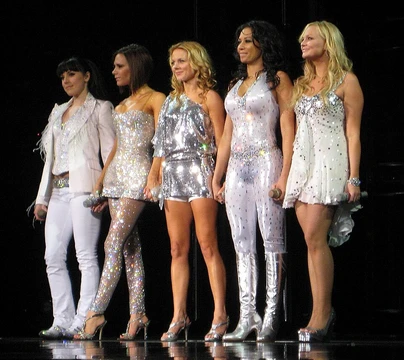
All Saints (group)
English girl group known for 1990s hits and cargo pants style.

Carol VanHook · CC BY-SA 2.0
All Saints were an English girl group that came together in London in 1996. They first went by the name All Saints 1.9.7.5., with Melanie Blatt, Shaznay Lewis, and Simone Rainford as members. After signing with ZTT Records, the group failed to gain traction commercially, and Rainford left following a power struggle with Lewis. In 1996, sisters Nicole and Natalie Appleton joined, and the group—now shortened to All Saints—signed with London Records.
Part of the late-1990s wave of British girl groups, they reached number two on the UK Albums Chart with their debut album, *All Saints* (1997). That album remains the fourth-best-selling girl group album in UK history. It produced three UK number-one singles: "Never Ever," the double A-side "Under the Bridge"/"Lady Marmalade," and "Bootie Call." "Never Ever" is the third-best-selling girl group single in the UK, trailing only the Spice Girls' "Wannabe" and Little Mix's "Shout Out to My Ex." It also won one Brit Award—Best British Single—and the group was nominated for Best British Breakthrough Act. Their second album, *Saints & Sinners* (2000), became their first UK number-one album and went multi-platinum, featuring the number-one singles "Pure Shores" and "Black Coffee." Internal conflicts led to the group splitting in 2001.
All Saints later reunited on Parlophone Records for a third album, *Studio 1* (2006), which peaked at number 40 in the UK, and they were dropped soon after. They split again in 2008, but regrouped in 2013 for live shows, which prompted the releases of *Red Flag* (2016) and *Testament* (2018). As of January 2016, the group had sold 12 million records. Musicians like Jessy Lanza and Charli XCX have named All Saints as an influence. The group also left a mark on British fashion in the late 1990s, especially with their signature cargo pants in photos and live performances.
Quick Facts
- Alias
- All Saints 1.9.7.5.
- Origin
- London, England
- Genre
- Pop / R&B
- Years Active
- 1993–2001 / 2006–2008 / 2013–2022Indefinite hiatus
- Label
- ZTT / London / Parlophone
- Past Members
- Natalie Appleton / Nicole Appleton / Melanie Blatt / Shaznay Lewis / Simone Rainford
Facts from the source article.
Lore & Background
All Saints were formed in 1996 as All Saints 1.9.7.5. with members Melanie Blatt, Shaznay Lewis, and Simone Rainford. The group struggled to find commercial success on ZTT Records and were dropped after Rainford left due to a power struggle with Lewis. In 1996, the group were joined by sisters Nicole and Natalie Appleton and signed to London Records under their shortened name. Their debut album, All Saints (1997), reached number two on the UK Albums Chart and contained three UK number-one singles: 'Never Ever', 'Under the Bridge'/'Lady Marmalade', and 'Bootie Call'. 'Never Ever' won one Brit Award and is the third-best-selling girl-group single in the UK.
Reader's Guide
All Saints were a significant act in the 1990s British girl group wave, achieving multi-platinum success and multiple number-one singles. Their debut album became the UK's third-best-selling girl group album, and their second album, Saints & Sinners (2000), became their first UK number-one album. The group's influence extended beyond music: their signature cargo pants style was noted in British fashion, and later musicians such as Jessy Lanza and Charli XCX cited them as an influence. Despite internal conflicts leading to a split in 2001, the group reformed multiple times, releasing albums in 2006, 2016, and 2018. As of January 2016, All Saints have sold 12 million records.
Did You Know?
- The group was originally named All Saints 1.9.7.5. after the recording studio and the year of their births.
- Musicians including Jessy Lanza and Charli XCX have cited All Saints as an influence.
Formation and Early Turmoil
Blatt and Lewis first entered the music scene as backing vocalists at Sarm West Studios, a ZTT facility near All Saints Road in London. In 1993, manager Ron Tom suggested the pair, alongside Simone Rainford, form a proper act. The trio rejected names like Spice, Slinky, and Shifty, landing on All Saints 1.9.7.5.—a reference to the studio's street and their birth year. They debuted publicly on the Touch Magazine stage at the Notting Hill Carnival. Creative friction over musical direction soon emerged. Their 1994 single "Silver Shadow" stalled in the lower chart regions, and Rainford's escalating tension with Lewis prompted her exit in 1995. After one further release, ZTT dropped the remaining duo. Undeterred, Blatt and Lewis held auditions. In May 1996, Blatt's father, a taxi driver, spotted Nicole Appleton—a former Sylvia Young Theatre School classmate. Too embarrassed to ask herself, Blatt let the usually shy Lewis make the pitch. Nicole sang in a restaurant bathroom, and the verdict was immediate. Her sister Natalie, initially considering a management role, was eventually coaxed into joining, with her parents stepping in to watch Natalie's young daughter Rachel.
Breakthrough and Chart Dominance
Signing with London Records in late 1996, the reconstituted quartet—now simply All Saints—began recording their debut with a rotating roster of producers including Karl Gordon, Cameron McVey, and Nellee Hooper. The album's mid-1997 single "I Know Where It's At" cracked the top five and pushed the group into the mainstream. Then came "Never Ever" in November 1997, which stormed to number one in both the UK and Australia, selling 1.2 million copies domestically and earning double-platinum certification. The track collected two BRIT Awards the following year for Best British Single and Best British Video. The self-titled album, released in October 1997, peaked at number two on the UK Albums Chart and ultimately achieved five-times-platinum status with 1.5 million sales. Two more number-one singles followed: the double A-side "Under the Bridge / Lady Marmalade" and "Bootie Call." Internationally, the record earned platinum in the United States, triple platinum in Canada, and double platinum in Australia. In November 1998, the group accepted the MTV Europe Music Award for Best Breakthrough Artist, though Blatt was absent from the ceremony due to her pregnancy.
Second Act and Fracture
Building on their debut's momentum, All Saints released Saints & Sinners in 2000, which became their first UK number-one album and achieved multi-platinum certification. The record produced two more chart-toppers: "Pure Shores" and "Black Coffee." Yet the very success that defined this era also intensified internal tensions. In-fighting among the members grew increasingly public, and by 2001 the group had split. A reunion followed when they signed with Parlophone Records, culminating in the 2006 album Studio 1. However, the project stalled at number forty on the UK Albums Chart, and the label dropped the group shortly after its release. A second split came in 2008, leaving the band in a prolonged hiatus. The contrast between the ferocious commercial run of 1997–2001 and the quiet fade of the mid-2000s underscores how fragile the group's chemistry had always been. What had once felt like an unstoppable force—three number-one singles from one album, a five-times-platinum record, international certifications across multiple continents—dissolved into chart irrelevance within a decade, a pattern that would not be reversed until their eventual reformation.
Legacy, Reunion, and Cultural Footprint
All Saints' influence extends well beyond their chart numbers. As of January 2016, the group had sold twelve million records worldwide. Their debut remains the UK's third-best-selling girl group album of all time, and "Never Ever" stands as the third-best-selling girl-group single in the country, trailing only the Spice Girls' "Wannabe" and Little Mix's "Shout Out to My Ex." Musicians including Jessy Lanza and Charli XCX have openly cited All Saints as a creative influence, a testament to the group's lasting imprint on contemporary pop. Their fashion legacy is equally notable: the signature cargo-pant aesthetic they wore in promotional imagery and live performances throughout the late 1990s became a defining visual of that era's British pop scene. After a 2008 split, the group reunited in 2013 for a run of live shows, which reignited fan interest and led to the releases of Red Flag in 2016 and Testament in 2018—proof that the quartet's appeal, while never as dominant as it once was, had never truly disappeared.
Gallery
Frequently Asked Questions
Who is All Saints (group)?
All Saints are an English pop girl group that came together in London in 1996 and became a defining act of the late-'90s British girl group wave. They are remembered for their R&B-flavoured pop singles, their signature cargo-pants look, and a debut album that climbed to number two on the UK Albums Chart.
Who are the members of All Saints?
The final four-member lineup was sisters Nicole and Natalie Appleton, Shaznay Lewis, and Melanie Blatt. Simone Rainford was part of the original trio under the name All Saints 1.9.7.5. but departed after a creative power struggle with Lewis, and the Appleton sisters joined shortly after in 1996.
What awards has All Saints won?
During their commercial peak in the late 1990s the group collected a Brit Award for Best British Single and an MTV Europe Music Award for Best Breakthrough Artist.
Why is All Saints important in 90s pop?
They proved the late-'90s British girl group wave could produce more than one dominant act by pairing dance-pop production with R&B-influenced vocal harmonies. Their 1997 debut album reaching number two on the UK Albums Chart showed the format had broad, lasting appeal beyond a single summer.
How did All Saints get their name?
The group initially performed under the longer moniker All Saints 1.9.7.5. before trimming it down to simply All Saints after re-signing with London Records. The shortened name stuck once the Appleton sisters joined and the lineup settled into its final four-member form.
More in English pop girl groups 1-24
Spotted an error? Know more?
Reader corrections go straight into our review queue. Suggest an edit · How this site is sourced