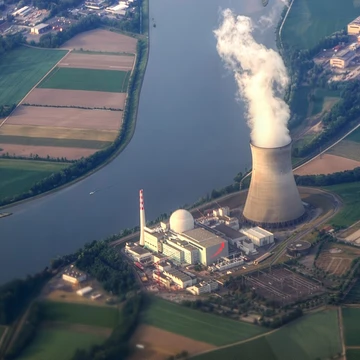
Nuclear technology
Technology harnessing nuclear reactions for energy, medicine, and weapons.
Last updated
Nuclear technology is the branch of technology that deals with the manipulation and application of nuclear reactions, specifically those involving changes to atomic nuclei. Its most familiar applications include nuclear reactors, nuclear medicine, and nuclear weapons, but it also appears in everyday items such as residential smoke detectors and gun sights. The scientific foundation of this field began with the discovery of radioactivity in 1896 by Henri Becquerel, who observed a new phenomenon while studying uranium salts. Subsequent investigation by Pierre and Marie Curie led to the isolation of highly radioactive radium and the identification of three distinct types of radiation: alpha, beta, and gamma rays.
These emissions were found to be ionizing radiation, capable of penetrating ordinary matter and causing harm in sufficient amounts. Early researchers suffered radiation burns and many later died from cancer due to exposure. Radioactivity was initially exploited in quack patent medicines and later for practical uses like luminous dials on meters. It was gradually understood that some atomic nuclei are unstable and decay randomly, releasing matter or energy.
The three forms of radiation were identified as alpha decay (emission of a helium nucleus), beta decay (emission of a high-energy electron), and gamma decay (emission of very high-frequency electromagnetic radiation). Most terrestrial energy ultimately originates from nuclear processes, either from the Sun's thermonuclear reactions or from radioactive decay within the Earth, which provides geothermal energy. Nuclear fission, the splitting of a nucleus into roughly equal parts, releases energy and neutrons.
Nuclear fission
If these neutrons cause further fissions, a chain reaction can occur, with the average number of neutrons per fission that continue the reaction denoted as k. A self-sustaining chain reaction requires a critical mass of fissile material. If the reaction is prompt critical, it grows uncontrollably, leading to an explosion; if it relies on delayed neutrons, it can be controlled using neutron absorbers, enabling the construction of nuclear reactors. The first fission reactors were developed during the Manhattan Project, primarily for weapons manufacture, and the first nuclear power plant to generate electricity began operation in 1951.
Quick Facts
- Known for
- Nuclear reactors
- nuclear weapons
- nuclear medicine
- First fission power plant
- Experimental Breeder Reactor No. 1 (EBR-1)
- Arco
- Idaho (1951)
Facts from the source article.
Lore & Background
Pierre and Marie Curie further explored this phenomenon, isolating radium and identifying three types of radiation: alpha, beta, and gamma. Early researchers suffered radiation burns and later cancers from exposure, and radioactive materials were initially exploited in quack medicines and luminous dials. Nuclear fission, the splitting of atomic nuclei, was discovered on the eve of World War II, leading to the Manhattan Project. This effort produced the first fission weapons, used against Japan in 1945, and also developed the first fission reactors, primarily for weapons manufacture.
In 1951, the Experimental Breeder Reactor No. 1 became the first nuclear fission power plant to generate electricity. Controlled fission, using neutron moderators and absorbers, later became the basis for civilian power generation. Controlled fusion has been achieved in particle accelerators and fusors, but these operate at a net energy loss, and viable fusion power remains elusive despite ongoing research.
Reader's Guide
Nuclear technology has profoundly influenced modern civilization, offering both immense benefits and grave risks. Its applications range from electricity generation via nuclear reactors to medical diagnostics and treatments, as well as smoke detectors and gun sights. The destructive power of nuclear weapons, first demonstrated in 1945, has made them a central concern in international policy and a defining element of the Cold War era.
The development of fission power plants ushered in the 'Atomic Age,' providing a low-carbon energy source but also raising challenges related to radioactive waste and safety. Fusion, while far more energetic per unit mass, has not yet been harnessed for practical power generation, remaining a long-term research goal. The legacy of nuclear technology is thus one of dual-use potential: it can serve peaceful progress or catastrophic destruction, and its control continues to shape global security and energy debates.
Did You Know?
- Radioactive patent medicines largely disappeared after it was realized that even small amounts of ionizing radiation could pose a severe long-term hazard.
Frequently Asked Questions
What is Nuclear technology?
Nuclear technology refers to the practical use of nuclear reactions across multiple fields, including electricity generation, medical treatments, and weaponry. It builds on the physics of atomic nuclei to produce energy, diagnostic tools, and destructive force.
What are Nuclear technology's main applications?
The field is best known for three major areas: nuclear reactors that generate electricity, nuclear medicine that treats and diagnoses disease, and nuclear weapons used as strategic military deterrents. These applications span civilian infrastructure, healthcare, and national defense.
What was the first nuclear power plant?
The Experimental Breeder Reactor No. 1 (EBR-1) in Arco, Idaho, became the first facility to generate usable electrical power from nuclear fission in 1951. This milestone proved that a nuclear reaction could reliably light bulbs and power equipment.
More in Energy & Power
Sources
Compiled from Wikipedia and the sources listed below. Text from Wikipedia is available under CC BY-SA 4.0; this entry is adapted from it.
- Wikipedia: Nuclear technology (CC BY-SA 4.0).
Spotted an error? Know more?
Reader corrections go straight into our review queue. Suggest an edit · How this site is sourced