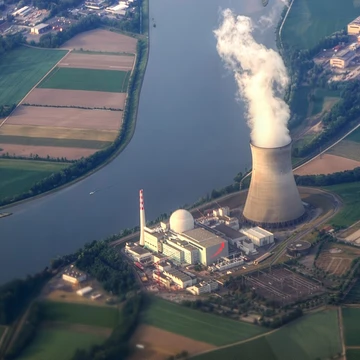
Cooling tower
Device that rejects waste heat by cooling water.
Last updated
A cooling tower rejects waste heat from a coolant stream, usually water, to the atmosphere.[1] Most cooling towers are small units placed on or near buildings, but large hyperboloid structures can be up to 200 m tall.[2][3]
Quick Facts
- Type
- Industrial device
- Primary function
- Reject waste heat via cooling water
- Common uses
- Power plants
- refineries
- chemical plants
- HVAC
Facts from the source article.
Key facts and history
Condensers reduce back pressure, which lowers fuel consumption and recycles boiler water, but they require ample cooling water.[4] By the early 20th century, evaporative methods of recycling cooling water were used in areas lacking adequate water supply.[5] The world's tallest cooling tower is the 210 m tower of the Pingshan II Power Station in China.[6] Dutch engineers Frederik van Iterson and Gerard Kuypers patented the hyperboloid reinforced-concrete cooling tower in 1916.[7]
What the cited sources add
The Duke Energy Nuclear Information Center notes that of over 250 cooling towers at U.S. power plants, fewer than 100 are at nuclear plants.[8] The same source explains that the visible plume from a cooling tower is clean water vapor, not smoke or harmful fumes.[8] The U.S. Environmental Protection Agency manual states that the cooling system determines the heat sink temperature in a power plant's thermodynamic cycle.[9] The U.S. Nuclear Regulatory Commission reports that of 118 nuclear reactors, 48 use closed-cycle cooling systems, most with cooling towers.[10]
A steam collector developed at MIT captured water that was 60 times more pure than normal cooling system water.[11]
References
- Wikipedia, "Cooling tower" (CC BY-SA 4.0), which cites: "What Is A Cooling Tower?", SPX Cooling Technologies; Evans, "How Cooling Towers work", The Engineering Mindset, 2016-10-02 (original not read by us) en.wikipedia.org
- Wikipedia, "Cooling tower" (CC BY-SA 4.0), which cites: "Identifying Nuclear Reactors in Google Earth", CleanEnergy Footprints (cleanenergy.org), 31 December 2012 (original not read by us) en.wikipedia.org
- Wikipedia, "Cooling tower" (CC BY-SA 4.0), which cites: "Myth of cooling towers is symptomatic of global warming information shortage", Royal Society of Chemistry, 2007-02-15; "What you need to know about nuclear cooling towers", Duke Energy Nuclear Information Center, 2017-07-24 (we also read that source) en.wikipedia.org
- Wikipedia, "Cooling tower" (CC BY-SA 4.0), which cites: "Steam-Engine Principles and Practice", McGraw-Hill, 1922, p. 283–286; Heck, "The Steam Engine and Turbine: A Text-Book for Engineering Colleges", D. Van Nostrand, 1911, p. 569–570; Watson, "Power plant and allied industries", The Engineer (With Which is Incorporated Steam Engineering), 1906, p. 69–72 (original not read by us) en.wikipedia.org
- Wikipedia, "Cooling tower" (CC BY-SA 4.0), which cites: International Correspondence Schools, "A Textbook on Steam Engineering", International Textbook Co., 1902; Watson, "Power plant and allied industries", The Engineer (With Which is Incorporated Steam Engineering), 1906, p. 69–72; Heck, "The Steam Engine and Turbine: A Text-Book for Engineering Colleges", D. Van Nostrand, 1911, p. 569–570; Snow, "The Steam Engine: A Practical Guide to the Construction, Operation, and care of Steam Engines, Steam Turbines, and Their Accessories", American School of Correspondence, 1908, p. 43–46 (original no en.wikipedia.org
- Wikipedia, "Cooling tower" (CC BY-SA 4.0), which cites: "Pingshan II: the largest Cooling Tower in the world designed by Hamon", Hamon.com (original not read by us) en.wikipedia.org
- Wikipedia, "Cooling tower" (CC BY-SA 4.0), which cites: "GB108863A Improved Construction of Cooling Towers of Reinforced Concrete.", Espacenet, Patent search; "Koeltorens van de Staatsmijn Emma", Glück Auf; "Power Plant Cooling Tower Like Big Milk Bottle", Hearst Magazines, February 1930, p. 201 (original not read by us) en.wikipedia.org
- "What you need to know about nuclear cooling towers", Duke Energy Nuclear Information Center, 2017-07-24. facts only, no text reused. nuclear.duke-energy.com
- "Closed-Cycle Cooling Systems for Steam-Electric Power Plants: A State-of-the-Art Manual", United States Environmental Protection Agency. facts only, no text reused. nepis.epa.gov
- "Generic Environmental Impact Statement for License Renewal of Nuclear Plants", U.S. Nuclear Regulatory Commission. facts only, no text reused. nrc.gov
- Irving, "MIT steam collector captures pure water for reuse in power plants", New Atlas, 2021-08-04. facts only, no text reused. newatlas.com
Each numbered sentence above was checked against the source it cites before publication. Sentences citing Wikipedia adapt text from the English Wikipedia article Cooling tower (contributors), used under CC BY-SA 4.0; this entry is available under the same licence. Other sources were used for facts only; no text or images are copied from them.
More in Energy & Power
Sources
Compiled from Wikipedia and the sources listed below. Text from Wikipedia is available under CC BY-SA 4.0; this entry is adapted from it.
- Wikipedia: Cooling tower (CC BY-SA 4.0).
Spotted an error? Know more?
Reader corrections go straight into our review queue. Suggest an edit · How this site is sourced