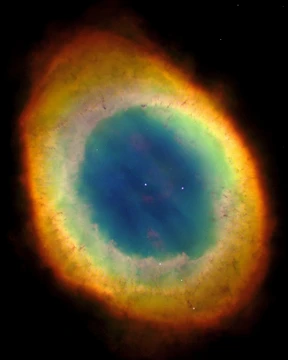
Herbig–Haro object
Bright patches of nebulosity from newborn stars' jets.
Last updated
Herbig–Haro (HH) objects are bright patches of nebulosity linked to newborn stars. They arise when narrow jets of partially ionized gas, shot out by a star at hundreds of kilometers per second, slam into surrounding clouds of gas and dust. These objects are common in star-forming regions, and several often appear around a single star, aligned with its rotation axis.
Most lie within about one parsec (3.26 light-years) of their source, though some have been spotted several parsecs away. HH objects are short-lived, lasting only tens of thousands of years, and can visibly change over just a few years as they race away from their parent star into the interstellar medium. Observations by the Hubble Space Telescope have revealed their complex evolution over short periods, with parts of the nebula fading while others brighten as they collide with clumpy interstellar material.
Discovery and history of observations
The first HH object was spotted in the late 19th century by Sherburne Wesley Burnham, who used the 36-inch refractor at Lick Observatory to observe the star T Tauri and noted a small patch of nebulosity nearby. This patch, later called Burnham’s Nebula, was thought to be an emission nebula and not recognized as a distinct class. T Tauri itself is a very young, variable star and the prototype for T Tauri stars—stars not yet in hydrostatic equilibrium between gravitational collapse and nuclear fusion. Fifty years later, several similar, almost star-like nebulae were found.
In the 1940s, George Herbig and Guillermo Haro independently studied these objects in the Orion Nebula. Herbig examined Burnham’s Nebula and found an unusual spectrum with strong emission lines of hydrogen, sulfur, and oxygen. Haro noted that all such objects were invisible in infrared light.
Herbig and Haro met at an astronomy conference in Tucson, Arizona, in December 1949. Herbig had initially focused on the nearby stars, but after hearing Haro’s findings, he conducted more detailed studies. Soviet astronomer Viktor Ambartsumian named them Herbig–Haro (HH) objects and, based on their proximity to young stars (a few hundred thousand years old), suggested they might represent an early stage in T Tauri star formation. Studies showed HH objects are highly ionized, and early theorists thought they were reflection nebulae containing low-luminosity hot stars.
Quick Facts
- Discoverer
- Sherburne Wesley Burnham
- First observed
- late 19th century
- Named after
- George Herbig and Guillermo Haro
- Typical temperature
- 9,000–12,000 K
- Typical density
- a few thousand to a few tens of thousands of particles per cm3
- Mass loss rate
- 10−8 to 10−6 solar masses per year
Facts from the source article.
Lore & Background
The first HH object was observed in the late 19th century by Sherburne Wesley Burnham, who noted a small patch of nebulosity near the star T Tauri. This object, later known as Burnham's Nebula, was not initially recognized as a distinct class. In the 1940s, George Herbig and Guillermo Haro independently studied several similar objects in the Orion Nebula.
Herbig examined Burnham's Nebula and found an unusual electromagnetic spectrum with prominent emission lines of hydrogen, sulfur and oxygen, while Haro found that all such objects were invisible in infrared light. After meeting at an astronomy conference in December 1949, Herbig carried out more detailed studies. The Soviet astronomer Viktor Ambartsumian gave the objects their name and suggested they might represent an early stage in the formation of T Tauri stars.
Early theorists speculated they were reflection nebulae containing low-luminosity hot stars, but the absence of infrared radiation ruled out stars within them. In 1975, American astronomer R. D. Schwartz theorized that winds from T Tauri stars produce shocks in the ambient medium, generating visible light. With the discovery of the first proto-stellar jet in HH 46/47, it became clear that HH objects are shock-induced phenomena driven by collimated jets from protostars. HH objects are commonly found in star-forming regions, with several often seen around a single star aligned with its rotational axis.
Most lie within about one parsec of the source, though some have been observed several parsecs away. Hubble Space Telescope observations have revealed complex evolution over a few years, as parts fade while others brighten upon colliding with clumpy interstellar material. Many HH objects remain invisible at visible wavelengths due to dust and gas and can only be detected in infrared; such objects observed in near-infrared are called molecular hydrogen emission-line objects (MHOs).
The Long Road to Recognition
The story of how these luminous patches came to be understood as a distinct astronomical class spans roughly five decades. In the late 1800s, Sherburne Wesley Burnham, peering through the 36-inch refractor at Lick Observatory, noticed a faint patch of nebulosity beside the young variable star T Tauri. He catalogued it simply as an emission nebula, and it languished under that generic label for half a century. It was not until the 1940s that George Herbig and Guillermo Haro, working independently on star-formation research, identified a family of similar objects in the Orion Nebula.
Herbig detected an unusual spectrum rich in hydrogen, sulfur, and oxygen emission lines, while Haro noted their complete absence in infrared light. The two astronomers finally crossed paths at a conference in Tucson, Arizona, in December 1949, where Herbig, initially dismissive of the nebulae, was persuaded to investigate more deeply. Soviet astronomer Viktor Ambartsumian subsequently proposed the name Herbig–Haro objects and linked them to the earliest phases of T Tauri star formation, a connection that would be confirmed decades later when the first protostellar jet was identified in HH 46/47.
From Collapse to Jet
The birth of a Herbig–Haro object begins deep inside a collapsing interstellar gas cloud. As gravity compresses the material, rising opacity traps radiative energy, heating the cloud until it halts further collapse and establishes hydrostatic equilibrium. Gas continues to spiral inward along a rotating disk, feeding a central protostar. A fraction of this accreting material is flung outward along the star's rotational axis as two narrow jets of partially ionised plasma.
The precise physics that collimates these outflows remains incompletely understood, but the leading explanation invokes the interplay between the accretion disk and the protostar's magnetic field, which accelerates gas from within a few astronomical units of the surface. Close to the source the flow fans out at angles of roughly ten to thirty degrees, but by the time it reaches tens to hundreds of astronomical units it has been squeezed into a tightly collimated beam. These jets also serve a critical mechanical role: they shed the excess angular momentum that accretion would otherwise pile onto the young star, preventing it from spinning so fast that it tears itself apart. When the jet material finally slams into the surrounding interstellar medium, the resulting shock front ignites the small, brilliant patches of emission we recognise as HH objects.
Shock Physics and Motion
The visible glow of an HH object is produced at what astronomers call terminal working surfaces—regions where the protostellar jet's shock waves plough into the surrounding interstellar medium. Spectroscopic measurements reveal that the emitting gas is receding from the parent star at several hundred kilometres per second, yet the emission lines in the spectra are noticeably weaker than one would expect from a collision at that speed. This discrepancy implies that some of the ambient material is already drifting along the jet's path at a lower velocity, softening the effective impact. Most HH objects sit within roughly one parsec, about 3.26 light-years, of their source star, though a handful have been detected several parsecs out.
They are inherently transient, persisting for only a few tens of thousands of years before fading. Because they are moving so rapidly, their appearance can shift over just a few years. Hubble Space Telescope monitoring has captured this evolution directly: as the shock fronts race through the clumpy, uneven material of the interstellar medium, some regions of the nebula dim while others flare to brightness, painting a constantly shifting portrait of a collision in progress.
Seeing Through the Dust
Although HH objects are fundamentally visible-wavelength phenomena, a significant fraction remain hidden from optical telescopes because the dense dust and gas that surround young stars absorb and scatter their light. For these obscured sources, astronomers must turn to infrared observations. When detected in the near-infrared, they are classified as molecular hydrogen emission-line objects, or MHOs, a designation that highlights the dominant spectral signature of the shocked gas. HH objects are most commonly encountered in active star-forming regions, and it is not unusual to find several aligned along the rotational axis of a single young star, betraying the bipolar geometry of the underlying jet system.
The Hubble Space Telescope has proved especially valuable for studying their time-variable behaviour. Over periods of just a few years, individual knots of nebulosity can fade as their shock fronts pass through, while new bright spots ignite where the jet encounters denser clumps of interstellar material. This dynamic interplay between the steady outflow and the lumpy medium means that no two snapshots of the same HH object look identical, making repeated observations essential for reconstructing the full picture of the collision.
Reader's Guide
Herbig–Haro objects are significant as direct by-products of the star formation process, providing visible evidence of the energetic outflows from newborn stars. Their study has clarified how protostars eject material along their rotational axes, carrying away excess angular momentum that would otherwise cause the star to disintegrate. The discovery that HH objects are shock-induced phenomena, with shocks driven by collimated jets, resolved earlier confusion about their nature. Spectroscopic observations revealing velocities of several hundred kilometers per second, combined with proper motion measurements from the Hubble Space Telescope, have shown that these objects evolve rapidly, with knots brightening, fading, or disappearing over just a few years.
This transient behavior, along with the presence of internal working surfaces where faster jets catch up with slower ones, offers insights into the pulsating and intermittent eruptions from young stars. The fact that many HH objects are only detectable in infrared as molecular hydrogen emission-line objects underscores the role of dust obscuration in star-forming regions. Their chemical composition, mostly hydrogen and helium with about 1% heavier elements, and the presence of shock-induced compounds like metal hydrides, provide clues about the chemistry of the interstellar medium. Overall, HH objects serve as dynamic laboratories for studying the interaction between stellar outflows and their environment.
Frequently Asked Questions
What is a Herbig-Haro object?
A Herbig-Haro object is a glowing patch of nebulosity produced when a newborn star hurls narrow jets of partially ionized gas at hundreds of kilometers per second into surrounding material. The collision between those jets and nearby clouds of gas and dust creates the bright emission we see.
How long do Herbig-Haro objects survive?
They are extremely short-lived, lasting only on the order of tens of thousands of years before the gas recombines and the glow fades. In some well-studied cases, the visible structure has shifted measurably over just a few years of monitoring.
What are the typical temperature and density inside a Herbig-Haro object?
The shocked gas reaches roughly 9,000 to 12,000 kelvin, and particle densities run from a few thousand up to a few tens of thousands per cubic centimeter. Most HH knots sit within about one parsec (3.26 light-years) of their parent star, though a handful have been detected several parsecs away.
More in Emission, Dark and Reflection Nebulae
Sources
Compiled from Wikipedia and the sources listed below. Text from Wikipedia is available under CC BY-SA 4.0; this entry is adapted from it.
- Wikipedia: Herbig–Haro object (CC BY-SA 4.0).
- Word definitions: the Codexery glossary, each quoted from its Wikipedia article.
Spotted an error? Know more?
Reader corrections go straight into our review queue. Suggest an edit · How this site is sourced