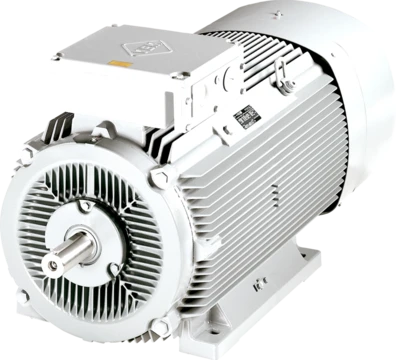
Motor soft starter
Last updated
Soft starters adjust motor voltage through use of back-to-back thyristors or triacs in each AC supply line to the motor.[1] During start-up, an AC electrical motor's load, torque, and current surge are temporarily lowered by a device called a motor soft starter.[2] Mechanical stress on the motor and shaft, plus electrodynamic stresses on power cables and the electrical distribution network, are all lessened, which increases the system's operational life.[2]
Quick Facts
- Series reactor range
- 25 kW / 33.5 hp 415 V to 30 MW 11 kV
Facts from the source article.
Key facts and history
The delayed switching effectively ramps up the average AC voltage to the motor until the motor sees full line voltage.[1] Generator action within a moving motor armature creates an electromagnetic force that works against the motor action, producing a variable resistance that grows as the motor speeds up.[2] When the motor is stationary, its resistance is low; applying full line voltage at that point results in a high starting or inrush current.[2] Induction motors started across-the-line draw inrush currents that are 7 to 10 times their running current, and for higher-efficiency motors, this multiple can be 10 to 15 times.[2]
Running torque can be exceeded by starting torque by as much as a factor of three.[2] A sudden mechanical stress on the machine, caused by the starting torque transient, shortens the equipment's service life.[2] Voltage dips can occur because the high inrush current puts strain on the power supply.[2] Throughout the start-up phase, a soft starter provides continuous regulation of the voltage supplied to the motor.[3]
The voltage applied to an induction motor can be controlled on one or more phases by solid state soft starters, with three-phase control yielding the most favorable outcomes.[3]
What the cited sources add
Leland Teschler notes that motors drawing large start-up current, perhaps six times normal operation, can stress motor components and cause power quality issues, particularly for larger motors of 1 hp or more.[1] A soft starter can be contrasted with a full-voltage starter, which applies full voltage directly to motor terminals on start up.[1] Some soft starters can also provide a soft-stop function in applications where an abrupt stop can cause problems.[1] A special kind of soft-start function called star-delta start is sometimes used on three-phase motors, starting with stator windings in a wye configuration and switching to delta when the motor hits normal operating speed.[1]
Soft starters are generally used with induction motors but may also provide benefits powering synchronous motors.[1] Some soft starters could serve as voltage controllers or voltage regulators for the motor, and can double as an energy manager by monitoring motor power factor.[1]
References
- "Soft starters", machinedesign.com, 2014-07-16. facts only, no text reused. machinedesign.com
- Wikipedia, "Motor soft starter" (CC BY-SA 4.0), which cites: Siskind, "Electrical Control Systems in Industry", McGraw-Hill, Inc., 1963, p. 150 (original not read by us) en.wikipedia.org
- Wikipedia, "Motor soft starter" (CC BY-SA 4.0), which cites: "Soft starters", machinedesign.com, 2014-07-16; "Reliance Electric GV3000 Drive 50V4160 Automation Industrial", 50v4160.com (we also read that source) en.wikipedia.org
Each numbered sentence above was checked against the source it cites before publication. Sentences citing Wikipedia adapt text from the English Wikipedia article Motor soft starter (contributors), used under CC BY-SA 4.0; this entry is available under the same licence. Other sources were used for facts only; no text or images are copied from them.
More in Electric Motors
Sources
Compiled from Wikipedia and the sources listed below. Text from Wikipedia is available under CC BY-SA 4.0; this entry is adapted from it.
- Wikipedia: Motor soft starter (CC BY-SA 4.0).
Spotted an error? Know more?
Reader corrections go straight into our review queue. Suggest an edit · How this site is sourced