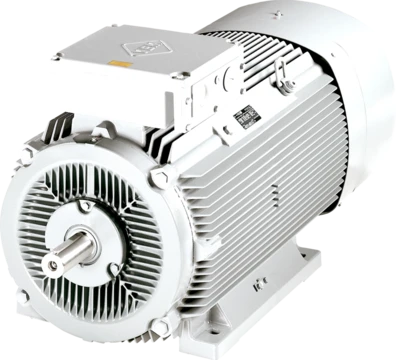
Reluctance motor
Reluctance motors induce magnetic poles on a ferromagnetic rotor without windings.
Last updated
A reluctance motor is an electric motor that creates temporary magnetic poles on a rotor made of ferromagnetic material. The rotor contains no windings. The motor produces torque by exploiting magnetic reluctance—the tendency of magnetic flux to follow the path of least opposition. These motors offer high power density at a low cost, which makes them appealing for a variety of uses.
However, they have drawbacks, including significant torque ripple—the variation between the highest and lowest torque during a single revolution—especially at low speeds, along with noise caused by this ripple. Until the early 2000s, their adoption was hindered by the difficulty of designing and controlling them. Progress in theory, computer-aided design tools, and affordable embedded control systems resolved these issues. Microcontrollers use real-time control algorithms to adjust drive waveforms based on rotor position and feedback from current and voltage.
Design and operating fundamentals
Before the advent of large-scale integrated circuits, the necessary control electronics were prohibitively expensive. The stator features multiple projecting electromagnet poles, similar to those in a wound-field brushed DC motor. The rotor is made of soft magnetic material, like laminated silicon steel, with projections that act as salient magnetic poles via reluctance. In switched reluctance motors, the rotor typically has fewer poles than the stator, which reduces torque ripple and prevents all poles from aligning at once—a state where no torque can be generated.
When a rotor pole sits midway between two adjacent stator poles, it is in the "fully unaligned position," the point of highest magnetic reluctance for that pole. In the "aligned position," two or more rotor poles directly face two or more stator poles, creating a state of minimum reluctance. Energizing a stator pole produces torque that moves the rotor to reduce reluctance, pulling the nearest rotor pole from the unaligned position into alignment (the same principle used in a solenoid or when picking up ferromagnetic metal with a magnet). To keep rotating, the stator field must lead the rotor poles, constantly pulling them along.
Quick Facts
- Peak efficiency
- 94%
- Power output experiment
- 23 kW (30.8 hp) at 14,000 RPM
- Power density experiment
- 1.4 kW / 1.88 hp
- Magnetization limit dual phase
- 1.5 T
- Conventional motor magnetization
- 2 T
- Comparable conventional rotor output
- 3.7 kW / 4.96 hp
Facts from the source article.
More in Electric Motors
Sources
Compiled from Wikipedia and the sources listed below. Text from Wikipedia is available under CC BY-SA 4.0; this entry is adapted from it.
- Wikipedia: Reluctance motor (CC BY-SA 4.0).
Spotted an error? Know more?
Reader corrections go straight into our review queue. Suggest an edit · How this site is sourced