Ouroboros
Ancient symbol of a snake eating its own tail.
Last updated
The ouroboros is an ancient symbol of a snake or dragon consuming its own tail. It entered Western tradition through Egyptian iconography and Greek magical practices, later adopted in Gnosticism, Hermeticism, and alchemy. The symbol represents cyclical renewal, eternity, and the unity of opposites.
Quick Facts
- Field
- Symbolism
- mythology
- alchemy
- Known for
- Depicting a snake or dragon eating its own tail, symbolizing cyclic renewal and eternity
Facts from the source article.
Historical representations
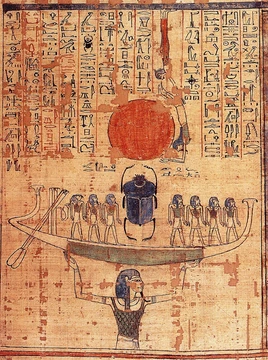
One of the earliest known ouroboros motifs appears in the Enigmatic Book of the Netherworld, an Egyptian funerary text from the 14th century BCE found in Tutankhamun's tomb. It depicts two serpents biting their tails, one encircling the head and upper chest and the other the feet of a large figure, possibly representing the unified Ra-Osiris. These serpents are manifestations of the deity Mehen, who protects Ra in his underworld journey. In Egyptian sources, the ouroboros represents the formless disorder surrounding the orderly world and its periodic renewal.
The symbol persisted into Roman times, appearing on magical talismans. The 4th-century commentator Servius noted its Egyptian use as representing the cyclical year.
In Gnosticism, the serpent biting its tail symbolized eternity and the world soul; the Pistis Sophia describes a twelve-part dragon surrounding the world with its tail in its mouth. The Chrysopoeia of Cleopatra, an early alchemical text from 3rd-century Alexandria known from a 10th-century copy, shows an ouroboros enclosing the words hen to pan (the all is one), with black and white halves possibly representing Gnostic duality. A 15th-century manuscript, The Aurora Consurgens, also features the ouroboros among symbols of sun, moon, and mercury.
Modern references
Carl Jung viewed the ouroboros as an archetype and the basic mandala of alchemy. Erich Neumann interpreted it as representing the pre-ego dawn state of undifferentiated infancy. August Kekulé described a vision of an ouroboros that led him to realize the structure of benzene. Martin Rees used the ouroboros to illustrate scales from subatomic to supragalactic, emphasizing links between the microworld and cosmos.
W. Ross Ashby applied biological feedback ideas to psychiatry, and Parmar contextualized the cybernetic ouroboros principle in musical improvisation. The snake eating its tail serves as a metaphor in autopoietic calculus for self-reference, developed by Francisco Varela, analyzing self-producing autonomous systems. This calculus combines cybernetic feedback logic, autopoiesis by Varela and Humberto Maturana, and George Spencer Brown's calculus of indications.
Did You Know?
- The term derives from Greek οὐρά (tail) and -βόρος (-eating).
- The ouroboros is interpreted as a fertility symbol in some religions, with the tail as phallic and the mouth as yonic.
- The snake's skin sloughing symbolizes the transmigration of souls.
More in Egyptian mythology
Sources
Compiled from Wikipedia and the sources listed below. Text from Wikipedia is available under CC BY-SA 4.0; this entry is adapted from it.
- Wikipedia: Ouroboros (CC BY-SA 4.0).
Spotted an error? Know more?
Reader corrections go straight into our review queue. Suggest an edit · How this site is sourced