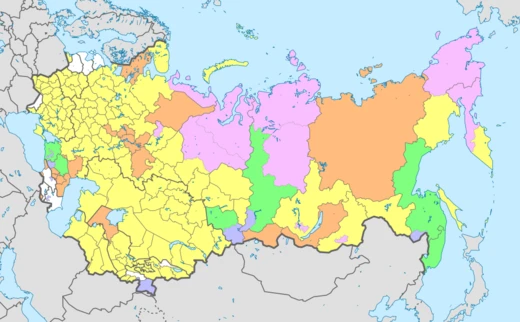
Crimea in the Soviet Union
Autonomous republic in Crimea from 1921 to 1945.
The Crimean Autonomous Socialist Soviet Republic was an autonomous republic within the Russian SFSR from 1921 to 1936, after which it was renamed the Crimean Autonomous Soviet Socialist Republic. Its existence was notable for the deportation of the Crimean Tatar population in 1944, which led to the republic's downgrade to an oblast in 1945. The territory was later transferred to the Ukrainian SSR in 1954 and regained autonomous status within Ukraine after a 1991 referendum.
Quick Facts
- Subdivision
- ASSR of the Russian SFSR (1921–45)
- Oblast of the Russian SFSR (1945–54)
- and Ukrainian SSR (1954–91)
- ASSR
- Nation
- Ukrainian SSR (1991)
- Symbol type
- Emblem (1938–1945)
- Lifespan
- 1921–1991
- Capital
- Simferopol
- Government
- Autonomous Soviet
- Socialist Republic (1921–45; 1991)
- Oblast (1945–91)
- Date start
- 18 October
- Established
- 1921
Facts from the source article.
History
The Crimean Autonomous Socialist Soviet Republic was created on 18 October 1921 within the Russian SFSR after the Red Army's Southern Front campaign forced the White Army to evacuate Crimea in late 1920. It was renamed the Crimean Autonomous Soviet Socialist Republic on 5 December 1936 by the Eighth Extraordinary Congress of Soviets of the USSR. Two attempts to establish Jewish autonomy in Crimea failed: the first, supported by the American Jewish Joint Distribution Committee, led instead to the creation of the Jewish Autonomous Oblast in Birobidzhan; the second, by the Jewish Anti-Fascist Committee between 1943 and 1944, resulted in the Night of the Murdered Poets and increased persecution of Jews.
Crimea was under de facto Nazi German control from September 1942 to October 1943, administered as Generalbezirk Krym-Taurien within Reichskommissariat Ukraine, with Alfred Frauenfeld as General Commissar. In 1944, under the pretext of alleged collaboration, the Soviet government deported the Crimean Tatar people via GKO Order No. 5859ss. Actual military collaboration was limited, with 9,225 Crimean Tatars serving in anti-Soviet units, but local administration cooperated extensively with the occupation due to Frauenfeld's reluctance to implement harsh policies.
Administrative divisions
Upon establishment in 1921, Crimea was divided into seven okrugs—Dzhankoy, Yevpatoriya, Kerch, Sevastopol, Simferopol, Feodosiya, and Yalta—which were subdivided into 20 raions. The okrugs were abolished in November 1923, leaving 15 raions; five were abolished in 1924. On 30 October 1930, the remaining ten raions were reorganized into 16 new ones, with four cities under direct republican control. Ten raions were added in 1935, one abolished, and one more established in 1937. These raions initially held national status for Crimean Tatars, Russians, Jews, Germans, and Ukrainians, but all lost that status by the start of World War II.
More in Early Soviet Republics
Spotted an error? Know more?
Reader corrections go straight into our review queue. Suggest an edit · How this site is sourced