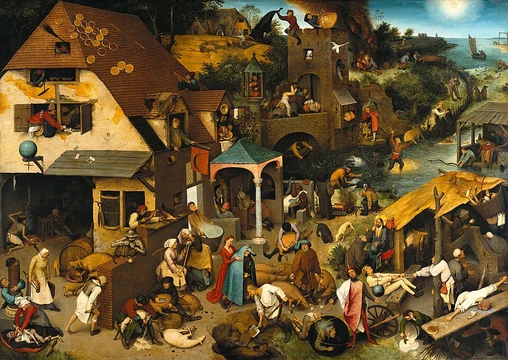
Witte Wieven
Spirits of wise women or elven beings in Low Saxon lore.

Witte Wieven (also known as Wittewijven) are spirits of 'wise women' or elven beings in Dutch Low Saxon mythology and legends. The mythology dates back at least to the pre-Christian era (7th century) and was known in present-day Netherlands, Belgium, and parts of France. They are sometimes called Juffers, Joffers, or Dames Blanches (White Ladies) in French.
- Origin
- Dutch Low Saxon mythology
- Era
- Pre-Christian (7th century or earlier)
- Region
- Netherlands, Belgium, parts of France
- Also known as
- Juffers, Joffers, Dames Blanches
- Associated with
- Wisdom, prophecy, healing, burial sites
Lore & Background
Historically, the witte wieven are thought to be wise female herbalists and medicine healers who cared for people's physical and mental ailments. They were said to have the talent for prophecy and looking into the future, and held high status in their communities. When they died, ceremonies were held at their grave sites to honor them. According to mythology, their spirits remained on earth as living spirits or elven beings that either helped or hindered people who encountered them. They tended to reside in burial sites or other sacred places; mist on a gravehill was thought to be the spirit of the wise woman appearing, and people would bring offerings and ask for help.
Reader's Guide
The Witte Wieven hold significance as a folkloric figure bridging pre-Christian Germanic beliefs and later Christian reinterpretations. Scholars debate their origins: some believe they arose from honoring graves of wise women, while others trace them to Germanic beliefs in disen, land wights, and alven (elves). Practices of offerings and grave veneration resemble those for disen and land wights, and in some localities they were directly described as 'Alfen' or 'Alven'. Jacob Grimm noted them as the Dutch variant of German Weiße Frauen, though mixed with elvish personages. Early medieval literature depicted them as pranksters, but later Christian teaching transformed them into mistflarden (wisps of mist or fog) characterized as evil ghost witches. Places named after them, such as Wittewievenbult and Wittewijvenkuil in the Netherlands, preserve local legends of their appearances. The term 'witte' may mean 'wise' rather than 'white,' though phonetic resemblance and color symbolism of whiteness with purity may have influenced the name.
Did You Know?
- The term 'witte wieven' literally translates to 'white women,' but is commonly interpreted as 'wise women.'
- In some localities, witte wieven were directly described as 'Alfen' or 'Alven' (elves).
- Jacob Grimm mentioned them in his 1835 work Deutsche Mythologie as the Dutch variant of German Weiße Frauen.
- Places named after them include Wittewievenbult (White Women Hill) and Wittewijvenkuil (White Women Pit) in the Netherlands.
More in Dutch folklore 1-24
Spotted an error? Know more?
Reader corrections go straight into our review queue. Suggest an edit · How this site is sourced