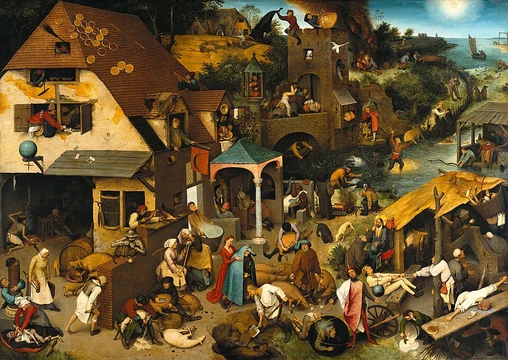
Folklore of the Low Countries
Folk traditions of Belgium, Netherlands, and Luxembourg.

The folklore of the Low Countries—covering Belgium, the Netherlands, and Luxembourg—is often called Dutch folklore. It includes epics, legends, fairy tales, and oral traditions, originally told in Dutch or in regional languages like Flemish, Frisian, Walloon, or Luxembourgish. This tradition draws from the folk stories of Flanders, Frisia, Wallonia, and Luxembourg, with roots in pre-Christian Gaulish and Germanic culture.
Many fairy tales resemble French and German versions because of these shared origins. In 1891, schoolteacher Jules Lemoine and folklorist Auguste Gittée published *Folk Tales from the Walloon Country*, carefully translating tales from original Walloon manuscripts, mostly from Hainaut and Namur. Later, in 1918, William Elliot Griffis released *Dutch Fairy Tales for Young Folks*, followed by *Belgian Fairy Tales* in 1919. That same year, Belgian writer Jean de Bosschère published *Folk Tales of Flanders* (in English as *Beasts and Men*). The Belgian tale "Karl Katz" shares similarities with the German "Peter Klaus" and Washington Irving's "Rip Van Winkle." French writer Charles Deulin, born near the Belgian border, crafted stories from local folk tales. "The Nettle Spinner," a Flemish fairy tale, later appeared in Andrew Lang's 1890 *The Red Fairy Book*.
*Dutch Fairy Tales for Young Folks* includes stories such as "The Entangled Mermaid," "The Boy Who Wanted More Cheese," "Prince Spin Head and Miss Snow White," "The Boar with Golden Bristles," "The Ice King and His Wonderful Grandchild," "The Elves and Their Antics," "The Gnomes and the Bells," "The Woman with Three Hundred and Sixty-Six Children," "The Oni on His Travels," "The Curly-Tailed Lion," "Brabo and the Giant," "The Farm that Ran Away and Came Back," "Saint Nicholas (Sinterklaas) and Black Pete," "The Goblins Turned to Stone," "The Mouldy Penny," "The Golden Helmet," "When Wheat Worked Woe" (a version of the Lady of Stavoren, or "The Most Precious Thing in the World"), and "Why the Stork Loves Holland." Notably, "The Little Dutch Boy" is not a genuine Dutch legend but a fictional story from Mary Mapes Dodge's American novel *Hans Brinker or the Silver Skates*; it is unknown in the Netherlands as traditional folklore.
Themes in these tales reflect old Celtic beliefs, such as the sacredness of trees.
- Region
- Low Countries (Belgium, Netherlands, Luxembourg)
- Languages
- Dutch and regional languages
- Earliest written work
- Het Leven van Sint Servaes (circa 1160-1170)
- Notable collectors
- Jules Lemoine, Auguste Gittée, William Elliot Griffis, Jean de Bosschère
- Key themes
- Flooded cities, sea legends, Christian saints, Arthurian romance, trickster fables
Lore & Background
Medieval Dutch folklore features Carolingian romances such as Karel ende Elegast, about Charlemagne and his friend Elegast, who has supernatural powers. The fable Van den vos Reynaerde, about Reynard the fox, is a Dutch version of the French Roman de Renart. Sea folklore includes legends of sunken cities like Kinderdijk and Saeftinghe. The Kinderdijk legend tells of a baby and a cat surviving a flood in a cradle after the Saint Elisabeth's Flood of 1421. The Voyage of Saint Brandaen is a 12th-century Middle Dutch translation of a Latin text, not a native Dutch piece, and is a Christian allegory rather than an Odyssey.
Reader's Guide
Folklore of the Low Countries preserves pre-Christian and medieval traditions, blending Celtic, Germanic, and Christian elements. It includes tales of saints (e.g., Beatrijs, Mariken van Nieumeghen) and Arthurian romances (e.g., Roman van Walewein). The legend of Sinterklaas and Zwarte Piet may derive from Wodan's Wild Hunt. The 'Little Dutch Boy' story is not traditional Dutch folklore but a fictional tale by American author Mary Mapes Dodge. Folk art includes puppet theatres featuring Genevieve of Brabant. Community festivals and holidays remain active living traditions.
Did You Know?
- The tale 'Karl Katz' is similar to both the German 'Peter Klaus' and Washington Irving's 'Rip Van Winkle'.
- The legend of Kinderdijk says a baby and a cat survived a flood in a cradle after Saint Elisabeth's Flood of 1421.
- The first literature written in Dutch is Het Leven van Sint Servaes, a poem from circa 1160-1170.
- The 'Little Dutch Boy' story is not a Dutch legend but was invented by American author Mary Mapes Dodge.
Geographic and Linguistic Reach
The folklore of the Low Countries is not a single national tradition but a shared cultural inheritance spanning three nations—the Netherlands, Belgium, and Luxembourg. Rather than being confined to one tongue, these oral and written narratives were traditionally carried in Dutch or in the various regional languages spoken across the Benelux region. This means the folklore of Flanders, the Dutch-speaking north of Belgium, sits alongside that of Frisia, Luxembourg, and Wallonia, each contributing its own distinct flavor to the collective body of tales. The result is a rich tapestry where epics, legends, fairy tales, and oral customs from different communities interweave, creating a tradition that resists easy national boundaries. Collectors and scholars have long recognized that these stories cross borders as naturally as the rivers that define the landscape, making the Low Countries' folklore a genuinely transnational phenomenon rooted in shared linguistic and cultural history rather than in any single state's identity.
Legends of the Drowned Sea
Dutch folk tales from the medieval period carry an unmistakable maritime anxiety, born from a landscape where the sea has repeatedly swallowed entire communities. The most haunting of these legends centers on sunken cities whose church bells and clock towers are said to still ring beneath the waves. The Kinderdijk story, rooted in the catastrophic Saint Elisabeth's Flood of 1421, tells of a baby and a cat found floating in a cradle after the city was lost to the water; the cat kept the cradle from capsizing, and the two became the sole survivors. The town of Kinderdijk takes its name from the spot where the cradle washed ashore. Similarly, the Saeftinghe legend attributes the destruction of a once-glorious city to the All Saints' Flood of 1584, triggered by a captured and mistreated mermaid whose curse unleashed the sea. A parallel tale, the Mermaid of Westenschouwen, follows the same pattern of a wronged mermaid, a curse, and a devastating flood. These stories transform real historical disasters into moral narratives where the sea becomes both punisher and eternal witness.
Epic Romances and the Trickster Fox
The earliest written folklore of the Low Countries takes the form of Carolingian romances centered on Charlemagne, called Karel in Dutch. The most celebrated, Karel ende Elegast, is a Middle Dutch epic composed around the late twelfth or early thirteenth century. It portrays Charlemagne as an ideal Christian monarch alongside his companion Elegast, whose name means "elf spirit" or "elf guest." Possessing supernatural gifts such as the ability to converse with animals, Elegast lives as a forest-dwelling thief and may himself be an elf. Together the pair embark on an adventure to expose and eliminate Eggeric, a traitor to the king. A different literary tradition flourished in the fable genre, most notably Van den vos Reynaerde, the Dutch rendition of the Reynard the Fox cycle. While the story derives from and expands upon the French Roman de Renart, the earliest fragments were actually discovered in Belgium. The Dutch version is widely regarded as a masterpiece of anthropomorphic satire, depicting the fox's cunning as he evades execution at the court of King Nobel the lion, outwitting a cast of animal characters including Bruun the Bear, Tybeert the Cat, Grimbeert the badger, and Cuwaert the Hare.
From Oral Tradition to Printed Page
Many fairy tales preserved in the Low Countries trace their roots to pre-Christian Gaulish and Germanic culture, explaining why numerous stories bear striking resemblances to French and German counterparts. The transition from oral tradition to published text gained momentum in the late nineteenth and early twentieth centuries. In 1891, schoolteacher Jules Lemoine and folklorist Auguste Gittée published Folk Tales from the Walloon Country, carefully transcribing and translating narratives from original Walloon manuscripts, predominantly from Hainaut and Namur. In 1918, American author William Elliot Griffis brought Dutch fairy tales to young English-language readers, followed in 1919 by a volume of Belgian tales. That same year, Belgian writer Jean de Bosschère released Folk Tales of Flanders, later published in English as Beasts and Men. Individual stories also crossed into broader collections; the Flemish tale The Nettle Spinner was included in Andrew Lang's 1890 The Red Fairy Book. Not every story linked to the region is genuinely local: "The Little Dutch Boy," often assumed to be a Dutch legend, is in fact the fictional work Hans Brinker or the Silver Skates by American author Mary Mapes Dodge, and is not recognized in the Netherlands as traditional folklore.
Frequently Asked Questions
What is the Folklore of the Low Countries?
It is the collective body of oral and written folk traditions—epics, legends, fairy tales, and stories passed down by word of mouth—from Belgium, the Netherlands, and Luxembourg. Though often simply called 'Dutch folklore,' it actually spans a broader cultural heritage shared across all three nations.
What languages and cultural roots does it draw from?
The stories were originally told in Dutch as well as regional tongues like Flemish, Frisian, Walloon, and Luxembourgish. Its deepest roots trace back to pre-Christian Gaulish and Germanic culture, which is why many tales share striking similarities with French and German folk traditions.
What are the most common themes in Low Countries folklore?
Recurring motifs include flooded cities, sea legends, stories about Christian saints, Arthurian romance, and trickster fables. These themes mirror the region's coastal geography, its strong Catholic heritage, and its shared mythological ancestry with neighboring countries.
Who are the key figures in collecting and publishing this folklore?
Notable collectors include Jules Lemoine, Auguste Gittée, William Elliot Griffis, and Jean de Bosschère. Lemoine and Gittée, in particular, published a significant folk tale collection in 1891, helping preserve stories that might otherwise have been lost to time.
What is the earliest known written work in this tradition?
The oldest written piece associated with the tradition is 'Het Leven van Sint Servaes,' dating to roughly 1160–1170. This hagiographic text about Saint Servatius marks one of the first times the region's folk storytelling was committed to the page.
More in Dutch folklore 1-24
Spotted an error? Know more?
Reader corrections go straight into our review queue. Suggest an edit · How this site is sourced