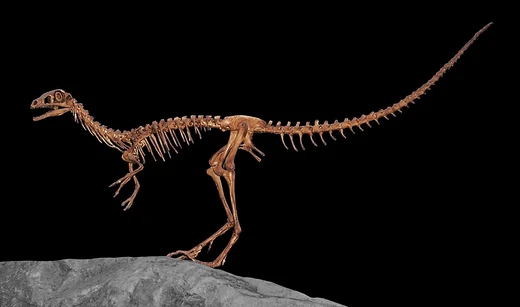
Pyroraptor
A small, feathered predatory dinosaur from Cretaceous France.
Pyroraptor, whose name means "fire thief," was a paravian dinosaur, likely a dromaeosaurid or unenlagiid. It lived around 72 million years ago on a Late Cretaceous island in what is now southern France. The only known partial fossil was found in Provence in 1992 after a forest fire, and the species was named Pyroraptor olympius in 2000.
Quick Facts
- Species
- olympius
Facts from the source article.
Discovery and naming
The first remains of Pyroraptor olympius were found at the La Boucharde locality of the Arc Basin in Provence, southeastern France. The genus and species were described by Ronan Allain and Philippe Taquet in 2000. The generic name combines the Greek word for fire and the Latin word for thief, referencing the forest fire that exposed the fossils in 1992. The specific name honors Mont Olympe, the mountain near the discovery site. The holotype is a single second toe claw from the left foot. Paratypes include the matching right claw, a left second metatarsal, another second toe claw, a right ulna, and two teeth. Additional referred material comprises five pedal digits, one manual digit, a metacarpal fragment, a right radius, a dorsal vertebra, and a tail vertebra. Teeth from northeastern Spain have been compared to Pyroraptor, but a 2022 study concluded they cannot be confidently assigned to this genus. The disarticulated nature of the remains makes it uncertain whether they belong to one individual; a 2012 study suggested the material represents at least two different individuals.
Description
Pyroraptor was a small, bird-like dromaeosaurid with enlarged curved claws on the second toe of each foot, each claw measuring 6.6 cm long. These claws may have served as weapons or climbing aids. Its two known teeth are flattened, curved backward, and have finer serrations on the rear margins than on the front. Like related dromaeosaurids, Pyroraptor likely had well-developed forelimbs with curved claws, a long thin tail for balance, and a covering of feathers.
Classification
Pyroraptor is considered a dromaeosaurid, but its exact position within the group is uncertain due to the limited remains. Initial descriptions noted a lack of diagnostic features for comparison, and a 2012 phylogeny found it to be a wildcard taxon that created instability in analyses unless removed. A 2014 phylogeny including Pyroraptor resulted in a polytomy. In 2019, a study placed Pyroraptor as an unenlagiine, noting this is consistent with Cretaceous Europe hosting typically Gondwanan species. Earlier work in 2005 had suggested some Laurasian dromaeosaurids like Pyroraptor might belong to Gondwanan lineages, but the scant material prevented testing. A 2012 study observed that Pyroraptor never fell within Laurasian dromaeosaur groups. The 2022 description of Vectiraptor noted similarities between Pyroraptor's foot morphology and that of unenlagiines, and another 2022 study found claw anatomy similarities between Pyroraptor and other unenlagiines.
Paleoecology
Pyroraptor is known from the Argiles et Grès à Reptiles Formation of southern France, part of the Ibero-Armorican island in the Tethys Ocean during the Late Cretaceous. It coexisted with dinosaurs such as Zalmoxes, Rhabdodon priscus, Ampelosaurus atacis, Lirainosaurus astibiae, Atsinganosaurus velauciensis, Arcovenator escotae, Tarascosaurus salluvicus, Struthiosaurus, Variraptor mechanorum, Gargantuavis philoinos, and Martinaves cruzyensis, as well as pterosaurs, crocodylomorphs, turtles, mammals, amphibians, and reptiles.
More in Dinosaurs of France
Spotted an error? Know more?
Reader corrections go straight into our review queue. Suggest an edit · How this site is sourced