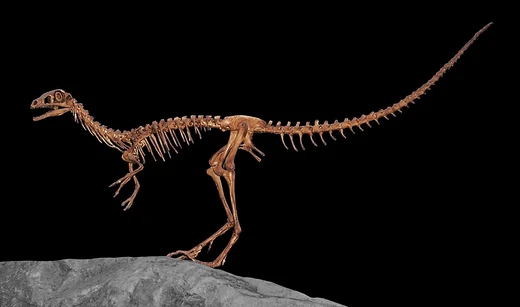
Erectopus
A basal allosauroid theropod from the Lower Cretaceous of France.
Erectopus (meaning 'upright foot') is a genus of basal allosauroid theropod dinosaur from the Lower Cretaceous. Its fossils have been found in the La Penthiève Beds Formation of France and possibly also the Cernavodă Formation of southern Romania. The type species is Erectopus superbus, originally described as a species of Megalosaurus.
Quick Facts
- Type species
- Erectopus superbus
- Etymology
- upright foot
- Geological age
- Lower Cretaceous (lower Albian)
- Formation
- La Penthiève Beds Formation
- Estimated length
- 5 meters
- Estimated weight
- 315 kg / 694 lb
- Holotype specimen
- MNHN 2001-4
Facts from the source article.
Discovery and naming
The fossil specimen MNHN 2001-4, the holotype for this dinosaur, was unearthed in the early 1870s from phosphate-rich layers at La Penthiève in Louppy-le-Château, eastern France. These same Albian-age deposits have also produced fossils of plesiosaurs, ichthyosaurs, and crocodiles. The bones first belonged to the private collection of Louis Pierson. In 1875, Charles Barrois described two teeth and a vertebra from the find. After more material came to light, Henri-Émile Sauvage used these remains in 1882 to establish a new species, Megalosaurus superbus. Friedrich von Huene re-examined the fossils in 1923 and decided they did not fit within Megalosaurus, so he created the genus Erectopus and named the species Erectopus superbus. Nine years later, von Huene argued that the original teeth and vertebra described by Barrois might not belong to the same species as the later finds. Assuming Sauvage had used those original pieces as the holotype for Megalosaurus superbus, von Huene proposed a second species, Erectopus sauvagei. He also stopped using Erectopus for the first species, labeling it "Gen. indeterm. superbus," which is not a scientifically valid name. After Pierson died, his collection was scattered, and the holotype was thought lost following World War II. However, casts of some bones were later found at the Muséum National d'Histoire Naturelle in Paris. Additionally, the front part of a left maxilla, which Sauvage had described in 1882, turned up through a Parisian fossil dealer in the late 20th century and was bought by paleontologist Christian de Muison. In 2005, Ronan Allain re-evaluated the material using these casts and the maxilla. He concluded that the correct name is E. superbus, since there was no evidence Sauvage had restricted the holotype to just the original teeth. The recovered maxilla was designated the lectotype, and the casts became the plastotype. The plastotype includes a partial right hand, the left thigh bone, left heel bone, two halves of the left shin bone, and a right foot bone. The combined inventory number for all these syntypes is MNHN 2001-4.
Description
Allain (2005) diagnosed Erectopus superbus by features including a rounded anterior ramus of the maxilla, a slender neck of the femur, and a posterior curvature of the proximal half of the femur. The calcaneum is twice as long as deep vertically, with its anterodorsal edge projected dorsally. The second metatarsal is half the length of the femur, and its lateral proximal margin is regularly concave. Allain estimated the weight at 200 kg, while a 2016 estimate gave a length of 5 meters and a weight of 315 kg.
Classification
In 2005, Allain classified Erectopus superbus as an allosauroid—a group sometimes called carnosaurs—based on the shape of its lower shin bone and the inferred form of its ankle bone. Among European Early Cretaceous carnosaurs, it is the third youngest, younger only than the Valanginian "Montmirat theropod" from southern France and the Barremian Neovenator salerii from England’s Isle of Wight. Carrano and colleagues later suggested in 2012 that Erectopus might belong to the metriacanthosaurids, though they did not specify any shared features.
More in Dinosaurs of France
Spotted an error? Know more?
Reader corrections go straight into our review queue. Suggest an edit · How this site is sourced