Canardia
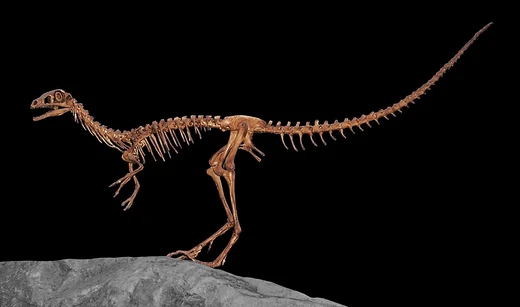
A juvenile lambeosaurine from the Late Cretaceous of France.
Canardia is a genus of lambeosaurine dinosaur from the Late Cretaceous Marnes d'Auzas Formation of Haute-Garonne, France. Known only from juvenile specimens, it lived between 67.5 and 66 million years ago on the Ibero-Armorican Island. Its name derives from the French word for 'duck,' referencing its membership in the duck-billed hadrosaur group.
Quick Facts
- Type species
- Canardia garonnensis
Facts from the source article.
Discovery and naming
Canardia is a dinosaur known from bones found at several sites in Haute-Garonne, southwestern France. The main site, Tricouté 3 near Marignac-Laspeyres, was uncovered in 1999 by a team from the Musée des Dinosaures d'Espéraza. It sits in the lower part of the Marnes d'Auzas Formation, a deposit from a lagoon-like continental setting. The remains, from at least two different animals, were preserved in a small lens of marly sandstone inside a thick sandstone layer. The skull bones include a nearly complete right maxilla (the holotype), a partial left maxilla, a right prefrontal, a partial right postorbital, a left quadrate, a right pterygoid, a partial left surangular, a right articular, a single dentary tooth crown, and a partial lower jaw tooth battery. The rest of the skeleton includes two partial left scapulae, a partial left sternal plate, a left humerus, and a partial right pubis. In 2003, these fossils were tentatively assigned to Pararhabdodon sp., but in 2013 Prieto-Márquez and colleagues recognized them as a new genus. All bones are small and come from young individuals. A maxilla and quadrate from the Larcan quarry, found in marine rocks of the Gensac Formation, were also placed in Canardia. These bones lay about one meter below a layer of iridium that marks the Cretaceous-Paleogene boundary, meaning this individual lived later than those from Marignac-Laspeyres. This shows Canardia was one of the last non-avian dinosaurs in Europe.
Description
The maxilla of Canardia features an enlarged rostrodorsal region forming a prominent subrectangular flange that rises vertically above the rostroventral process, a trait also seen in Aralosaurus tuberiferus. However, Canardia differs from Aralosaurus in having a subhorizontal ectopterygoid shelf, whereas in Aralosaurus it is inclined. The maxilla preserves at least 26 tooth positions, compared to 30 in Aralosaurus. Maxillary teeth bear a single median carina, while dentary teeth have an accessory ridge in front of the sub-central carina, as in Aralosaurus and many other hadrosaurs. The prefrontal of Canardia is distinct: its rostroventral process is rostrocaudally narrow, unlike the broad, laterally exposed process of Aralosaurus, and it possesses a dorsomedial flange absent in Aralosaurus. Aralosaurus lacked a crest on the skull roof but had a hollow structure in front of the orbits; Arenysaurus had a skull roof supporting a crest, but no crests of Arenysaurini have been discovered.
Palaeoecology
Paleontologists generally agree on an Asian origin for European lambeosaurines. Prieto-Márquez and colleagues proposed that Canardia and the Spanish genus Pararhabdodon had Asian relatives Aralosaurus and Tsintaosaurus, respectively, which are 20 and 15 million years older. This suggests the Ibero-Armorican Island served as a refuge for archaic lambeosaurine groups. Longrich and colleagues, who place Canardia in Arenysaurini, also support an Asian origin. Since no lambeosaurines are known from the late Campanian and early Maastrichtian of the Ibero-Armorican Island, the ancestors of Canardia likely arrived late, possibly at the end of the early Maastrichtian or during the late Maastrichtian. Migration probably occurred in stages via temporary land links from western Asia to eastern European islands, then between islands to the Ibero-Armorican Island. From there, lambeosaurines reached North Africa by oceanic dispersal, with hadrosaurs swimming or rafting across 500 km of open sea. The Marnes d'Auzas Formation represents sediments from coastal lagoons and tidal marshes at its base to alluvial plains and fluvial channels in its upper part, located on the west coast of the Ibero-Armorican Island facing the Atlantic Gulf.
More in Dinosaurs of France
Spotted an error? Know more?
Reader corrections go straight into our review queue. Suggest an edit · How this site is sourced