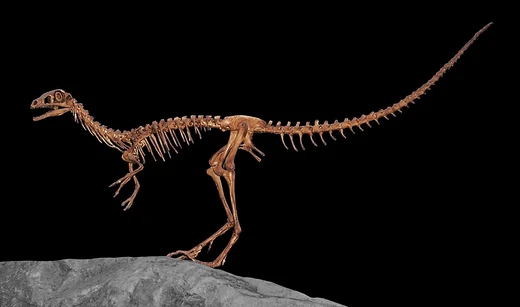
Poekilopleuron
A Jurassic theropod with varied ribs and a complex history.
Poekilopleuron is a genus of carnosaurian theropod dinosaur from the middle Bathonian of the Jurassic, approximately 168 to 166 million years ago. Its name, meaning 'varied ribs,' refers to the three types of rib present in the animal. The genus is notable for its long and complex taxonomic history, with many spelling variants and junior synonyms, though the original material was destroyed during World War II.
Quick Facts
- Type species
- Poekilopleuron bucklandii
Facts from the source article.
Discovery and naming
The holotype of Poekilopleuron was discovered in July 1835 near La Maladrerie and described by Jacques Amand Eudes-Deslongchamps in an 1836 report, with a more detailed monograph published in 1837. The original material, housed in the Musée de la Faculté des Sciences de Caen, was destroyed during World War II, but casts of the gastralia, phalanges, and forelimb survive as the plastotype, including specimens at the Muséum National d'Histoire Naturelle (MNHN 1897-2) and Yale Peabody Museum (YPM 4938). The fossils came from the Calcaire de Caen in Normandy, dating to the middle Bathonian. Eudes-Deslongchamps named the type species P. bucklandii after William Buckland, deliberately using the same specific epithet as Megalosaurus bucklandii so that if the genera were synonymized, only the generic name would change. The generic name derives from Greek for 'varied ribs.'
Description
The most distinctive feature of Poekilopleuron was its forelimbs, which were about 60 cm long and indicated a more original build compared to later theropods with reduced forelimbs. The humerus was elongated and powerfully muscled, while the antebrachia were short and robust, a trait shared with Torvosaurus. A unique feature is the absence of the olecranon process on the ulna. The fossil preserved a rare complete set of fourteen pairs of gastralia. Cau (2024) suggested that Dubreuillosaurus may be a junior synonym, representing a less mature individual.
Classification
Poekilopleuron is difficult to classify because its original material is lost and only casts remain. Eudes-Deslongchamps thought it might belong to Megalosaurus bucklandii, and after 1879 it was often subsumed under that species. In 1923, Friedrich von Huene placed it in Megalosaurus but as a separate species, renaming it Megalosaurus poekilopleuron because both species carried the epithet bucklandii. Most later authors continued using Poekilopleuron. The name has been spelled in variants such as Poecilopleuron and Poikilopleuron, but the original spelling is valid. Five other species were named in the genus, including Poekilopleuron gallicum, Poicilopleuron valens (probably Allosaurus), Poikilopleuron pusillus (later Aristosuchus), Poekilopleuron schmidti (a nomen dubium based on a chimaera), and Poekilopleuron valesdunensis (later renamed Dubreuillosaurus).
Paleobiology
The material of Poekilopleuron bucklandii includes two tail vertebrae with an ankylosed chevron and centrum, indicating a pathology. Two phalanges also show pathologies: one probable pedal phalanx has three low exostosis-like projections, and a probable manual phalanx exhibits a rounded projection resembling a callus. Ralph Molnar noted the occurrence of three pathologies in one individual as noteworthy. The specimens cannot be re-examined due to their destruction in 1944.
More in Dinosaurs of France
Spotted an error? Know more?
Reader corrections go straight into our review queue. Suggest an edit · How this site is sourced