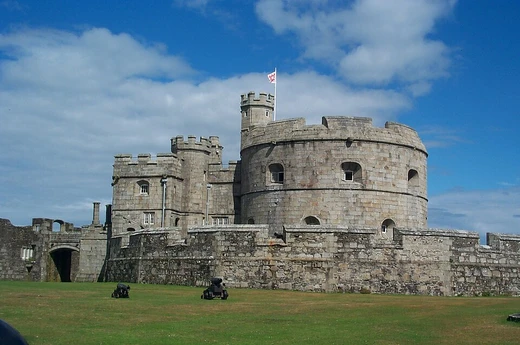
Fort Paull
A Palmerston Fort on the Humber, later a museum.
Last updated

via Wikipedia: Fort Paull · see source
Where it is
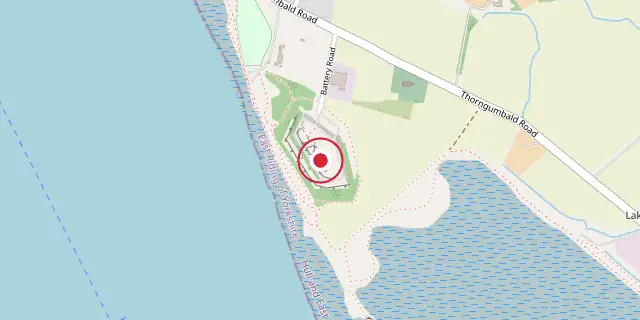
Coordinates: 53°42′47″N 0°13′44″W (53.7130, -0.2290) · Open in OpenStreetMap
Coordinates and connected clubs: the infobox of Wikipedia: Fort Paull (CC BY-SA 4.0). Map: drawn by Codexery from OpenStreetMap tiles.
Fort Paull is a gun battery on the north bank of the Humber, near the village of Paull in the East Riding of Yorkshire, England. Its pentagonal design replaced earlier batteries that had occupied the site since Henry VIII's reign, and it originally mounted nineteen 64-pounder RML guns before being rearmed in 1894 with modern breech-loading and quick-firing artillery.
History
Fort Paull has seen military activity since the 16th century, with batteries established there under Henry VIII, Charles I during the Civil War siege of Hull, and again during the Napoleonic Wars. The first fort on the spot was begun in 1542, designed to hold twelve guns.
The present structure, a pentagonal fort, was constructed between 1861 and 1864 following Royal Commission recommendations, placing it among the Palmerston Forts. Its original armament of nineteen 64-pounder rifled muzzle-loading guns was hidden or removed in 1894, replaced by concrete positions for three 6-inch breech-loading guns on hydropneumatic carriages and two 4.7-inch quick-firing guns. A mining station was added in 1886, and searchlights arrived in 1907.
At the start of World War I, Paull was considered too near Hull, so it was disarmed once new forts at Sunk Island and Stallingborough were built. Between the world wars, the fort served as a training base. During World War II, it was turned into a magazine supporting the Russian convoys, and a degaussing station was also installed. Fort Paull opened as a public museum in 2000.
After the Museum of Army Transport closed, it became the home of the last complete Blackburn Beverley heavy transport aircraft. In January 2020, the attraction announced it would not open for the 2020 season.
Its contents were auctioned on 19 September 2020, raising a six-figure sum; the Blackburn Beverley sold for £21,000 to the Solway Aviation Museum. In May 2024, a Facebook post revealed the site had been purchased and would undergo work to reopen, expressing a wish to bring it back for future generations and start running events again, beginning from scratch after most museum items were sold. The attraction reopened on 28 September with a classic car weekend.
Did You Know?
- The first fort on the site was started in 1542 with a capacity for 12 guns.
- In 1894, the original nineteen 64-pounder RML guns were replaced by three 6-inch BL guns and two 4.7-inch QF guns.
More in Device Forts
Sources
Compiled from Wikipedia and the sources listed below. Text from Wikipedia is available under CC BY-SA 4.0; this entry is adapted from it.
- Wikipedia: Fort Paull (CC BY-SA 4.0).
Spotted an error? Know more?
Reader corrections go straight into our review queue. Suggest an edit · How this site is sourced